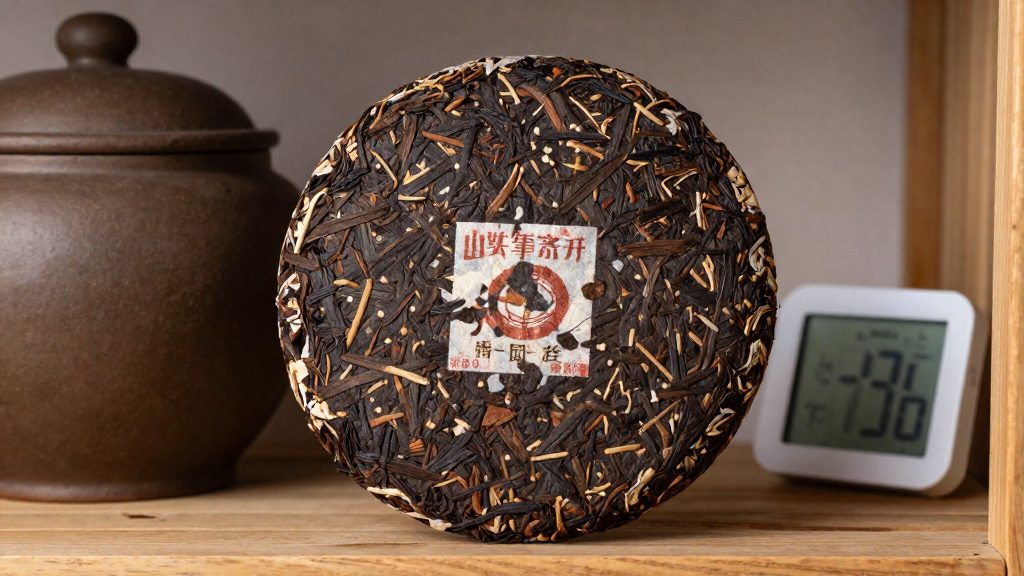
Pu-erh cake is usually kept indoors, away from temperature extremes and strong smells, and left in its compressed form. According to TeaDB (2014), tightly pressed cakes contain less oxygen and age more slowly than loose leaf under the same conditions. These baseline conditions are the starting point before any finer adjustments.
What does a pu-erh cake need to stay in good condition?
Three conditions apply to every cake:
- Compression limits oxygen exposure. Tightly compressed cakes contain less oxygen and age more slowly than loose leaf under the same conditions (TeaDB, 2014). Keeping a cake pressed, rather than breaking it into loose pieces for everyday use, preserves this advantage.
- Temperature extremes and outdoor storage are ruled out. TeaDB (2017) advises avoiding temperature extremes and never storing the tea outdoors. Choose an indoor spot where the temperature stays steady, not one that is hot in summer or cold in winter.
- Strong smells must be kept away. Path of Cha (2025) and TeaDB (2017) both advise keeping cakes away from strong smells. In practice, this means storing the cake away from kitchens, cleaning products, perfume and incense.
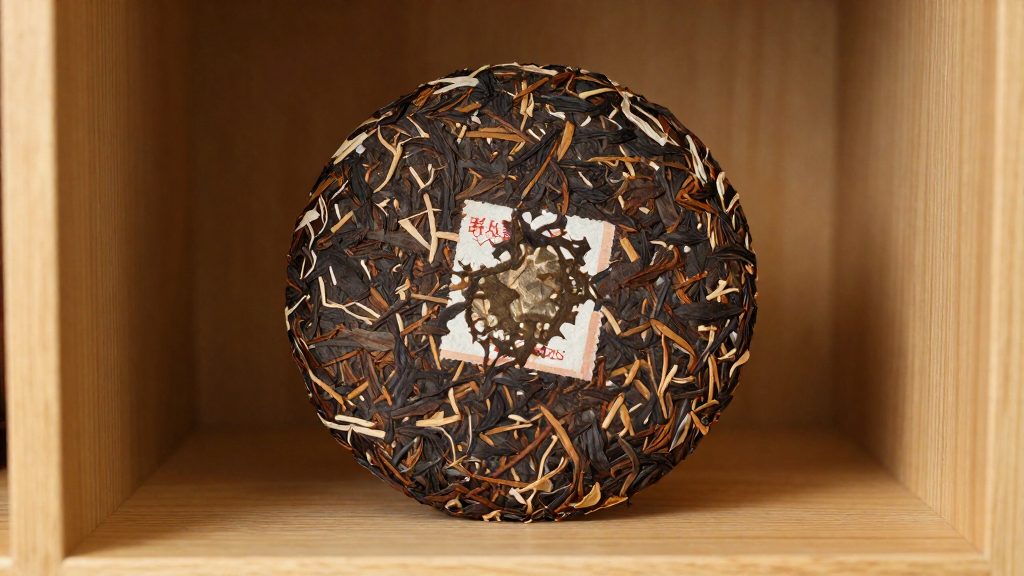
Ideal humidity and temperature
For dry storage, TeaDB (2014) gives a general target of 60–70% relative humidity (RH) and 60–70°F (about 15–21°C) for pu-erh. Path of Cha (2025) sets narrower RH targets by cake type and a warmer temperature range.
| Source (date) | Scope | Relative humidity | Temperature |
|---|---|---|---|
| TeaDB (2014) | Dry storage, general pu-erh | 60–70% | 60–70°F (about 15–21°C) |
| Path of Cha (2025) | Sheng (raw) cakes | About 65% | 65–75°F (18–25°C) |
| Path of Cha (2025) | Shou (ripe) cakes | 60–65% | 65–75°F (18–25°C) |
The two temperature ranges overlap at 65–70°F (about 18–21°C). This overlap is our own observation, not a recommendation from either source, but it can serve as a practical middle ground if you want one setting for both types.
Avoiding daily swings
Path of Cha (2025) advises avoiding daily swings in both temperature and humidity. A stable setting matters more than hitting one exact figure.
Where the figures are disputed
- Path of Cha (2025) reports that Yunnan tea masters favoured about 50% RH or lower, which conflicts with the 60–70% target above. The best humidity target is therefore disputed.
- Reader comments under the TeaDB article call 40% RH low for long-term storage, and another suggests not exceeding 75% RH. These are individual opinions, not established findings.
Because the recommended values differ across sources and the best target is disputed, a starting point of 60–65% RH stays within both specialist sources and below the roughly 70% level that Path of Cha links to mould risk. Adjust from there based on how the cake fares.
Should you seal pu-erh or let it breathe?
Sources disagree on whether to seal pu-erh cakes airtight or allow some airflow. The trade-off is between reducing oxygen contact and avoiding trapped moisture and odours. Whether to add an airtight seal on top of compression is a debated point, not an established rule.
| Option | What the sources say | Trade-off |
|---|---|---|
| Original wrapper kept on | Path of Cha (2025) suggests keeping it on each cake | Protects the cake without adding an enclosure |
| Cardboard box | Blocks light and airflow (TeaDB, 2017) | Limits air exchange; a TeaDB commenter questions its effectiveness in dry Canadian winters, which is an opinion, not a confirmed finding |
| Airtight seal | Debated: sources differ on whether it is preferable | Reduces oxygen contact but also limits moisture exchange; not an established rule |
The original paper wrapper is the cake’s first layer, so keep it on whatever enclosure you choose. A cardboard box adds light and airflow protection but little else, so it works best where the room itself is stable.
Treat airflow versus sealing as a setting to test rather than a fixed rule. Compare the cake’s condition over several months before changing your approach.
Containers that work at home
Specialist sources name three household options: zip-top bags, opaque Mylar bags inside lidded bins, and food-grade plastic bins. Several of these limit air exchange, which is a debated choice (see above). Each needs a short preparation step before the cake goes in.
| Container | Preparation | Source |
|---|---|---|
| Ziplock bags | Double-bagging for extra caution | TeaDB (2017-03-25) |
| Opaque Mylar bag inside a lidded food-grade bin | Place each cake in its own opaque Mylar bag, then put it in the lidded bin | Path of Cha (2025-10-22) |
| Food-grade plastic bin | Air it out before loading | TeaDB (2017-03-25) |
Ziplock bags
Put the cake in one bag, seal it, then place that bag inside a second sealed bag. TeaDB describes this double layer as a precaution. Check that both bags are fully closed before you store the cake.
Opaque Mylar bags in lidded bins
Path of Cha suggests sealing each cake in an opaque Mylar bag, then keeping that bag inside a lidded food-grade bin. Use one bag per cake so that opening one bin doesn’t expose the others.
Plastic bins: airing out first
TeaDB notes that plastic bins can leave a plastic odour on tea, so they should be aired out before use. Leave the empty bin, with its lid off, in a ventilated room. Sniff it periodically, and load it only once no plastic smell is detectable.
Keeping sheng and shou apart
Store raw (sheng) and ripe (shou) pu-erh cakes in separate storage groups, according to TeaDB (2017). Each group then has its own unit, so a cake of one type never shares a bin, bag or shelf zone with the other.
Separate units per type
Give each group a unit of its own. TeaDB (2017) names these home setups:
| Unit | How it separates the groups | Practical note |
|---|---|---|
| Separate bin | One food-grade plastic bin per type | Store it apart from the other group’s bin |
| Separate bag | One bag per type, with cakes grouped inside | Ziplock bags are workable |
| Separate shelf zone | A marked area of one shelf per type | Keep the zone away from strong smells, windows and direct sun |
Labelling by type and purchase date
Write the type (sheng or shou) and the purchase date on each cake’s wrapper, and mark each bin or bag with its group. Checking the label on the container lets you confirm a group without unwrapping every cake. Recording the purchase date shows which cakes have been stored longest, which helps you choose what to brew first.
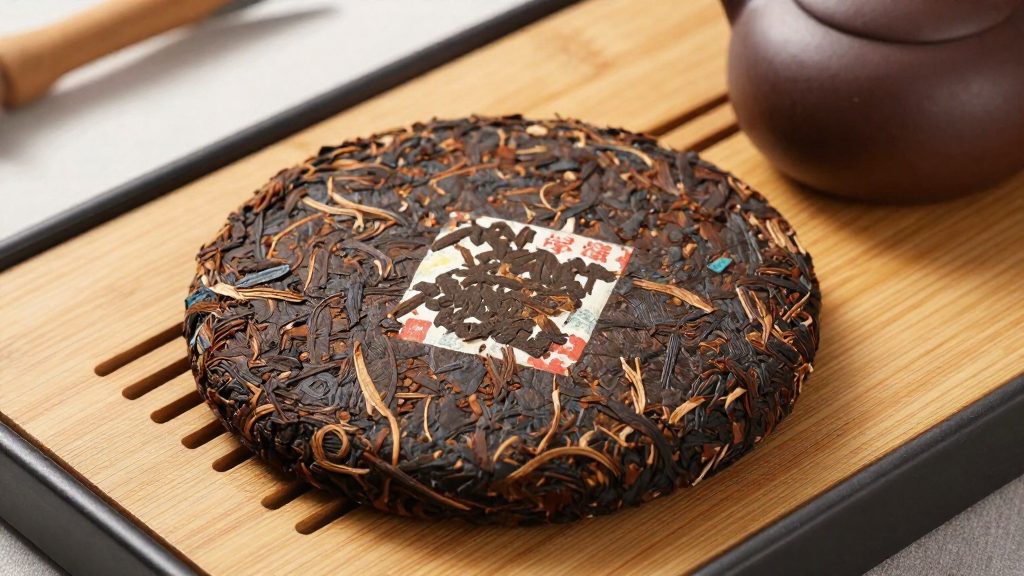
Canadian winters and dry indoor air
Heating season is the main change in a Canadian home that affects stored pu-erh. A furnace or baseboard heater can lower indoor humidity for months without any visible sign, so a cake that was stable in autumn may be drying out by January. TeaDB (2014) describes drier-stored tea as ageing more slowly, so winter air can change how a cake ages. Whether to correct for it depends on your goals, and the best humidity target is disputed.
Where to place cakes in a heated home
| Spot | Winter risk | Practical action |
|---|---|---|
| Beside a radiator or heating vent | Warm, moving air dries the wrapper and the cake surface | Move the cake to a shelf on an interior wall |
| Window ledge | Direct sun and temperature swings, which TeaDB (2017) advises against | Keep the cake out of the window line and direct sun |
| Interior cupboard, away from exterior walls | Steadier temperature with less exposure to cold draughts | Use as the default winter location |
Choose the spot with the most stable temperature over the one with the most convenient access.
Monitoring the air at the cake
Check the reading at the same time of day over several days before changing anything. A single reading taken right after the heating cycles on can be misleading.
Packaging and the winter climate
A commenter on TeaDB argued that boxes may be less effective in Canada’s drier winter climate. This is a commenter’s opinion, not an established finding. The placement suggestions above are practical judgments, not sourced rules.
Pu-erh storage guidance here comes from specialist sources: TeaDB and Path of Cha, which is a shop’s blog. No Canadian official body sets a standard for pu-erh storage, so treat these as practice guides rather than regulatory targets.
How do you spot mould or off smells?
Visible growth and a damp, stale smell are the two main warning signs for a pu-erh cake. Path of Cha says to keep humidity below about 70% to limit the risk of mould and mustiness (Path of Cha, 2025-10-22). Inspect the cake and its packaging in daylight, and smell the cake before judging. If you see fuzzy growth or the cake smells musty, do not drink it.
Visible signs on the surface
- Fuzz or raised growth: fuzzy patches, threads or spots on the cake, wrapper or bag. Look at the edges and the face of the cake, and at the inside of the bag.
- White bloom: an even, dusty, whitish film. It can resemble mould, so check whether it spreads or becomes fuzzy over several days.
- Condensation: damp patches on the bag or the inside of a bin lid show that moisture has been building up.
Musty smell versus absorbed odours
A musty smell is damp and stale, closer to a cellar than to the tea itself. An absorbed household odour smells like a specific nearby item. Compare the two:
| Check | Musty or mouldy | Absorbed household odour |
|---|---|---|
| Character | Damp, stale, cellar-like | Matches one identifiable source |
| Where it is strongest | Near visible growth or inside a damp bag | Evenly through the packaging |
| Next step | Re-check the hygrometer and inspect the cake for growth | Identify the source and check how the cake was stored near it |
When should you just drink it?
Whether to brew a stored pu-erh cake or keep it is a personal decision based on what you want from it. If you keep a cake to see how it changes over time, leave it whole and sealed. If you bought it to drink now, brew it as you go. Many home storers do both by splitting the cake: they keep most of it untouched and brew from a small, separate portion.
Ageing goals versus drinking enjoyment
Decide before you open the cake. Each brewing session uses part of the cake, so a cake you drink regularly will not be available for long-term comparison. A cake you never open gives you no tasting feedback. Decide which goal applies to each cake you own and store it accordingly.
Breaking a cake into portions
Pu-erh cakes are pressed and are usually broken apart by hand before brewing. To portion one for regular drinking:
- Unwrap only the section you plan to use.
- Break off a small piece with a tea pick or a knife, working along the cake’s natural lines.
- Return the rest to its original wrapper and storage bag.
- Store raw (sheng) and ripe (shou) cakes apart, as TeaDB (2017) recommends for storage groups, including after portioning.
Brewing a sample to check aroma and clarity
Before you commit to drinking a cake regularly, brew a small sample. Check the dry leaf aroma first, then the aroma of the wet leaf after the first infusion. Next, look at the liquor in a clear cup. A clear, even colour and a pleasant aroma are good signs, but they do not guarantee the cake is free of mould; if there is any doubt, do not drink it. Cloudiness or an unclear aroma means you should test a different part of the cake before deciding.