How long does loose leaf tea last?
Smith Teamaker (2026) says most of its own teas have a shelf life of about two years when stored well. This is one brand’s figure, not a rule for all loose leaf tea. Other publishers give different figures: Zhen Tea (Canada, 2026) gives about 3 years as a rough guideline for basic-quality tea, so treat these as estimates, not guarantees. Dry leaves kept dry do not spoil in the strict sense, but they lose flavour and aroma after the best-by date.
How long does loose leaf tea last?
What the two-year figure assumes
Smith Teamaker names three threats to dry leaves: light, air and moisture. It also says tea lasts longer in a dry climate. The two-year figure therefore applies to leaves kept away from these three conditions, not to tea left open on a sunny windowsill or in a steamy kitchen.
Reading the best-by date
- Best before date (best-by): Smith Teamaker places the loss of flavour and aroma after this date. Past it, tea that has stayed dry mostly loses flavour and aroma, so expect a weaker cup. Check for moisture or mould before brewing.
- Check the pack first: Read the date printed on the packaging and follow the manufacturer’s instructions on the label. This is the most specific date you have for a given product.
- Compare against your own record: A printed date only tells you the producer’s estimate. Your own purchase or opening date tells you how long the tea has actually been stored.
Buying in smaller amounts
Teatulia (2026) advises buying small quantities. A small pack is opened and reclosed fewer times over its life than a large one, so the tea spends less time exposed to air and moisture. Buy the amount you can finish within the window your storage supports, and restock before the leaves start to fade.
Shelf life by tea type
The drink-by window depends mainly on the tea’s processing category. Among the ranges below, oxidized black and oolong teas have the longest window, apart from pu-erh (see below). Green oolongs fall in the shorter group. Sources give different figures for some categories, so the ranges below are starting points, not guarantees.
| Tea category | Drink-by window | Source |
|---|---|---|
| Green, white and herbal teas | Up to about one year | Teatulia (2026) |
| Yellow and green oolong teas | Within weeks to a couple of months | Zhen Tea (2026) |
| Oxidized black and oolong teas | Up to about two years | Teatulia (2026) |
Green, white and herbal teas
Teatulia gives up to about one year for these categories. Humidity sets the practical window more than the calendar does.
Yellow and green oolong teas
Zhen Tea (2026) says these are best drunk within weeks or a couple of months. Its list places green tea in this shorter group, which conflicts with Teatulia’s one-year figure for green tea. The sources differ on green tea, so for best flavour err on the shorter side and check the date on the pack.
Oxidized black and oolong teas
Teatulia (2026) gives up to about two years. Zhen Tea (2026) says many oolongs and black teas taste better after about a year and stay at peak for another year or two, which points to a similar range.
Brand-level figures
Smith Teamaker (2026) states that most of its teas have a shelf life of 2 years, and Zhen Tea (2026) gives about 3 years as a rough guideline for basic-quality tea. These figures are not category-specific, so they should not replace the category ranges above.
Does tea go bad or just go stale?
Dry tea rarely spoils the way milk or bread does. Teatulia (2026) states that tea does not truly spoil but goes stale. Smith Teamaker (2026) makes the same distinction: dry leaves kept dry do not spoil, but they lose flavour and aroma after the best-by date. Tea kept dry goes stale rather than spoils, so an old tin with no sign of moisture or mould will usually just taste flat, thin or dusty. If you see mould, discard the tea. Mould is the exception, because it is a sign of moisture and is covered in the sensory check below.
Flat aroma as the main staleness sign
Loss of aroma is the clearest sign that tea has faded. Aroma compounds are the first thing to go, so the dry leaves often smell weaker than the tea type should. Compare the tin with what you remember of that tea when it was fresh, or with a newly opened pack of the same tea.
- Strong, distinct scent: the leaves still smell like their type (grassy, floral, malty, roasted) and the smell is noticeable from the open tin.
- Faint or dull scent: you have to bring the tin close to your nose, or the leaves smell of little more than dry paper.
- Stale or cardboard note: a flat smell with an off, woody or papery character suggests the leaves have aged past their best.
Sensory check of dry leaves before brewing
Run this check before brewing an older tin:
- Open the tin and smell it immediately. Lift the lid, put your nose close to the leaves and inhale once. Do this before the leaves have been handled much.
- Look for mould. Zhen Tea (Canada, 2026) notes that mould usually points to excess moisture in the leaves at production. If you see any mould, discard the tea.
- Feel for damp clumps. Fresh dry leaves are separate and light. Leaves that stick together or feel soft suggest moisture has got in.
- Brew a small test cup. If the aroma is weak, a short test brew shows whether the flavour has faded before you use a full batch.
How should you store loose leaf tea?
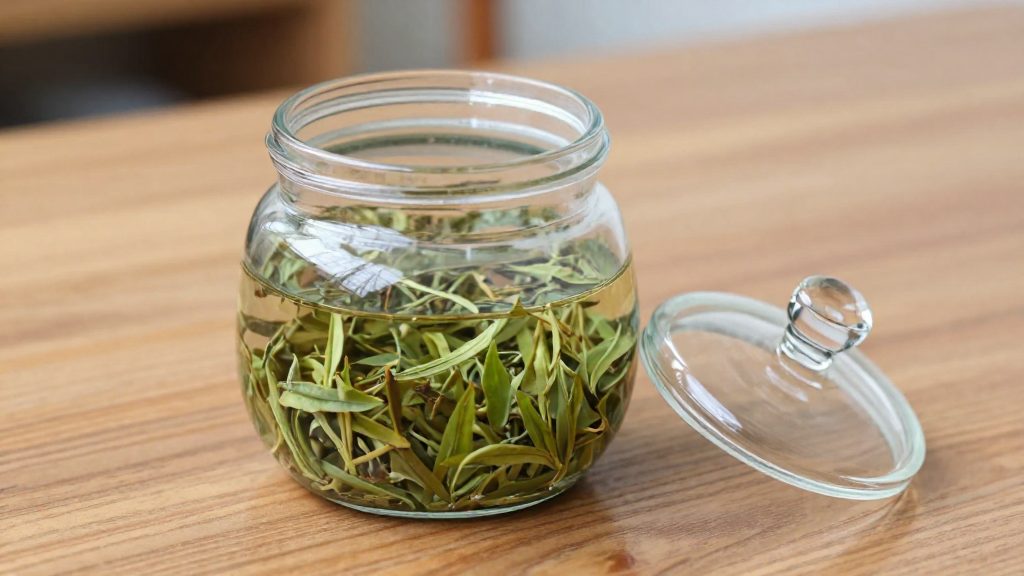
Store loose leaf tea in an airtight, opaque container made of tin, aluminum or glass, kept at room temperature of about 20 to 25°C (68 to 77°F), away from light, air, moisture and strong odours. Of these, humidity has the largest effect on how long the leaves stay fresh.
Container features
| Feature | Guideline | Source |
|---|---|---|
| Seal | Airtight | Teatulia (2026) |
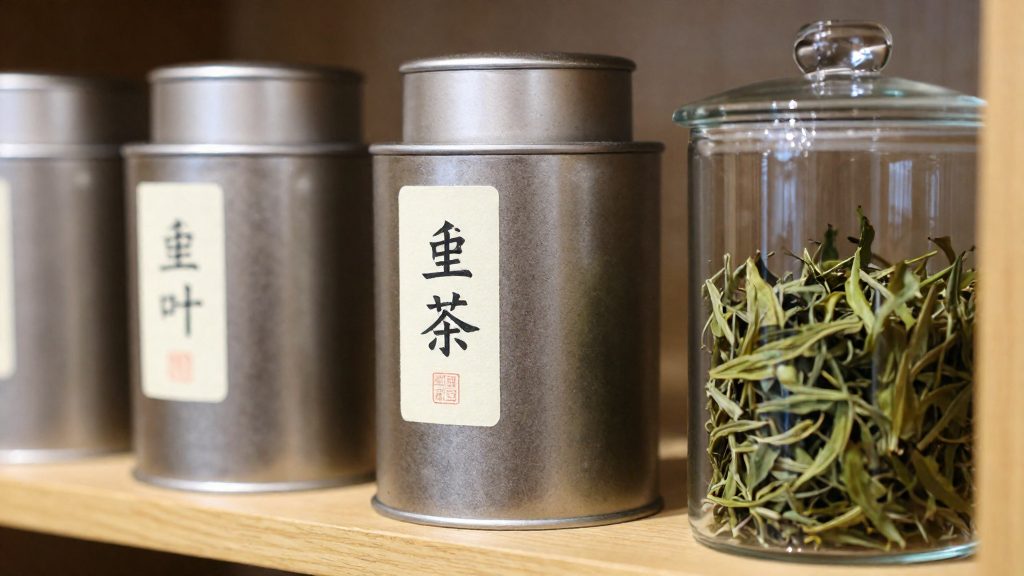
| Material | Tin, aluminum or glass | Teatulia (2026) |
| Lid | Double-lidded, in metal or ceramic | Red Blossom Tea Company (2026) |
| Light | Opaque, shielded from direct sunlight | Teatulia (2026); Zhen Tea (2026) |
Temperature and odours
Keep the container at a steady room temperature. For aged teas, Zhen Tea (2026) gives a ceiling of 45°C and relative humidity below 75%. Store tea away from strong smells such as coffee and spices, since tea leaves absorb odours from their surroundings (Teatulia, 2026; Zhen Tea, 2026).
Adjusting for humid climates
Humidity changes the timeline. Red Blossom Tea Company (2026) compares two cases for green tea:
- Dry climate: green tea stays crisp for at least a year in San Francisco.
- Humid climate: green tea can go stale in under six months in humid Zhejiang.
Should tea go in the fridge or freezer?
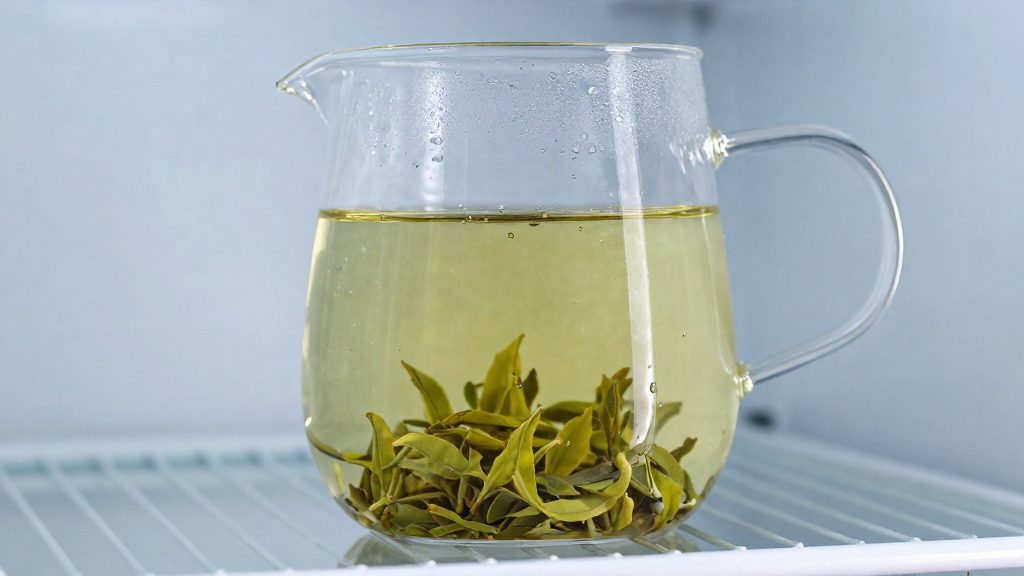
For everyday storage, no. Teatulia (2026) advises against refrigerating or freezing tea because moisture can shorten its life, and Red Blossom Tea Company (2026) advises against it because of condensation. The concern is less about spoilage in the food-safety sense than about water reaching dry leaves. Sources do not fully agree, so one exception is noted below.
How condensation forms
A tin kept in a fridge or freezer is colder than the room around it. When the lid is lifted in a warm kitchen, water vapour in the air meets the cold inner surfaces and the leaves, and it condenses there. Each time a cold tin is opened in warm, humid air, the leaves are exposed to this again.
Recommended storage temperature
Keep the tin in a stable, dry spot rather than a cold one.
Where sources disagree
| Source | Advice on cold storage | Reason given |
|---|---|---|
| Teatulia (2026) | Do not refrigerate or freeze | Moisture can shorten life |
| Red Blossom Tea Company (2026) | No fridge or freezer | Condensation |
| Zhen Tea (Canada) (2026) | Refrigeration recommended for green, yellow and green oolong teas | Not stated |
Because the Zhen Tea (Canada) (2026) advice runs opposite to the other two, check the manufacturer’s storage instructions on the pack before refrigerating any tea.
Does matcha keep as long as other teas?
Matcha is a fine powder, so it is generally expected to fade faster than whole leaves once opened. None of the supplied sources gives a matcha-specific shelf life, so follow the best-before date on the tin. Fine powder exposes far more surface area to air, light and moisture, so its colour, aroma and taste fade sooner once the tin is opened. Teatulia (2026) suggests drinking tea within a few months of purchase for best flavour, which is shorter than its outer limits of one to two years. It gives no matcha-specific figure.
Why powder ages faster
Whole leaves keep their structure, so only the outer surface meets air. Powder breaks that protection:
- Surface area: each particle is exposed, so oxygen and humidity reach the tea directly.
- Light: Zhen Tea names direct sunlight as one of the main enemies of tea, and a powder shows any light damage quickly.
- Moisture: Red Blossom Tea Company names humidity as the biggest factor in storage. Powder presents more surface to humid air, so a damp scoop can make it clump.
Judging freshness on the tin
Check these points before buying or opening a tin:
- Producer’s best-by date: If no date is printed, ask the seller or check the producer’s website.
- Colour: fresh matcha is bright green. A dull, yellowish or brownish powder suggests age or light exposure.
- Aroma: a fresh powder smells vegetal and sweet. A flat or stale smell means the flavour has already faded.
- Clumping: fine, free-flowing powder is a good sign. Hard lumps suggest moisture has entered the tin.
Resealing opened tins
Once a tin is open, air is the main threat, so limit each exposure:
- Reseal the lid immediately after scooping.
- Use dry utensils. Moisture is the main reason powder clumps and degrades.
Does pu-erh improve with age?
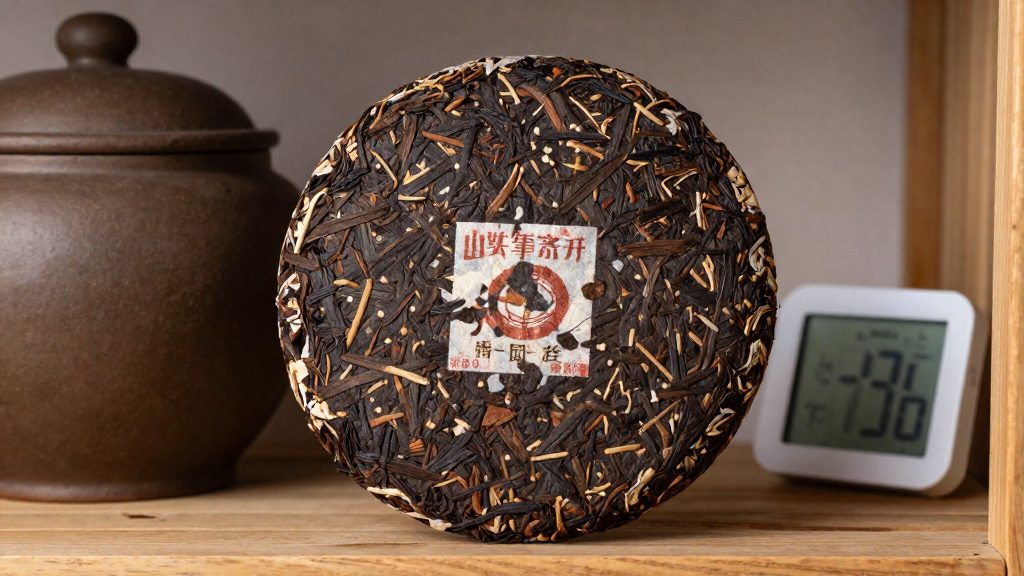
Pu-erh is the one tea type in the fact set that can be kept for an open-ended period. According to Teatulia (2026), pu-erh can be kept indefinitely if it is stored properly, and its flavour often improves with age. This contrasts with green and herbal teas, which Teatulia (2026) places at up to about one year, and with oxidised oolong and black teas, which keep up to about two years. Zhen Tea (Canada, 2026) lists pu-erh, white tea and some oolongs as commonly aged, so sources differ on white tea (Teatulia: up to about one year).
For aging, Zhen Tea (Canada, 2026) advises keeping relative humidity below 75% and temperature below 45°C.
Practical steps for keeping pu-erh:
- Choose a spot with stable temperature, out of sunlight and away from humid areas such as kitchens and bathrooms.
- Keep the container closed between uses, and do not move the leaves between a humid and a dry location.
- Check the label for the date of production or purchase.
Loose leaf versus tea bags: which stays fresh longer?
Format matters because it sets how much tea surface is exposed to air. Both formats face the same threats. They differ in how much leaf surface each one reaches and in how well the packaging blocks it.
| Factor | Loose leaf | Tea bag |
|---|---|---|
| Leaf size | Whole or large pieces | Typically finer cut leaf |
| Exposed surface | Less cut edge per gram | More cut edge per gram |
| Main protection | The tin or pouch that holds the leaf | The outer box or pouch (some brands also wrap each bag) |
Surface area and aroma
Cut edges release aroma faster. Whole leaf keeps its aroma in larger pieces, so fewer aromatic compounds are released into the air. Finer cut leaf, typical of many tea bags, presents more cut edge to the air for the same weight, so bagged tea may fade somewhat faster. The supplied sources do not quantify this, and the packaging and storage matter more.
Packaging seal
The seal decides bagged freshness. Each bag is only as protected as the pouch or box around it. A bag left in a torn or loosely closed package has effectively lost its barrier against air and moisture. Once the outer pack is opened, reseal it tightly or move the bags into a container that closes fully.