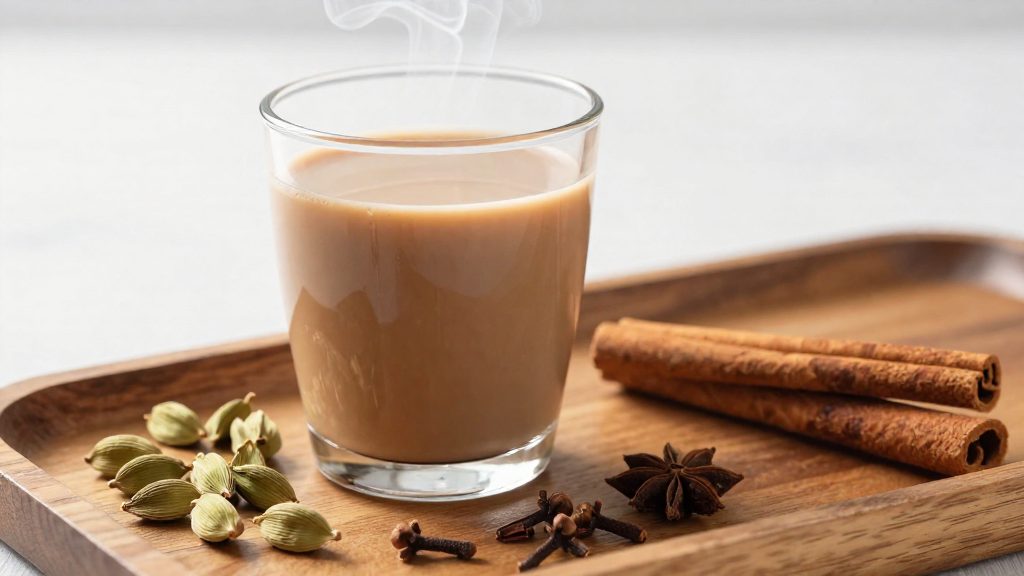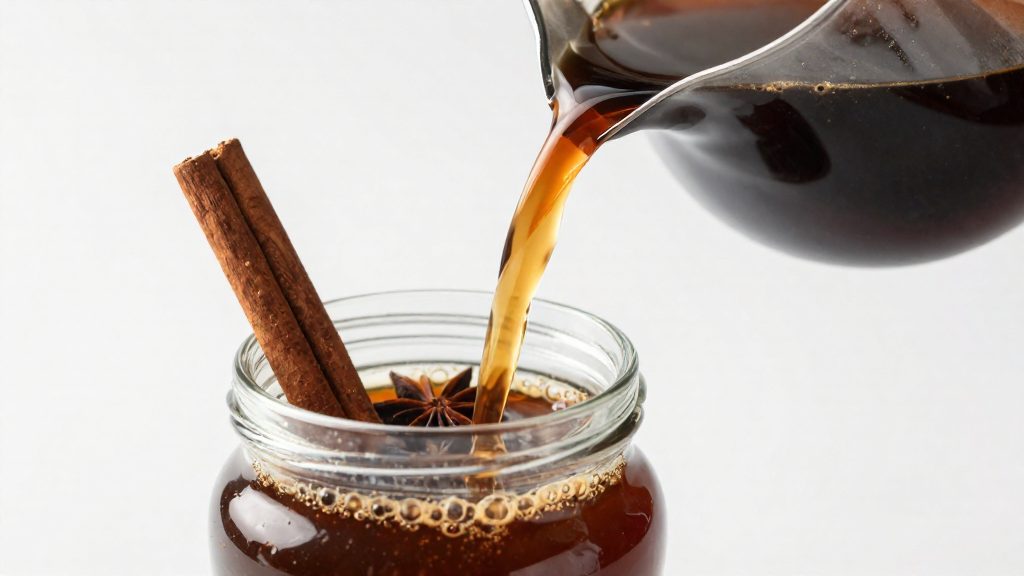
What is chai concentrate?
Chai concentrate is a sweetened, spiced tea base made by steeping black tea, usually Assam, with ginger and whole spices, then straining the liquid for later use. One recipe from Easy Indian Cookbook (2026) yields about 4 cups and is served at a 1:1 ratio with milk. It is a base for milk drinks, not a finished cup, and it is diluted when served.
Masala chai versus concentrate base
Masala chai is usually brewed one cup at a time, with tea, spices, milk and sugar cooked together. A concentrate base separates these steps. The tea and spices are extracted in water first, the sugar is added to that liquid, and only the strained result is kept. Milk is added at serving, so the base carries the tea, spice and sweetness while the milk is the last step.
Why concentrate suits batch brewing
- Batch brewing yields several servings from one session. The Easy Indian Cookbook (2026) recipe makes about 4 cups.
- Larger versions exist. Darn Good Veggies (2026) gives a larger-batch alternative with more tea and spices, a different spice set and a different steeping method.
Concentrate versus syrup and instant mixes
Concentrate gets its flavour from steeping real tea and whole spices, so its character depends on how it was brewed. Syrups and instant mixes rely on a manufacturer’s flavouring or powdered blend, so their strength and dilution are set by the product.
| Format | Flavour source | Dilution |
|---|---|---|
| Homemade chai concentrate | Tea and whole spices steeped in water, sweetened | 1:1 with milk as a usual starting point (Easy Indian Cookbook, 2026) |
| Masala chai (single cup) | Tea and spices brewed with milk per cup | None; made to order |
| Commercial syrup | Manufacturer’s flavouring | Check the product label |
| Instant mix | Powdered blend that dissolves in liquid | Check the product label for water and milk amounts |

Ingredients and spice ratios
The standard batch from Easy Indian Cookbook (2026) makes about 4 cups of concentrate. It uses 5 cups of water, 5 teaspoons of Assam black tea (or 5 tea bags), and 5 teaspoons of sugar, plus the spices below. The spice role descriptions are general culinary characterisations, not measured results.
| Ingredient | Quantity (4-cup batch) | Flavour role |
|---|---|---|
| Fresh ginger | 2–3 inches | Sharp, warming heat that gives the concentrate its backbone |
| Cardamom pods | 10 | Aromatic, floral and citrusy top notes |
| Cloves | 4 | Intense, pungent warmth; strong, so a small count goes a long way |
| Cinnamon sticks | 2 | Sweet, woody base notes |
| Star anise | 1 | Liquorice-like sweetness |
| Fennel seeds | 1 teaspoon | Mild anise-like sweetness that rounds the blend |
| Black pepper | ½ teaspoon | A slight bite that lifts the other spices |
Scaled large-batch version
Darn Good Veggies (2026) gives a larger-batch alternative with 8 black tea bags. It is not a simple multiple of the standard recipe. It uses 4 cups of water rather than 5, and it has a different spice set:
| Ingredient | Quantity (8-bag batch) |
|---|---|
| Black tea bags | 8 |
| Water | 4 cups |
| Cardamom pods | 12–15 |
| Cloves | 12–15 |
| Star anise | 3–4 |
| Peppercorns | About 20 |
| Ginger slices | 8–10 |
| Cinnamon sticks | 2 |
| Sweetener | 1/3 to 1 cup |
The larger batch raises cardamom and cloves to 12–15 each and star anise to 3–4. It drops fennel entirely and uses whole peppercorns (about 20) instead of ½ teaspoon of black pepper. The sweetener range is also wider than the 5 teaspoons of sugar in the standard recipe.
How do you make chai concentrate step by step?
The method is a three-stage sequence: simmer the spices and ginger first, then add the sugar and tea for a short steep, then rest the pot off the heat before straining. According to Easy Indian Cookbook (2026), the whole process for one batch is built around timing, because over-simmered tea turns the concentrate bitter.
| Step | Action | Timing (Easy Indian Cookbook, 2026) |
|---|---|---|
| 1 | Simmer the crushed spices and sliced ginger in the 5 cups of water | 5 minutes |
| 2 | Add the 5 tsp sugar and the tea, then steep | 4–5 minutes |
| 3 | Take the pot off the heat and let it rest | 10 minutes |
| 4 | Strain into a clean container | After the rest |
Crush the spices before they go in. Cracking cardamom pods, cinnamon sticks and fennel seeds releases more flavour into the water during the first five minutes than whole pieces would. Cut the 2–3 inches of fresh ginger into slices so it can release its heat in the same window.
Add the sugar and tea together. Once the spice simmer is done, the sugar and tea go into the same pot. The tea then steeps for 4–5 minutes. Stay within this window: the source specifically warns that simmering the tea too long makes the concentrate bitter.
Rest, then strain. Moving the pot off the heat lets the liquid rest before straining. After 10 minutes, strain out the spices and tea leaves or bags.
Recipes differ on steep time. Darn Good Veggies (2026) uses a longer, covered steep for a larger batch, so check which method a recipe follows before adjusting the timing.
Which black tea works best?
For a chai concentrate, the black tea forms the body under the spices. The Easy Indian Cookbook (2026) specifies Assam, which is commonly described as malty. The Easy Indian Cookbook (2026) specifies Assam. Other black teas are untested in the sources, so expect the cup to taste different.
| Option | Role in the concentrate | How to check the pack |
|---|---|---|
| Assam | Malty base that the recipe specifies | Confirm “Assam” appears on the label |
| Taylors Yorkshire Gold | Breakfast blend, so the tea component can vary | Read the ingredient list for the variety or origins |
| Twinings English Breakfast | Breakfast blend, so the tea component can vary | Read the ingredient list for the variety or origins |
| Ceylon | Lighter base that lets the spices lead | Choose a label that names Ceylon as the origin |
A blend name does not confirm which teas it contains. Check the ingredient list before comparing products, since two packs with similar names can differ.
To choose between an Assam base and a lighter Ceylon base, make a small batch with each. Cool both fully, then compare them as 1:1 cups with milk. If the tea overwhelms the spices, switch to the lighter option. If the cup tastes thin, keep the Assam base and add more concentrate.
How long does chai concentrate keep?
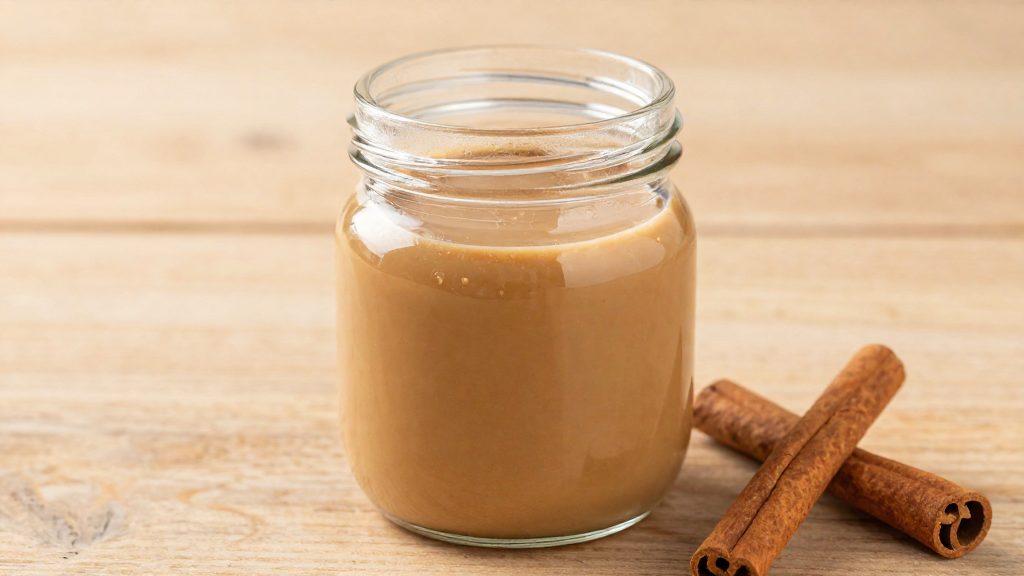
Homemade chai concentrate keeps up to 1 week in the refrigerator and up to 3 months in the freezer, according to Easy Indian Cookbook (2026) and Darn Good Veggies (2026). Easy Indian Cookbook (2026) stores it in a clean, dry container once it is fully cooled. These figures come from recipe authors, not from a food-safety body, so treat the one-week limit as a maximum. Keep the concentrate cold at all times, and discard it if it smells sour or looks different from when you made it.
| Storage method | Container | Time limit |
|---|---|---|
| Refrigerator | Clean, dry container | Up to 1 week |
| Freezer, cube stage | Ice cube trays | Freeze the cooled concentrate in cubes |
| Freezer, long-term | Freezer-safe container | Up to 3 months |
Freezing in two stages
The freezer method has two steps, as described by Easy Indian Cookbook (2026):
- Pour the cooled concentrate into ice cube trays and freeze it.
- Once the cubes are solid, move them into a freezer-safe container.
Freezing in cubes lets you thaw only the amount you need. The freezer-safe container keeps the frozen cubes together for the rest of the storage period.
How do you turn it into milk tea?
To make milk tea, combine the chai concentrate with milk in equal parts. The recipe sources in this section give a 1:1 concentrate-to-milk ratio as the usual serving starting point. Adjust from there: more concentrate for a stronger cup, more milk for a milder one.
Starting with equal parts
- Warm the milk in a small pan over medium heat, stirring occasionally, until it is hot but not boiling.
- Pour equal amounts of concentrate and hot milk into a mug, for example 1/2 cup of each for a full cup.
- Stir to combine and serve immediately.
Because the concentrate is already sweetened and spiced, you can taste the mix before adding any extra sugar.
Adjusting the strength
| Goal | Adjustment |
|---|---|
| Stronger, spicier cup | Increase the concentrate, for example 2 parts concentrate to 1 part milk |
| Milder, creamier cup | Increase the milk, for example 1 part concentrate to 2 parts milk |
Make one change at a time and taste between adjustments, so you can judge how each proportion affects the balance of tea, spice and sweetness.
Hot milk tea serving
For a single serving, start with the 1:1 ratio, then adjust by feel. Serve hot in a pre-warmed mug so the drink stays at a drinking temperature for longer.
Hot, iced and tea-bag variations
Concentrate works for iced chai and for single cups, but the two uses need different handling. For iced chai, freeze the concentrate in cubes so it chills the drink with chai rather than plain ice. For a single cup, the batch recipes give no per-cup steep time, so the bag label is the safer guide.
Iced chai from frozen concentrate cubes
The cubes replace ice, so the drink stays strong as they melt.
To build an iced chai:
- Place frozen cubes in a glass, filling it about halfway.
- Pour cold milk over the cubes.
- Stir and taste.
Taste again after a few minutes, because melting cubes dilute the drink.
Single cup with one tea bag
The batch recipes use tea differently from a single cup. The Darn Good Veggies (2026) larger batch uses 8 bags for 4 cups of water, which describes a batch ratio, not a per-cup guide. Its method also steeps the tea off the heat and covered for at least 20 minutes, while Easy Indian Cookbook (2026) steeps for 4–5 minutes and then rests the pot off the heat for 10 minutes. These sources disagree on timing, so for one bag, follow the steep time on the packet or the manufacturer’s instructions.
Two method points differ between the sources:
- Steep time differs: Easy Indian Cookbook (2026) steeps 4–5 minutes and warns against simmering the tea too long, while Darn Good Veggies (2026) steeps at least 20 minutes off the heat.
- Darn Good Veggies (2026) covers the pot while the tea steeps.