What is a rooibos chai latte?
Rooibos chai latte is a spiced, milk-based drink made with a rooibos blend instead of the usual tea base. It follows the chai latte format: a strongly flavoured tea concentrate is combined with hot milk, and the milk is often frothed. According to Arbor Teas (2026), a caffeine-free version can be made with a rooibos chai blend such as Masala Chai Rooibos, using the same method as a regular chai latte. The spices are what make it chai, and the rooibos is what changes its character.
What is a rooibos chai latte?
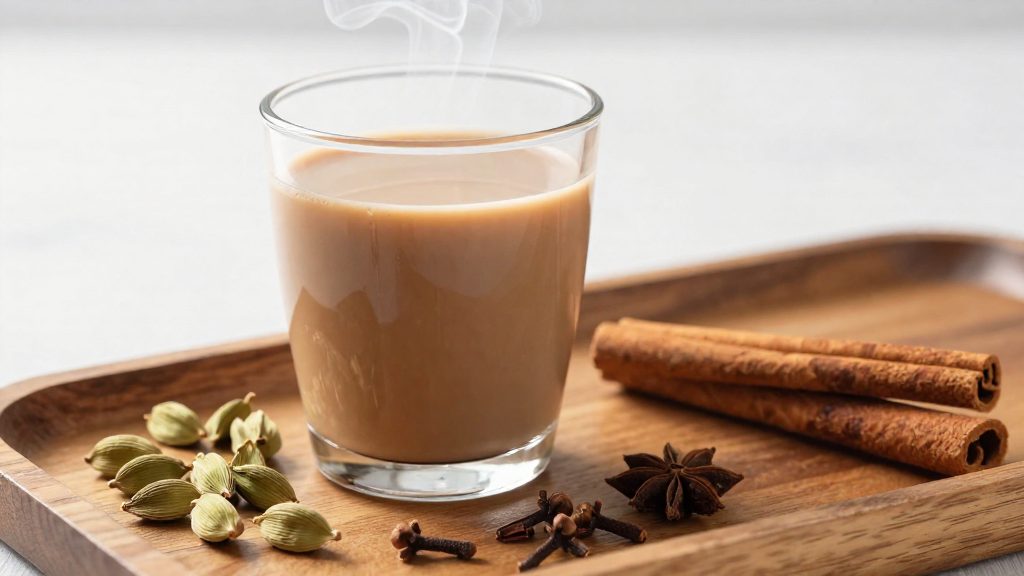
The classic chai spice base is cardamom, cinnamon, ginger, pepper and cloves, according to TEALEAVES (2026). These spices give chai its warm, pungent profile. A rooibos chai latte keeps that spice base and swaps the tea leaf for rooibos, a reddish herbal infusion. Rooibos is a herbal infusion, not a true tea. TEALEAVES (2026) describes it as naturally sweet, so the spice balance matters.
The difference between a chai latte and a plain milk tea is structural:
- Chai latte: a concentrate is brewed separately, strained, and then poured into heated milk. The concentrate and milk are combined in a 1:1 ratio.
- Plain milk tea: tea is brewed and milk is added to the cup, without a separate concentrate step or the spice-led base.

What you need to make it at home
A rooibos chai latte needs a tea base, a spice base, a pan, a strainer and basic measuring tools. You can buy the tea and spices ready-mixed or assemble them yourself.
Prepackaged blend or separate spices
You have two routes:
- A prepackaged rooibos chai blend. Arbor Teas sells Masala Chai Rooibos, a rooibos chai blend. This is the fastest option because the tea and spices are already combined (Arbor Teas, 2026).
- Separate spices with plain rooibos. You choose each spice and its amount.
Equipment
- Heavy saucepan. A pan with a thick base spreads heat more evenly, which helps when you simmer spices and milk. Use one large enough to hold the full volume of liquid without spilling when it boils.
- Fine strainer. Use a fine-mesh strainer to remove tea leaves and spice fragments before you pour the drink into the cup. A coarse strainer lets small pieces of ground spice pass through.
- Measuring spoon. A standard measuring spoon keeps the tea and spice amounts consistent from one batch to the next. Measure dry ingredients level, not heaped.
Crushing whole spices
Whole spices release their flavor more readily once they are cracked or ground. Two common tools do this:
- Mortar and pestle. Lightly crush cardamom pods, cinnamon sticks and cloves to break them open without turning them to powder.
- Spice grinder. A small electric or manual grinder gives a finer, more uniform result. Pulse in short bursts so the spices don’t heat up and turn into dust.
Crush spices shortly before you brew them, because pre-ground spices lose aroma faster than whole ones.
How do you brew a strong rooibos chai concentrate?
To make a stronger concentrate, multiply the loose-leaf amount you normally use for one cup of tea. Arbor Teas (2026) uses twice the usual loose-leaf amount for one cup and three times the usual amount for a stronger latte, steeped in 1/2 cup of boiling water. Measure the leaves by your usual cup’s quantity, not by weight, so the multiplier stays consistent.
| Concentrate strength | Loose leaf | Water | Steep |
|---|---|---|---|
| Standard latte base | 2 × usual cup amount | 1/2 cup (about 118 mL) boiling water | 5 minutes, then strain |
| Stronger latte base | 3 × usual cup amount | 1/2 cup (about 118 mL) boiling water | 5 minutes, then strain |
Steep in a heatproof vessel with a lid or cover to keep the liquid hot. Strain the leaves out at the end of the 5 minutes so the concentrate does not keep extracting. The resulting liquid is the base you will later combine with milk.
The five-minute steep comes from Arbor Teas’ chai latte method for regular chai. No rooibos-specific steep time was confirmed, so check the time on your blend’s package before relying on it.
How do you froth the milk without a machine?
You can froth milk with a sealed jar, a whisk or a French press, all after heating the milk gently on the stove. According to Arbor Teas (2026), the milk is heated, frothed if you like, and then poured into the brewed tea concentrate, so the foam is optional.
Heat the milk until it steams
Warm the milk in a small saucepan over low to medium heat, stirring. Stop when steam rises and small bubbles form at the edges. As a practical tip, avoid letting the milk boil hard, because it can scorch.
Frothing methods
| Tool | How to froth |
|---|---|
| Sealed jar | Pour the hot milk into a jar filled no more than halfway, close the lid tightly and shake hard until the volume increases and foam forms. Open the lid carefully, because pressure builds inside. |
| Whisk | Whisk the hot milk briskly in the saucepan or a wide bowl until foam forms on the surface. |
| French press | Pour the warm milk into the carafe, fit the plunger without pressing it down, and pump it up and down until foam forms. |
Combine equal parts concentrate and milk
Pour 1/2 cup of the heated milk into the 1/2 cup of concentrate, then spoon the foam on top if you like. This 1:1 ratio of concentrate to milk is the standard set out by Arbor Teas (2026). Sweeten to taste, preferably in the hot concentrate before adding the milk.
Which milk and sweetener work best?
The milk sets the body and foam of the cup, and the sweetener sets how the drink tastes against the spices. Choose the milk by the texture you want, then add sweetener in small steps. Rooibos is described as naturally sweet (TEALEAVES, 2026), so the blend often needs less added sweetener than a black-tea chai.
Milk options
Check the carton for fat content and any “barista” or frothing label before you buy. Fat content affects body and how well the foam holds.
| Milk | Body in the cup | Foam | Flavor fit with rooibos chai |
|---|---|---|---|
| Dairy (whole or 2%) | Rounder, heavier | Dense and stable | Neutral, lets the spices lead |
| Oat | Creamy, slightly thick | Often soft, can fall faster | Mild sweetness that suits cinnamon and clove |
| Soy | Fuller than almond | Many brands are formulated to foam | Slight beany note, which can flatten delicate spices |
| Almond | Thinnest | Light, quick to collapse | Nutty note that pairs with cardamom |
Sweeteners and how they dissolve
Sweeten to taste. For easiest dissolving, stir sugar, honey or maple syrup into the hot concentrate before adding the milk, and adjust after tasting.
- Sugar: dissolves quickly in hot concentrate and has no added flavor, so it shows the spices most directly.
- Honey: thicker, so stir it into the concentrate while it is still hot. Its floral note comes through clearly.
- Maple syrup: already liquid, so it mixes easily. Its caramel-like flavor complements cinnamon and clove.
Balancing vanilla and warm spice
Ginger and pepper add bite, so a sweetener that rounds them, such as maple, suits a spicier blend. Vanilla extract reads as sweeter than plain sugar, so start with a small amount and taste before you add any sweetener. If the cup tastes sharp, add the sweetener to the concentrate; if it tastes flat, add more spice first before more sugar.

Can you make it iced?
Yes. An iced rooibos chai latte uses the same spiced concentrate as the hot version, but it is poured over ice instead of being served hot. Because melting ice adds water to the glass, the spice balance depends on starting with a stronger, fully chilled cold concentrate.
Choose a stronger concentrate
For iced, brew the stronger concentrate so the drink still tastes of spice after the ice has diluted it.
Chill before pouring over ice
Steep and strain the concentrate as described for the hot method, then cool it completely before it reaches the ice. Warm concentrate melts ice faster, which adds ice-melt dilution sooner. Fill a glass with ice, pour the cold concentrate over it, and then add cold milk.
Is rooibos chai latte caffeine-free?
According to Arbor Teas and TEALEAVES, a rooibos chai latte is caffeine-free when the blend contains only rooibos and spices. This comes from brand statements, with no official source confirming it, so check the label of your blend.
Health Canada gives caffeine values per 8 oz (237 mL) cup for comparison (Health Canada, 2026):
| Tea type | Caffeine per 8 oz (237 mL) cup |
|---|---|
| Brewed black or green tea | 30 to 50 mg |
| Instant tea | 15 mg |
| Decaffeinated tea | 0 mg |
These values describe a standard cup of each tea type. They are not measurements of a chai latte, so they cannot be used to estimate the caffeine in a black tea chai latte, which is made with a stronger concentrate and milk.
Health Canada’s recommended maximum daily caffeine intake is 400 mg for adults and 300 mg for pregnant people (Health Canada, 2026). Because this is a daily total, caffeine from every drink and food counts toward it, not only from tea.
How to store leftover concentrate
Leftover chai concentrate is best refrigerated in a sealed glass container and checked by smell and appearance before each use. Use it within a short time, because no storage time is sourced here. The concentrate is a brewed liquid, not a dry product, so its freshness depends on temperature and air exposure rather than on the shelf life of the spices alone. The dry rooibos chai blend, which is stored separately, follows different rules.
Cool the concentrate before sealing
Let the strained concentrate stand at room temperature until it stops steaming. Do not seal it while hot: trapped heat and condensation inside a closed container encourage spoilage. Pour it into a clean glass jar or bottle with a tight-fitting lid, leaving a small air gap at the top.
Glass is the preferred choice because it does not absorb the spice aromas, which can linger in plastic and affect later batches.
Refrigerate and check before use
Store the sealed container in the refrigerator. Place it on a shelf rather than the door, where temperature swings are greater.
Before each use, check the concentrate:
- Smell: a sour, fermented or sharply off odour means discard it. Fresh concentrate should smell of rooibos and spice.
- Appearance: visible mould, cloudiness that was not there before, or bubbles and fizz signal spoilage.
- Taste: if the smell and look are normal but the flavour is clearly sour, throw the batch away.
Store the dry blend away from light
Keep the dry rooibos chai blend in an airtight container, away from light and heat. Light, heat and air weaken the aroma of the spices over time. Store the blend somewhere cool and dark, such as a cupboard, rather than on a sunny windowsill or beside the stove.