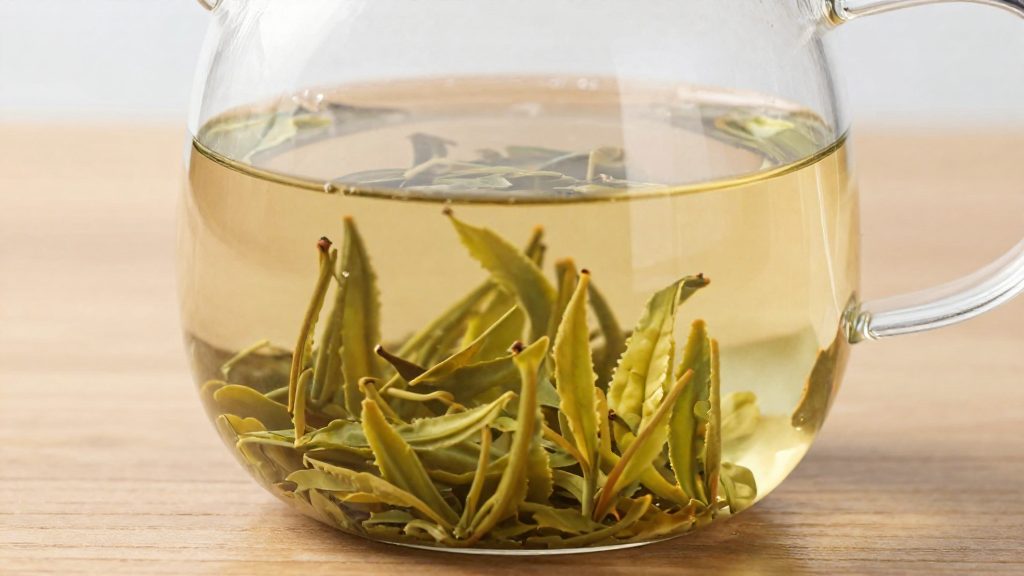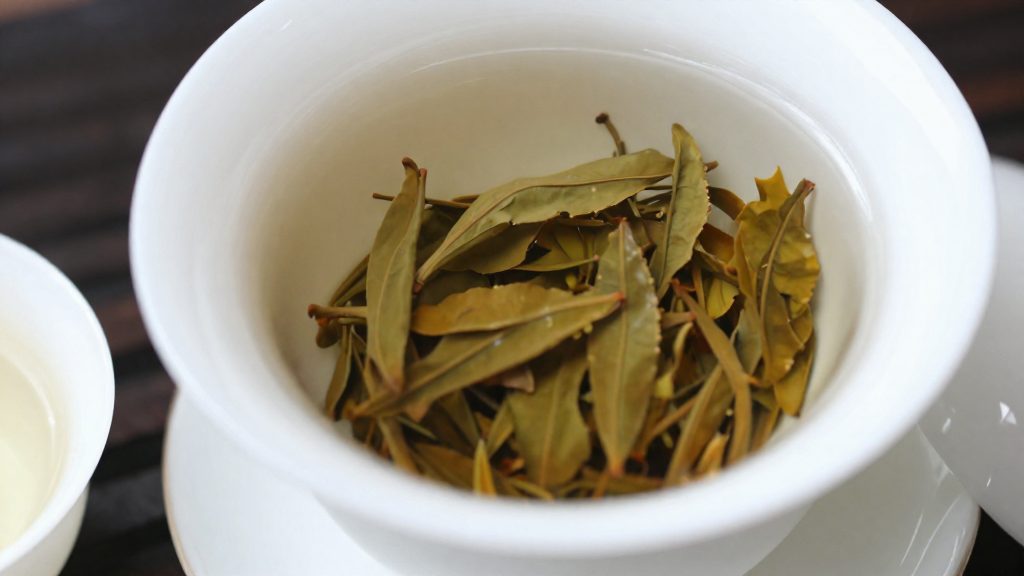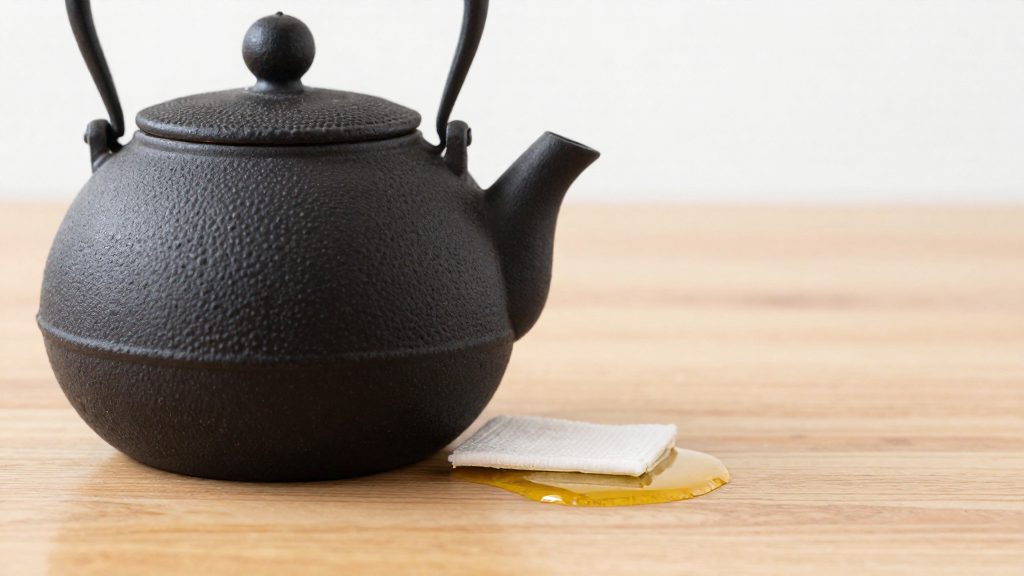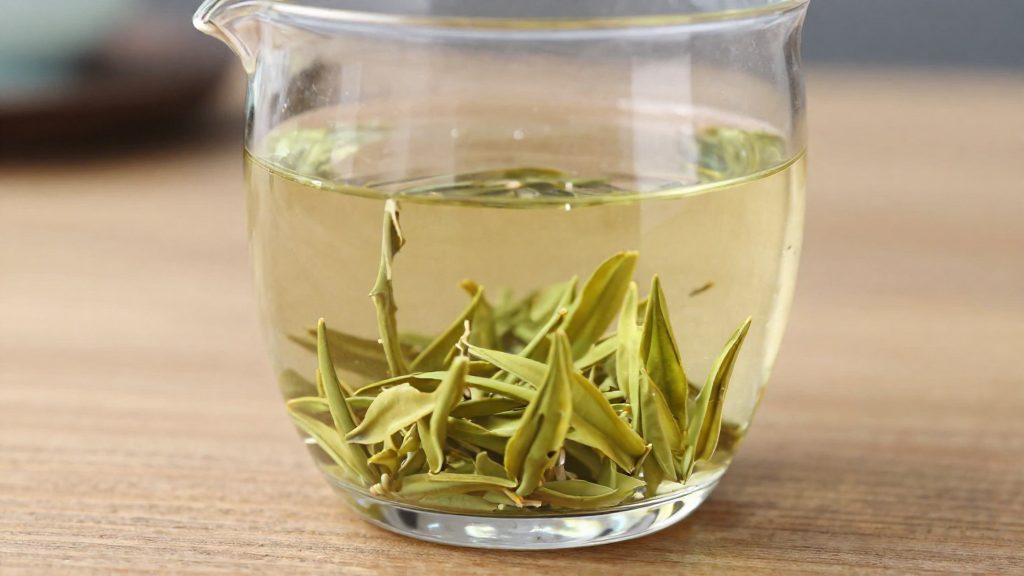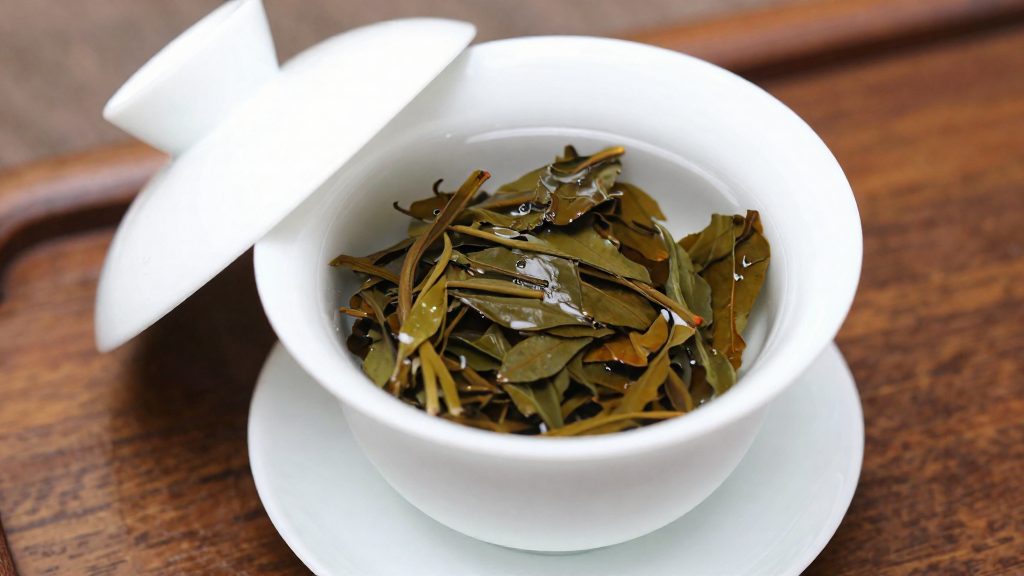
A gaiwan is a lidded bowl that lets you steep and pour tea in a single vessel. The leaves stay in the bowl under the lid while you infuse, and you pour off the liquid by tilting the bowl with the lid held in place. Each step below uses the same three parts.
Gaiwan or teapot: which suits oolong better?
For lightly roasted oolong, where the aim is to taste subtle differences between infusions, a gaiwan suits best. For deeply roasted oolong, a teapot suits better. According to Good Tea Place (2026), teapots retain heat better than gaiwans, which suits darker teas such as roasted oolong and black tea, while gaiwans suit delicate oolong where nuance matters. The deciding factor is the roast level of the leaf, not the vessel’s reputation.
Roast level sets the vessel
| Oolong style | Suited vessel | Reason given by the source |
|---|---|---|
| Lightly roasted, delicate | Gaiwan | Nuance matters, and the gaiwan teaches gongfu control over steeping (Good Tea Place, 2026) |
| Deeply roasted, darker | Teapot | Teapots retain heat better and suit darker teas (Good Tea Place, 2026) |
Nuance versus body: the trade-off
The choice comes down to nuance against body. A gaiwan favours nuance: it suits oolong where you want to follow how the cup changes from one infusion to the next. A teapot favours the heavier character of a darker roast. Path of Cha (2026) puts the standard gaiwan size at about 110 ml (about 3.8 oz).
Oolong styles that reward a single vessel
A gaiwan suits a beginner who wants to compare several delicate oolongs in one vessel without changing cups.
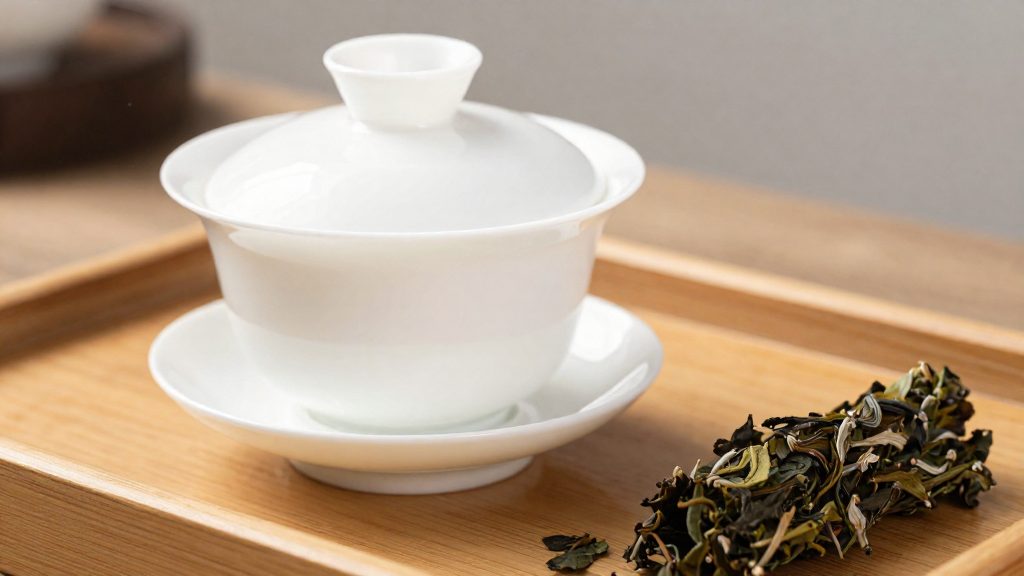
What is a gaiwan, and how does it work?
The three parts
| Part | Role during brewing |
|---|---|
| Lid | Covers the leaves while they infuse, and holds them back when you pour |
| Bowl | Holds the dry leaves and the water, and is the vessel you steep in |
| Saucer | Serves as the base under the bowl, and gives you a stable surface to hold it |
Infusing and pouring in one vessel, step by step
- Add the dry leaves to the bowl.
- Pour hot water down the side of the bowl, not onto the leaves.
- Place the lid on the bowl and let the leaves infuse.
- To pour, hold the lid knob with your fingers, then tilt the bowl slightly so a narrow gap opens at the lip.
- Pour the liquid into your cup while the lid keeps the leaves inside.
- Leave the leaves in the bowl, add hot water again, and repeat for the next infusion.
Because the leaves never leave the bowl, you do not need a separate strainer or teapot for each infusion.
Rinsing before the first brew
Path of Cha (2026) advises rinsing the gaiwan with hot water before adding leaves. Swirl the water around the bowl and the lid, then empty it into a waste container before you measure out the tea. This clears dust from the new vessel and warms the bowl so the first infusion starts evenly.
Why do teapots hold heat better?
Good Tea Place (2026) says teapots retain heat better than gaiwans. A likely reason is thermal mass, the amount of material that absorbs and stores heat. Heat leaves a brewing vessel through its walls, its lid and its spout, so the thickness of the body and the closure of the openings determine how fast the liquid cools.
Wall mass stores heat
A heavier wall holds more heat before its surface temperature falls, so the water inside stays warm for longer. Path of Cha (2026) describes porcelain walls as thinner and says porcelain cools faster. A gaiwan’s thin bowl therefore gives up heat more quickly than the thicker body of a teapot.
Lid and spout as openings
The lid and spout are the points where heat escapes most directly. Each time the lid is lifted, warm air and steam leave the vessel and the infusion loses temperature. Keeping the lid on for the whole steep limits this loss.
Porcelain or Yixing clay for beginners
Both materials can brew oolong, but they behave differently over repeated use. According to Jing Tea (2026), non-porous glazed porcelain can brew any tea type with only a rinse between sessions. A Yixing teapot made of porous zisha clay absorbs a little tea oil with each use, so it becomes seasoned to one tea type.
| Factor | Glazed porcelain | Yixing zisha teapot |
|---|---|---|
| Surface | Non-porous glaze | Porous unglazed clay |
| Tea types | Any type, with a rinse between sessions (Jing Tea, 2026) | Seasoned to one type; traditional drinkers dedicate one pot to one tea (Jing Tea, 2026) |
| Beginner handling | Path of Cha (2026) says porcelain is easier to handle than unglazed Yixing | Good Tea Place (2026) says a teapot is easier, without naming the material |
Seasoning a zisha pot
Seasoning is the cumulative result of tea oil absorbed into unglazed clay. Once a pot has taken on one tea’s character, using it for another tea can carry flavour across. If you choose zisha, decide on the tea type before the first session and keep that pot for it.
Where sources disagree
Sources do not agree on which material is easier for a beginner. Path of Cha (2026) favours porcelain. Good Tea Place (2026) describes the teapot as easier. The disagreement is unresolved, so judge handling by how the vessel feels in your hands rather than by the material alone.
What size should you buy first?
Capacity, not style, decides the size to buy first. Path of Cha (2026) gives the standard gaiwan size as about 110 ml (about 3.8 oz), so that is a sensible reference point when you compare listings. Start there, then adjust for how many people usually drink from the vessel.
Matching capacity to drinkers
- Count the cups you pour in one session, including your own.
- Compare the listed volume with the cup size you actually use. A vessel’s capacity is the total you can brew at once, so a small gaiwan limits how much tea each person gets.
- If you regularly brew for two or more people, look for a capacity above the 110 ml standard. Sources in this article do not give a specific volume for each number of drinkers, so judge from your own cups.
- If you brew mostly for yourself, the standard size keeps each session simple to handle.
Checking the stated capacity
- Manufacturers list capacity in millilitres, ounces, or both. Convert to the same unit before comparing listings, since 110 ml and 3.8 oz are the same reference size.
- Read whether the figure refers to the bowl’s total volume or the usable pouring volume. Listings do not always make this clear.
- Compare the capacity with the same unit across teapots and gaiwans; this keeps the comparison fair.
Leaf amount and steep times for oolong
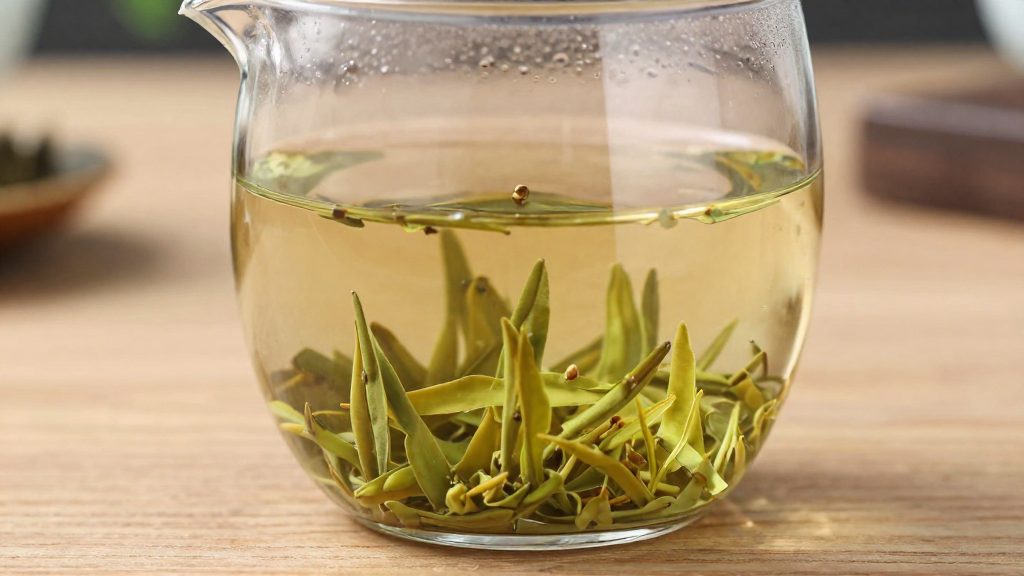
A standard gaiwan takes about 5 to 8 g of leaf, according to Jing Tea (2026). Gongfu brewing uses a much higher leaf-to-water ratio than Western brewing, so the leaf charge is the first variable to set when you switch from a mug or bag to a lidded vessel. The source gives no oolong-specific ratio in grams per millilitre, so treat 5 to 8 g as a starting range and adjust it by taste.
The first infusion can be as short as 10 to 20 seconds, per Jing Tea (2026). This is a general gongfu figure, not specific to oolong, and the sources give no water temperature. Start at the low end of that range and extend the steep only if the first cup tastes thin. Pour the liquor out completely after each infusion so the leaves stop extracting.
A good oolong can give 6 to 10 infusions from the same leaf charge, according to Jing Tea (2026). Each later infusion usually runs longer than the one before, so keep a rough count of steeps and note how the cup changes. The number of infusions depends on the oolong and on the leaf amount, so the range is a guide rather than a fixed count.
| Variable | Figure from source | Source |
|---|---|---|
| Leaf per standard gaiwan | About 5 to 8 g | Jing Tea (2026) |
| First infusion | About 10 to 20 seconds | Jing Tea (2026) |
| Infusions from a good oolong | 6 to 10 | Jing Tea (2026) |
Which one should you buy first?
For most beginners, the first purchase should be a single starter vessel. A gaiwan is the more flexible choice for oolong: it is a lidded porcelain bowl that infuses and pours in one piece. A teapot, by contrast, can be a Yixing zisha clay pot, which Jing Tea (2026) describes as porous, so it becomes seasoned to one tea type. Choose based on the oolongs you already drink and the budget you can commit.
Start with one vessel, not accessories
Buy the vessel before any infuser, tray or tool. A single gaiwan suits lightly roasted, delicate oolongs, so it is a sensible first purchase if those are the teas you drink. Deeply roasted oolongs are better served by a teapot. Add accessories only after you have brewed the same tea a few times and identified what you are missing.
Match the purchase to the oolongs you drink
- Lightly roasted, delicate oolongs: a gaiwan suits these.
- Roasted or darker oolongs: a teapot is the better fit.
- Mixed collection: start with a gaiwan, since it avoids committing a porous clay pot to a single tea type.
Set a budget that covers vessel and infuser
Plan the budget around the vessel and a way to hold the leaf. A gaiwan’s lid and bowl already act as the infuser, so a separate infuser is optional for this format. If you choose a teapot, budget for a fine mesh infuser or built-in strainer, since loose leaf needs to be kept out of the pour. Check the product label or manufacturer’s instructions for capacity and care before buying, because the reference sizes available for this comparison are not verified for every model.