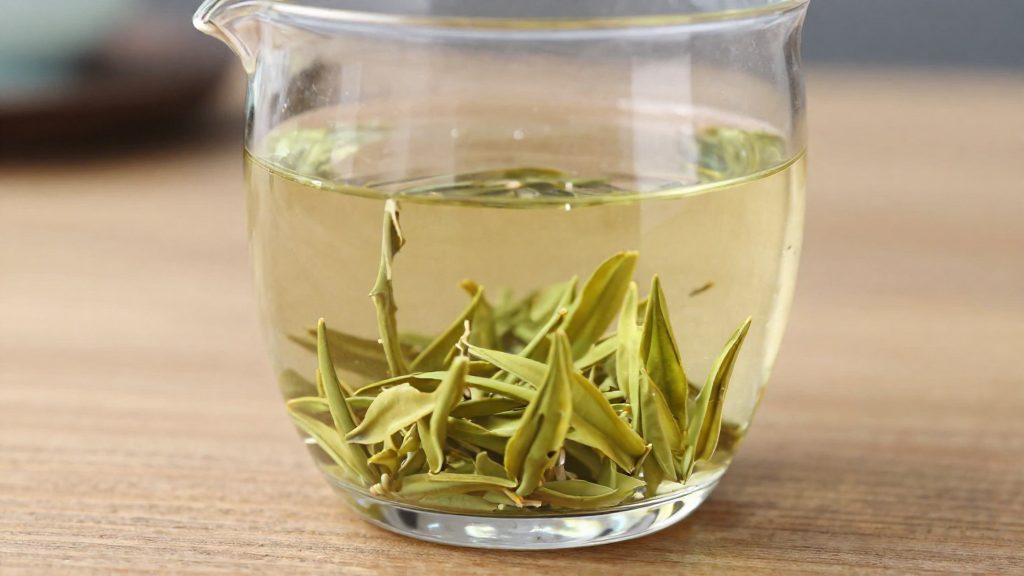
Filtering tap water is likely to help tea flavour when your tap water has an off-taste or odour. The Tea & Coffee Trade Journal says chlorine, ammonia and iron can negatively affect a brew, but no independent study confirms a consistent improvement. When tap water is already neutral in taste and smell, filtration usually changes the cup very little. Whether it’s worth buying a filter depends on whether your water has a problem to fix.
Does filtered tap water improve tea taste?
When filtration makes a clear difference
If your tap water carries off-flavours from chlorine, ammonia or iron, filtration is most likely to change the cup.
| Tap water condition | Likely effect of filtration on tea |
|---|---|
| Chlorine, ammonia or iron taste or smell | Clearer, cleaner flavour after carbon filtration |
When it changes little
- Neutral tap water with no detectable taste or smell usually produces tea that tastes much the same when filtered.
- Very soft water: the Tea & Coffee Trade Journal says water that is too soft can reduce flavour extraction.
Is filtration worth the cost?
- Worth it: tap water smells of chlorine, has a metallic taste, or is visibly particulate.
- Probably not needed: tap water tastes and smells neutral, and a side-by-side test shows no difference.
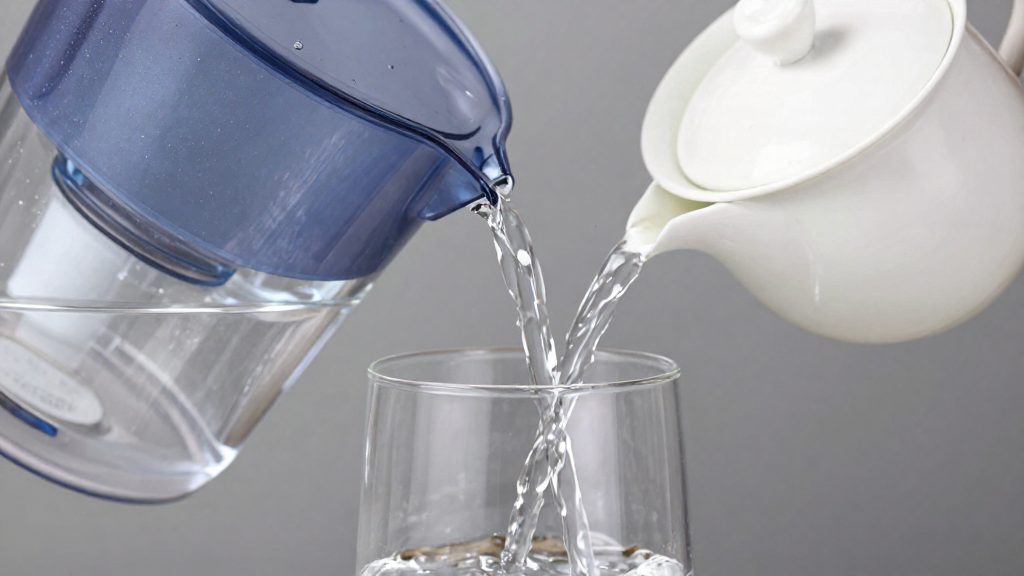
What chlorine does to delicate teas
Chlorine, ammonia and iron are tap-water contaminants that the Tea & Coffee Trade Journal says can negatively affect the taste of a brew. Their effect is most noticeable in delicate green and white teas, which are lightly processed and rely on fresh, grassy, floral or vegetal aromas. An off-note that a stronger black tea might mask stands out in the cup.
| Tap-water off-flavour | Aroma it adds | What it covers in a green or white brew |
|---|---|---|
| Chlorine | Often described as pool-like | Can negatively affect taste (Tea & Coffee Trade Journal) |
| Ammonia | Often described as a cleaning-product smell | Can negatively affect taste (Tea & Coffee Trade Journal) |
| Iron | Often described as metallic | Can negatively affect taste (Tea & Coffee Trade Journal) |
Chloramine and disinfectant residues
Chloramine is a combined disinfectant. Some sources suggest carbon filters may not fully remove it, but this is unverified here. Check the filter’s specification to see whether it names chloramine as a removed contaminant.
Why mineral content and hardness matter
Hardness is set mainly by calcium and magnesium. The UK Tea Academy’s white paper, “The Ultimate Ingredient for The Perfect Cup of Tea,” as reported by STiR Tea & Coffee (2020-06-16), proposes a water specification that balances calcium and magnesium to set hardness. The same specification also covers removing chlorine and preserving buffer capacity.
| Water component | Effect on the cup |
|---|---|
| Calcium and magnesium | Set the water’s hardness (UK Tea Academy specification) |
| Chlorine | Removal included in the UK Tea Academy specification |
| Buffer capacity | Preserved in the UK Tea Academy specification |
Buffer capacity in the specification
Buffer capacity is one of the parameters in the UK Tea Academy specification, alongside chlorine removal and the calcium and magnesium balance. For the numeric targets, read the white paper itself.
Why very soft water can taste flat
According to the Tea & Coffee Trade Journal, water that is too soft can reduce flavour extraction, which is why very soft water may give a thinner cup.
Is softer or harder water better for tea?
An undated Tea & Coffee Trade Journal trade feature gives a total dissolved solids (TDS) range of 50 to 150 ppm for brewing tea, and names 150 ppm as the ideal. The journal is an undated trade feature and no primary source was confirmed for the figure, so treat it as a trade guideline rather than an official standard. The same source says the water should match the tea’s delicacy.
Delicate teas need mild water. The journal states that delicate green and white teas need very mild water. Stronger teas tolerate more minerals, according to the same source.
| Tea style | Water guidance (Tea & Coffee Trade Journal) |
|---|---|
| Delicate green and white | Very mild water |
| Stronger teas | Tolerate more minerals |
To apply the range at home:
- For green or white tea, the source asks for very mild water, but it also names 150 ppm as the ideal and gives no sub-range per tea. Reading this as the lower part of the range is the article’s own inference, not a figure from the source.
- For stronger teas, the source’s statement that they tolerate more minerals means a reading higher in the range is acceptable.
- A TDS meter reports total dissolved solids, not hardness alone, so read the number as an overall indicator of mineral content.
Which filters help: carbon, pitcher or reverse osmosis?
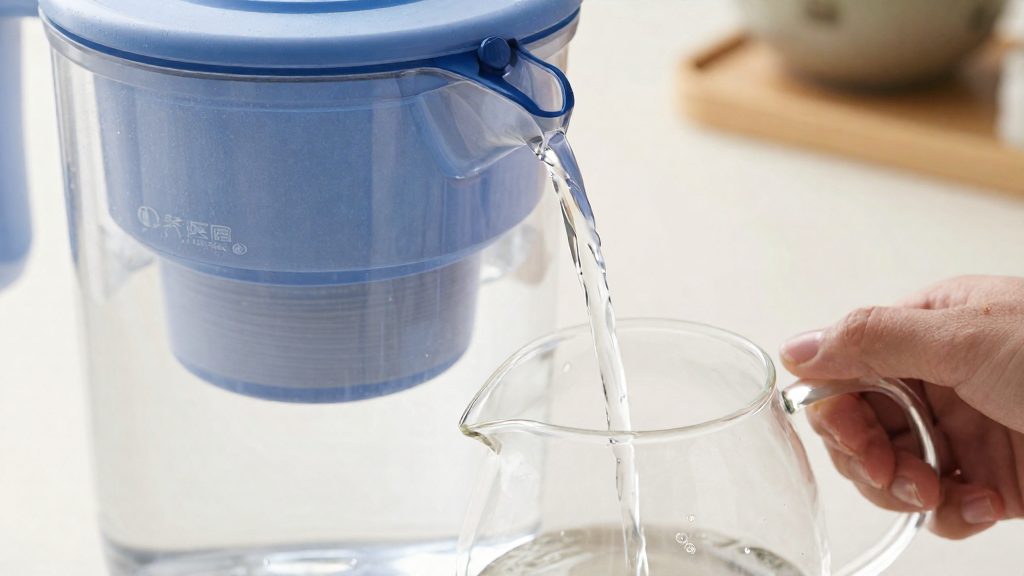
According to Tea & Coffee Trade Journal, carbon filtration is the minimum recommended treatment for tea water. It removes taste, odour and some particulates. Pitcher and tap-mounted cartridges are often carbon-based, but check each product’s label for what it actually removes. Reverse osmosis is a more intensive process that strips dissolved minerals.
| Filter | What it targets | Points to check |
|---|---|---|
| Carbon filter (minimum recommended) | Taste, odour, some particulates | Baseline standard for tea water |
| Pitcher with carbon cartridge | Carbon cartridge; removal list varies by product | Read the cartridge label for its listed contaminants |
| Tap-mounted carbon cartridge | Same carbon principle; exact removal list varies by product | Confirm the manufacturer’s stated contaminants |
| Reverse osmosis | Strips dissolved minerals | Measure TDS and add minerals if the result is below the target range |
Reverse osmosis strips dissolved minerals, so the water may fall below the 50–150 ppm trade range, which could reduce flavour extraction. If your reading is below 50 ppm, consider remineralising, following the manufacturer’s instructions for any product you use. Follow the manufacturer’s instructions for any remineralising product you use.
Limescale, kettles and cloudy iced tea
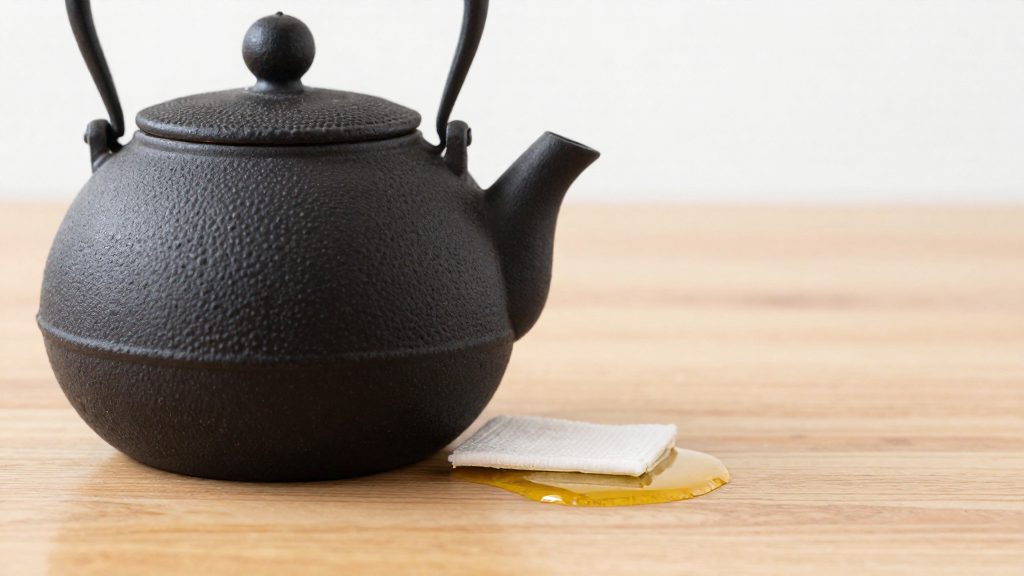
Hard water causes limescale, the chalky white deposit that builds up inside kettles (Tea & Coffee Trade Journal). Keeping the kettle descaled is the first step for anyone brewing with hard water at home.
Limescale in kettles
Limescale accumulates faster where the water is harder, and the deposit reduces heat transfer and can slow boiling. Two practical habits help:
- Empty the kettle after use so less water sits and evaporates, leaving minerals behind.
- Descale on a schedule that matches how often you boil water and how hard your local supply is.
To descale, follow the kettle manufacturer’s instructions for the descaling agent and the dilution. Avoid scrubbing a heating element with abrasives, which can damage its surface. Rinse thoroughly, then boil and discard one or two full kettles of clean water before brewing, so no residue reaches your cup.
Hard water and cloudy iced tea
A UK tea retailer, Jing Tea, states on its shop blog that hard water clouds tea and that very soft water makes it weak. This is the retailer’s own claim, not an independent study, and it is not treated as established here.
Some online sources cite a hardness threshold at which iced tea turns cloudy, but this is unverified and is not given here. If your iced tea clouds consistently, your local water hardness is a likely contributor, but the cause can also lie in the tea itself or in how it was chilled.
How to test your water at home
Three low-cost checks show what is in your water before you change a filter or adjust a brewing target: a TDS meter reading in ppm, your utility water quality report, and hardness test strips. Together they show how much dissolved material your water carries and which substances may affect taste. The steps below explain how to take each measurement. They do not set target values for individual teas.
Measuring TDS with a meter
A TDS meter reports total dissolved solids in parts per million (ppm). Place the probe in the water, wait for the reading to stabilise, and record it. Test both tap water and the water you actually brew with, so you can see what a filter changes.
Calibrate the meter before use, following the manufacturer’s instructions for the calibration solution and any temperature setting. Calibration steps differ between models, so check the printed guide rather than a generic procedure. Rinse the probe between samples.
Reading your utility water quality report
Your municipal water utility is the most complete source of information about your supply in Canada. Check its website for a water quality report, or contact it and ask for the latest results for your service area. Note that the 50–150 ppm trade range does not come from a Canadian source.
Look for chlorine, hardness and iron. Reports often list values in different units, so note the unit before comparing a figure with your meter reading.
Reading hardness test strips
Dip the strip for the time stated on its packaging, remove it, and compare the test pad with the colour chart printed on that pack within the stated time. Colour charts differ between brands, so use the chart supplied with your strips rather than a generic table. Record the result with its unit.
Hardness strips measure the calcium and magnesium component of your water’s hardness.
| Test | What it measures | Unit | Reference point |
|---|---|---|---|
| TDS meter | Total dissolved solids | ppm | Trade guide: 50–150 ppm |
| Utility report | Chlorine, hardness, iron (where listed) | As reported by utility | Utility’s own published values |
| Hardness strip | Hardness | Colour chart on the pack | Chart supplied with the strips |