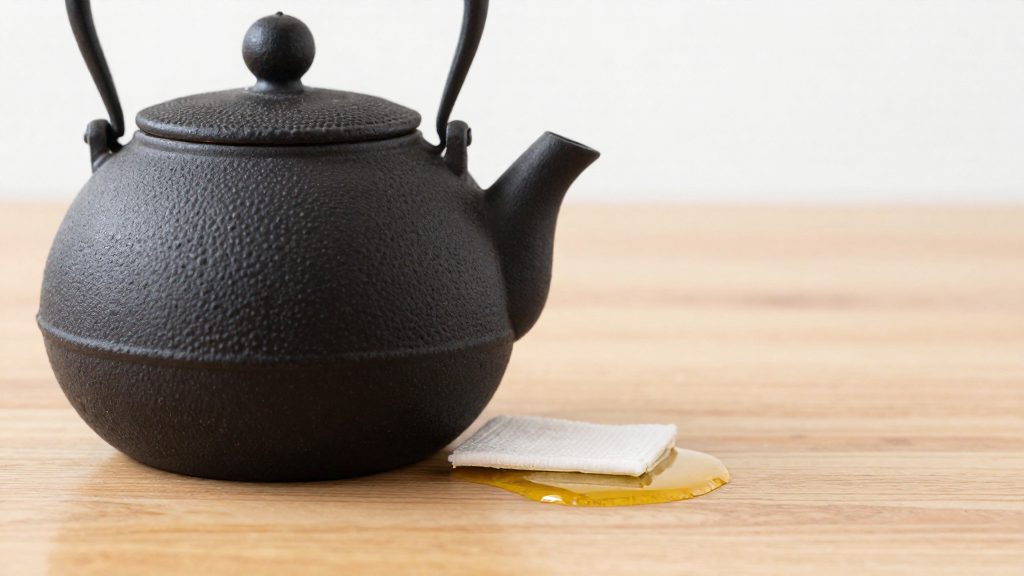
An unlined tetsubin is an iron kettle with a raw iron interior, built to boil water as well as hold it. An enamel-lined teapot has a glazed interior and is built for steeping only. According to Musubi Kiln (2026), most ironware teapots are enamel-lined and need no seasoning, and they must not be placed over a flame or stove. The two differ in construction, in the surface that touches the water, and in whether the vessel is designed for heating.
What is the difference between a tetsubin and an enamel-lined teapot?
Interior surface and intended use
| Feature | Unlined tetsubin | Enamel-lined teapot |
|---|---|---|
| Interior surface | Bare iron, exposed to water | Enamel coating, which Artful Tea (2026) says helps prevent rust |
| Intended use | Boiling water in kettle form (Musubi Kiln, 2026) | Steeping only (Musubi Kiln, 2026) |
| Rust exposure | Iron is in direct contact with water and can develop red rust | Enamel lining reduces direct iron contact |
Kettle form versus steeping-only design
A tetsubin is shaped and used as a kettle. An enamel-lined teapot is a steeping vessel, so its role ends once the leaves are infused.
Exposed iron and rust susceptibility
Because the iron interior is exposed, a tetsubin needs drying after each use.
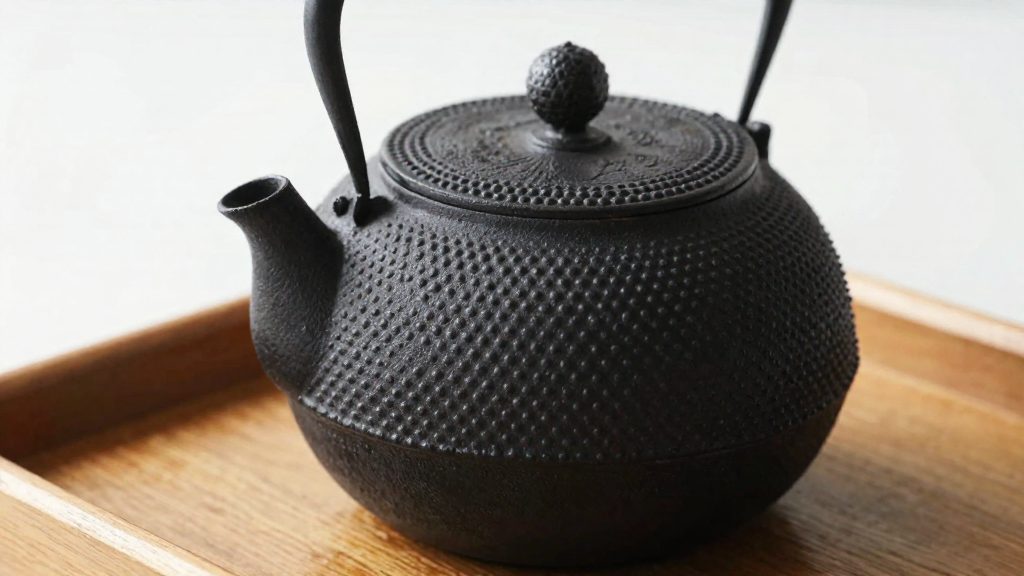
Does a cast iron teapot need seasoning?
Only unlined iron vessels rely on seasoning. Most ironware teapots are enamel-lined and need no seasoning, according to Musubi Kiln (2026). The enamel interior acts as the rust barrier, so these pots are ready to use once rinsed.
Enamel-lined pots
Western cast iron teapots usually have an enamel interior. Check the maker’s instructions to confirm whether your pot is enamel-lined or bare inside.
Unlined iron and the mineral film
Unlined tetsubin kettles have no enamel coating, so their protection depends on a mineral film. Because the film is the protective layer on a bare interior, clean it only with a soft sponge and no detergent (Akazuki, 2026).
Bare iron and rust risk
Moisture left on bare iron is a concern, which is why the sources stress drying the kettle completely after use (Musubi Kiln, 2026).
How to season an unlined tetsubin kettle
The narashi method is the boiling procedure used for bare iron kettles. You fill the kettle to about 80% of its capacity with drinkable tap water or mineral water, boil it down to about one-third of its volume without letting it boil dry (heat it only in the way your kettle’s maker allows, since the sources disagree on direct stove use), discard the water, and repeat the process 3–4 times, or until the water runs clear. According to Musubi Kiln (2026), the mineral film left behind by this process helps prevent rust.
Step-by-step procedure
| Step | Action | Target |
|---|---|---|
| 1 | Fill the kettle | About 80% of capacity |
| 2 | Boil | Reduce to about one-third of the original volume |
| 3 | Discard the water | Empty the kettle completely |
| 4 | Repeat | 3–4 cycles, or until the water runs clear |
Reading the result
- Clear water is the cue to stop repeating the cycle, as the method describes (Musubi Kiln, 2026).
- Cloudy or discoloured water in the early cycles is expected. Keep repeating the cycle until the output is clear.
- Never let the kettle boil dry, as this is the main risk during the process (Akazuki, 2026).
How do you prepare an enamel-lined cast iron teapot for first use?
An enamel-lined cast iron teapot does not need seasoning, so the only preparation before first use is a warm rinse. The narashi method applies to unlined tetsubin kettles and not to enamel-lined pots.
First-use rinse
- Pour warm water into the teapot and swirl it around the interior.
- Empty the water.
- Rinse the strainer separately with warm water, since it is a removable part.
Check the care label first
Before the first rinse, read the care label or instructions supplied with the teapot. These state the manufacturer’s first-use guidance for that specific model. If the label is missing or unclear, contact the maker or retailer before use.
Should you use oil to season a teapot?
For most cast iron teapots, oil has no established role.
| Teapot type | Recommended approach | Role of oil |
|---|---|---|
| Unlined tetsubin kettle | Narashi, using drinkable tap or mineral water | Not part of the method; oiling is unverified |
| Enamel-lined cast iron teapot | No seasoning; rely on the enamel interior | None; the enamel is the protective layer |
Why oil does not fit the narashi method
Narashi is a water-only process. The iron changes through repeated boiling with water, so there is no step where an oil layer would be added. Oil seasoning, as used on cookware, is a separate idea that the water method does not require.
Unlined kettles and oil layers
Some online Q&A material mentions flaxseed or vegetable oil for seasoning. Akazuki (2026) advises against putting oil on a teapot. Treat oil seasoning as unverified for unlined kettles. For rust control on an unlined kettle, the documented step is drying.
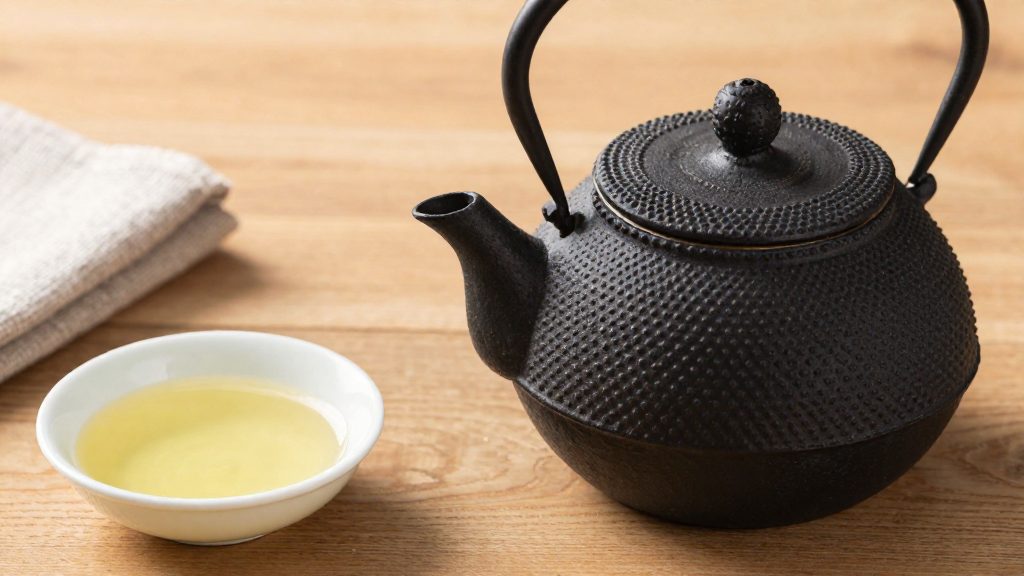
Drying and cleaning after each use
Post-use care has three steps: empty the pot, clean the interior without detergent, and dry it fully with the lid off. The exact method depends on whether the pot is unlined iron or enamel-lined cast iron.
| Step | Unlined iron (tetsubin) | Enamel-lined cast iron |
|---|---|---|
| Interior cleaning | Soft sponge, no detergent (Akazuki, 2026) | Rinse with water; soap and cleaners can damage the enamel and iron (Artful Tea, 2026) |
| Drying | Wipe inside and out while still warm (Akazuki, 2026) | Dry with a soft towel (Artful Tea, 2026) |
| Final drying | Lid off, using residual heat until fully dry (Musubi Kiln, 2026) | Air-dry upside down (Artful Tea, 2026) |
Unlined iron pots
Empty the pot right after steeping. Clean the interior with a soft sponge and water only. Wipe the inside and outside dry while the iron is still warm, then leave the lid off so the remaining moisture evaporates from the residual heat. Musubi Kiln (2026) specifies that the kettle must be dried completely with the lid off, so leftover water should not stay inside the pot.
Enamel-lined cast iron pots
Dry the pot with a soft towel, then set it air-dry upside down so water drains out and the interior dries without trapping moisture.
Rust: what to do about it
Red rust on an iron kettle is not harmful to health, according to Musubi Kiln (2026), the manufacturer and distributor of Nambu ironware. The surface marking is still worth reducing, and the same source gives a tea-leaf boil for that purpose.
Musubi Kiln (2026) describes the method as follows:
- Add about 1 tsp of green or black tea leaves to the kettle.
- Boil the leaves in the kettle for about 30 minutes.
- Discard the tea after boiling. The leaves are used only to treat the kettle.
Musubi Kiln (2026) recommends this step for red rust specifically. It does not describe the boil as a replacement for the seasoning process or for other care steps.
Can you put a cast iron teapot on the stove?
Usually not. Whether a cast iron teapot can go on a stove depends on its interior. Musubi Kiln (2026) says most ironware teapots are enamel-lined and must not be put over a flame or stove, because this can peel the enamel. Akazuki (2026) says an unlined tetsubin should never be heated directly on a stove. Artful Tea (2026) states that a pure uncoated tetsubin can go on the stove, which conflicts with the Akazuki guidance.
| Interior | Stove use | Source |
|---|---|---|
| Enamel-lined | Not permitted | Musubi Kiln (2026) |
| Unlined (pure uncoated) tetsubin | Sources conflict: Akazuki (2026) says never heat directly on a stove; Artful Tea (2026) says it can, but to check with the maker if unsure. Do not assume it is stove-safe. | Akazuki (2026); Artful Tea (2026) |
| Pure uncoated tetsubin | Stated as acceptable by Artful Tea (2026), but the source advises confirming with the maker. | Artful Tea (2026) |
Enamel-lined teapots
The enamel coating is what separates these pots from the iron below it. Heating the pot directly on a flame or electric ring risks damaging that coating. Use an enamel-lined pot only to steep tea, and heat water in a separate kettle.
Unlined tetsubin
For the unlined tetsubin, Akazuki (2026) gives the clearest rule: keep it off direct heat. The bare iron is the part that rusts, and the sources disagree on whether a tetsubin can take stove heat, so do not assume it can.