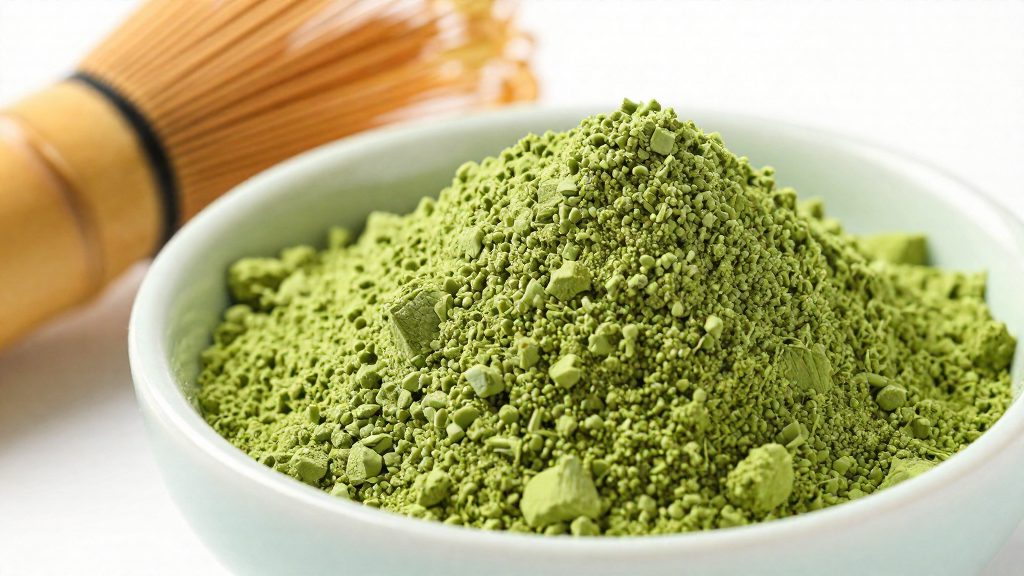
Matcha powder contains about 19 to 44 mg of caffeine per gram of powder, according to Healthline (2026), which links this range to a review by Kochman et al. (2020). Because the figure is expressed per gram of dry powder, the total in any serving depends on how many grams go into the cup or bowl. The range is wide, so treat it as a band rather than a fixed value for every tin.
How much caffeine is in a gram of matcha?
The 19 to 44 mg range
- Lower bound: 19 mg of caffeine per gram of matcha powder.
- Upper bound: 44 mg of caffeine per gram of matcha powder.
- Attribution: Healthline (2026), citing Kochman et al. (2020).
- Ratio between bounds: the upper figure is about 2.3 times the lower one, so a 1 g portion can fall anywhere across that band.
Why powder weight is the unit
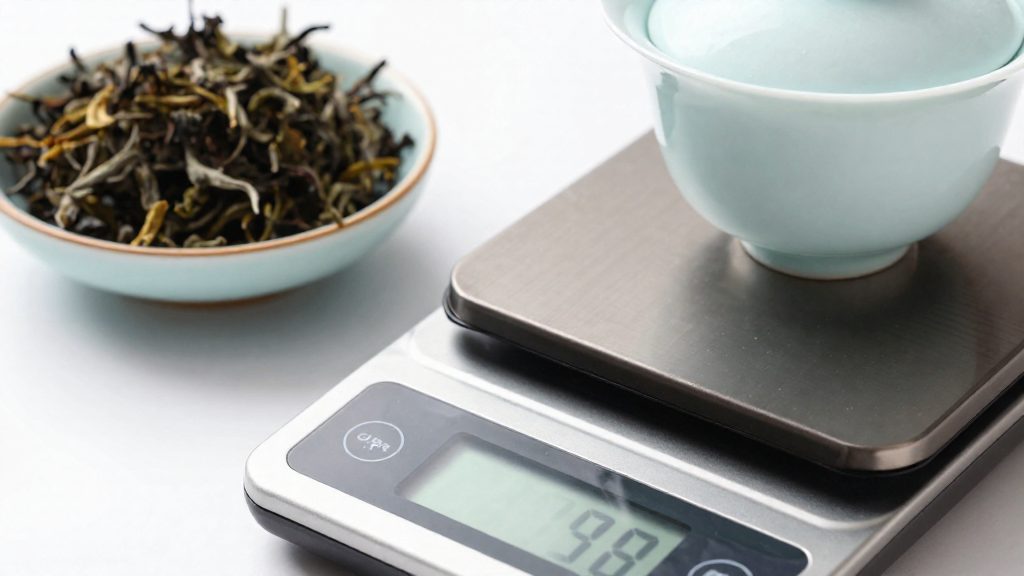
Caffeine in matcha is reported per gram of powder, not per cup, per scoop or per tea bag. Powder weight is the most repeatable measure from one preparation to the next. A kitchen scale that reads to 0.1 g gives a more consistent input than a volume measure.
Reading the range
- The range is a published band across matcha in general. It is not a rating for a specific grade, shade or harvest.
- Some vendor sites and blogs quote different ranges, such as 34 to 50 mg or more, or 12 to 25 mg per gram. These are unverified, cite no lab data, conflict with each other and partly overlap this band.
- If you need the methodology behind the Kochman et al. (2020) range, read the original review directly.
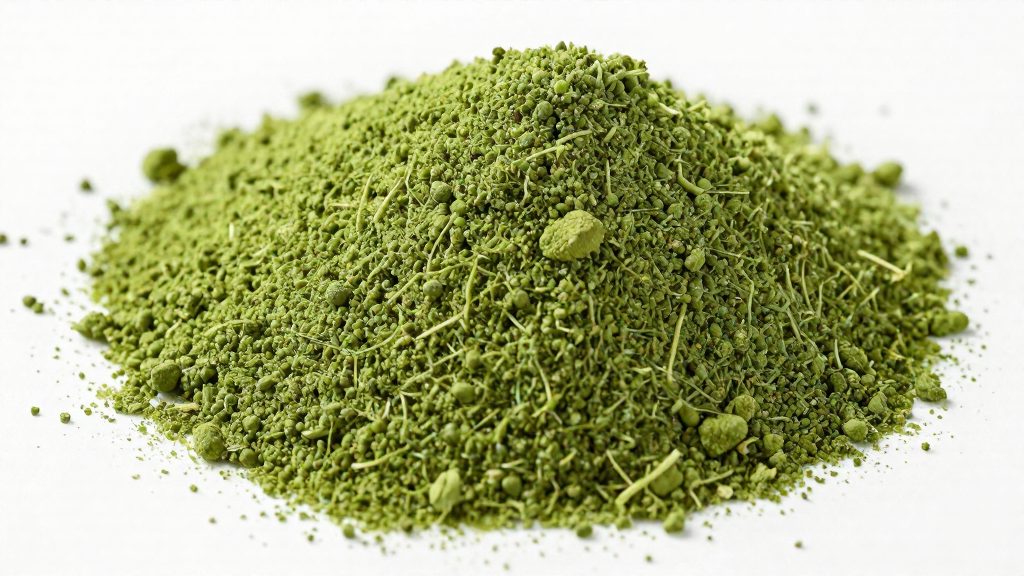
What the 19 to 44 mg range does and does not tell you
The 19 to 44 mg per gram range for matcha powder comes from Kochman et al. (2020), a review of matcha, as cited by Healthline (2026-10-15). It does not say which grades or conditions produce the low and high ends.
What a per-gram figure measures
A per-gram figure describes caffeine in the dry powder before water is added. Healthline converts the band into a serving estimate of 38 to 176 mg for 2 to 4 g of powder, which shows how far the result moves once the weight changes.
Reading a figure without a stated method
A per-gram number is comparable only when the test procedure, the powder tested and the weight basis are known. Without them, treat the figure as an estimate. Check whether a vendor names a lab method and the specific product before comparing it with another brand.
Powder weight is itself hard to judge by eye. A Canadian brand, Breakaway Matcha (2019-09-11), lists a light half-teaspoon at about 1 g, a level teaspoon at 1.5 to 2 g, a heaping teaspoon at 2 to 3 g and a tablespoon at about 6 g. The same spoon can therefore hold a threefold difference in powder, and so in caffeine.
Why one figure cannot fit every matcha
The published and commercial numbers do not agree with each other:
| Figure (mg per g) | Attribution | Status |
|---|---|---|
| 19 to 44 | Kochman et al. (2020), via Healthline (2026-10-15) | Broad published band for matcha powder; test method not given |
| 34 to 50 or more | Vendor blogs, ceremonial and premium grades | Unverified; no lab data cited |
| 12 to 25 | Vendor blog, other matchas | Unverified; conflicts with the band above |
| about 25 to 35 | Breakaway Matcha (Canada), derived from its weight table | Estimate calculated from a table, not a stated lab value |
A Uniprix listing reportedly gives about 60 mg per cup of infusion. This is unverified and conflicts with Health Canada’s 30 to 50 mg per 8 oz cup. That is a per-cup value, and it cannot be converted into mg per gram without knowing the powder weight and brewing method. It also conflicts with the cup figures discussed elsewhere in this article, which is a further reason to avoid mixing units.
What does a typical bowl or latte contain?
A typical matcha serving is 2 to 4 g of powder, which gives roughly 38 to 176 mg of caffeine, according to Healthline (2026-10-15). The total is serving weight multiplied by the per-gram value:
- Low end: 2 g × 19 mg per gram = 38 mg
- High end: 4 g × 44 mg per gram = 176 mg
The 176 mg upper limit requires both the heaviest serving and the highest per-gram value. Actual servings fall somewhere inside the span, depending on the weight used and the powder itself.
Latte and bowl share one dose. A bowl (the powder whisked with a small amount of hot water) and a latte (the same powder whisked with milk) contain the same total caffeine when the powder weight is identical. Milk adds volume but no caffeine, so the latte is more dilute per millilitre while carrying the same total.
Teaspoon or scale: how to measure matcha
A teaspoon is a rough guide for matcha because the same spoon can hold very different weights. Breakaway Matcha, a Canadian matcha brand, gives approximate powder weights for common spoon measures (Breakaway Matcha (Canada), 2019-09-11). Use these figures as a starting point, then weigh the powder on a gram scale before applying any per-gram caffeine figure.
| Spoon measure (Breakaway Matcha, 2019-09-11) | Approximate matcha weight |
|---|---|
| Light half-teaspoon | about 1 g |
| Level teaspoon | 1.5 to 2 g |
| Heaping teaspoon | 2 to 3 g |
| Tablespoon | about 6 g |
Why the same spoon weighs different amounts
Breakaway Matcha states that volume varies with three factors: sifting, freshness and compaction. Sifting changes how loosely the powder fills the spoon, freshness affects how the powder behaves in the tin, and compaction changes how much fits into a given space. Two level teaspoons taken from the same tin on different days can therefore differ in weight, which is why the table above is a range.
Weighing matcha at home
- Place an empty bowl or cup on the scale and press tare (zero) so the reading shows only the powder.
- Spoon matcha into the bowl until the reading reaches your target, such as 2 g.
- Record the weight that corresponds to a level or heaping spoonful from that tin, and reuse that figure for the same tin.
A scale that shows fractions of a gram gives more useful readings at these small weights than one that rounds to 5 g.
Applying the per-gram caffeine figure
To estimate the caffeine in a portion, use this formula:
Caffeine (mg) = grams weighed × caffeine per gram
The result is only as precise as the weighed amount and the per-gram figure, so the range remains an estimate.
Matcha vs green tea vs black tea
Health Canada (2026) gives a per-cup reference for steeped tea: an 8 oz (237 ml) cup of brewed black or green tea contains 30 to 50 mg of caffeine. The same cup size is listed at 15 mg for instant tea and 0 mg for decaffeinated tea.
| Tea preparation | Caffeine per 8 oz (237 ml) cup | Source |
|---|---|---|
| Brewed black or green tea | 30 to 50 mg | Health Canada (2026) |
| Instant tea | 15 mg | Health Canada (2026) |
| Decaffeinated tea | 0 mg | Health Canada (2026) |
Within the brewed range, the leaf type, quantity, water temperature and steeping time all affect where a given cup lands. Health Canada’s figures describe the standard cup, not a particular brewing method.
Matcha does not fit this table directly. Matcha is a whole-leaf powder that is whisked and consumed entirely, not steeped and strained. Its caffeine per cup therefore depends on the number of grams used, not on steeping time, so a matcha cup and a steeped cup of the same volume can contain different amounts of caffeine.
Some product listings give higher per-cup figures for matcha, including about 60 mg, without stating the powder weight or brewing method.
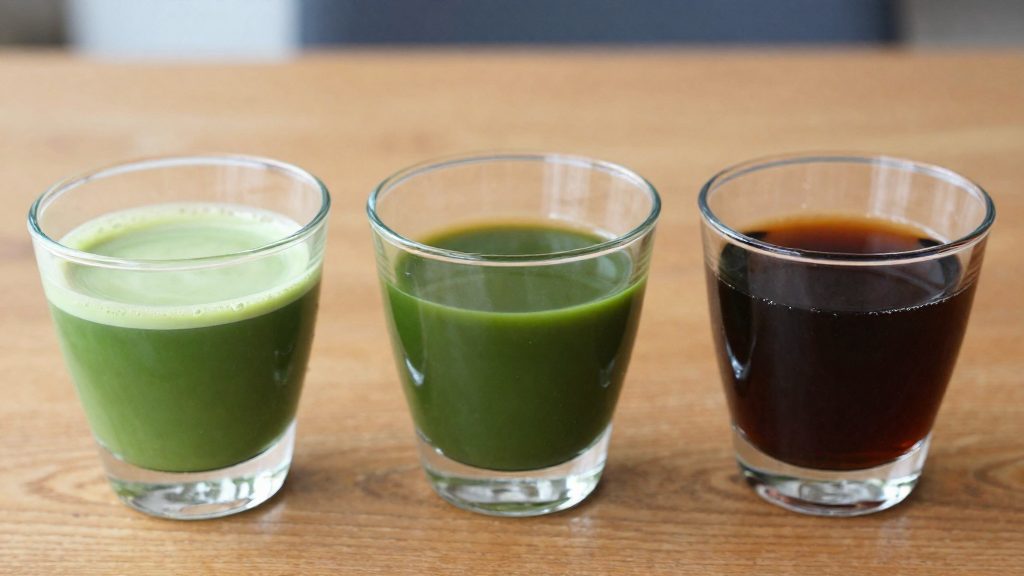
Does grade or harvest change the caffeine?
No verified figure in this article shows that grade or harvest season changes caffeine per gram. The grade-based numbers come from vendor claims, and they conflict with each other.
| Claim | Value (mg per gram) | Source | Status |
|---|---|---|---|
| Ceremonial or premium grades | 34 to 50+ | Vendor blog (unnamed here) | Unverified; no lab data cited |
| Other matchas | 12 to 25 | Separate vendor blog | Unverified; conflicts with the 34 to 50+ claim |
| Matcha in general | 19 to 44 | Healthline (2026), citing Kochman et al. (2020) | One range, not split by grade, shade or harvest |
| Breakaway Matcha (Canada) | 25 to 35 (implied) | Breakaway Matcha (2019) | Derived from a weight table, not stated on the page; no lab test cited |
The two vendor ranges point in opposite directions, so neither can be used to rank grades. The Healthline range is the only one tied to a named review, but it covers all matcha, so a grade name on a tin does not place that tin inside it.
Harvest timing and shade cover are not quantified in any cited source here. No figure links either factor to a caffeine value, so neither can be treated as a verified cause of the differences above.
What Health Canada says about daily caffeine
Health Canada sets daily maximums for caffeine intake, and these thresholds differ by group. For adults the recommended maximum is 400 mg per day. For people who are pregnant, planning pregnancy or breastfeeding, it is 300 mg per day. For children and adolescents, the limit is set by body weight at 2.5 mg per kg of body weight (Health Canada, 2026).
| Group | Health Canada recommended maximum |
|---|---|
| Adults | 400 mg per day |
| Pregnant, planning pregnancy or breastfeeding | 300 mg per day |
| Children and adolescents | 2.5 mg per kg of body weight |
To check matcha against these limits, divide the ceiling by the caffeine content per gram of powder. Matcha’s per-gram figures are not settled. Healthline cites about 19 to 44 mg per gram, linked to Kochman et al. (2020). The range is taken from Healthline, so consult the original review for its methodology. Some vendor blogs give higher or lower values that conflict with this range and with each other. Using the range as a rough guide:
| Group and limit | Grams of matcha to reach the limit (at 44 mg/g) | Grams of matcha to reach the limit (at 19 mg/g) |
|---|---|---|
| Adult, 400 mg | about 9 g | about 21 g |
| Pregnancy or breastfeeding, 300 mg | about 7 g | about 16 g |
For a child, the limit scales with weight. A 20 kg child has a 50 mg daily ceiling, which equals about 1.1 to 2.6 g of matcha across the same per-gram range.