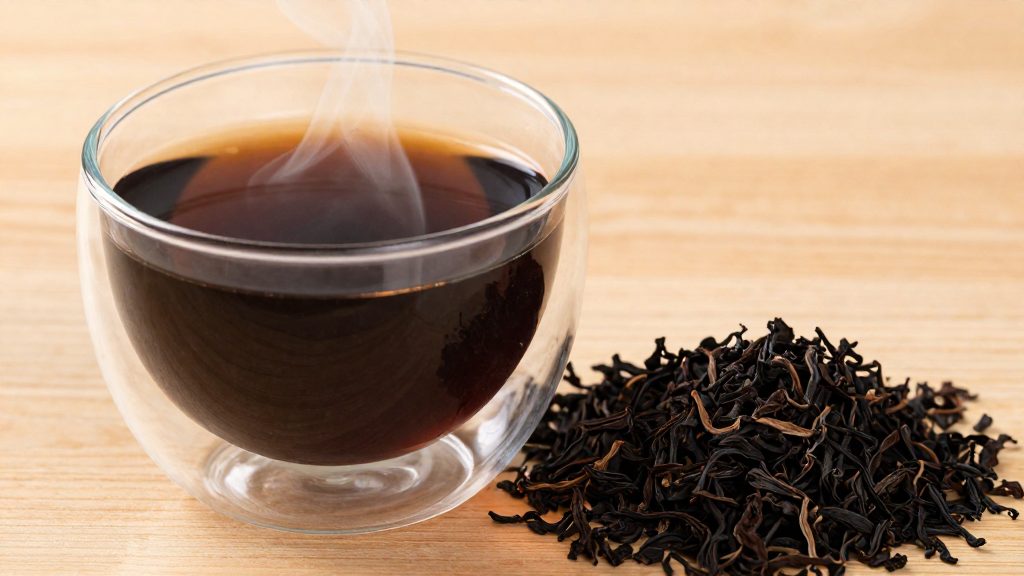
According to Nutrition Advance (2026-07-13), a 240 mL (8 oz) cup of black tea contains about 47 mg of caffeine on average. The site attributes this figure to the USDA, but that attribution is not confirmed. The figure is a typical average for that cup size, not a fixed amount, so the caffeine in a given cup can be higher or lower depending on how the tea is brewed. Use 240 mL as the reference volume when comparing this number with other sources.
How much caffeine is in a cup of black tea?
Using the 240 mL reference
- Measure the cup first. Compare figures only when they use the same volume. The 47 mg average applies to 240 mL, so a value given for a different volume does not translate directly.
- Read 47 mg as a reference point. It describes a typical cup and does not set a limit for any single cup.
Comparing with other published figures
Twinings Canada gives guidance of 40–76 mg per tea bag in a 200 mL cup for unflavoured black tea (Twinings Canada, 2026). That value is per bag and per 200 mL, not per 240 mL cup, so it cannot be placed directly beside the 47 mg average. The two upper ends also differ.
What does Health Canada say about tea caffeine?
According to Health Canada (2025-04-02), one cup of brewed black or green tea contains about 30 to 50 mg of caffeine. The cup size behind this figure is 8 oz (237 mL). Health Canada gives one range for both tea types, so its guidance does not separate black tea from green tea. The range is a general per-cup figure, not a value for a specific brand, leaf grade or brewing method.
| Item | Health Canada per-cup guidance |
|---|---|
| Beverage | Brewed black or green tea |
| Serving | One cup, 8 oz (237 mL) |
| Caffeine | About 30 to 50 mg |
Why do caffeine figures differ between sources?
Published caffeine values for black tea differ mainly because they measure different things: a per-bag value or a per-cup value, a 200 mL cup or a 240 mL cup, and a government publication or a brand’s own page. Twinings Canada gives 40–76 mg per tea bag in a 200 mL cup for unflavoured black tea, and 31–45 mg for flavoured black tea.
Cup volume: 200 mL versus 240 mL
Twinings Canada uses a 200 mL cup as its reference. Health Canada uses 8 oz (237 mL), and Nutrition Advance (2026-07-13) uses 240 mL. Volume changes the total. If two cups are brewed to the same strength, the 240 mL cup holds 20% more liquid and therefore 20% more caffeine than the 200 mL cup.
Per-bag and per-cup units
A per-bag range describes what one bag yields in one cup. A per-cup range describes the finished cup, whatever the bag or leaf amount.
Brand and blog figures
Brand and blog pages often publish their own ranges. Cup size, bag or leaf weight and test method are frequently not stated, so these figures cannot be compared reliably with the sourced values above.
| Source | Figure | Basis | Status |
|---|---|---|---|
| Twinings Canada | 40–76 mg (unflavoured black), 31–45 mg (flavoured black) | Per bag, 200 mL cup | Published guidance |
| Nutrition Advance (2026-07-13) | About 47 mg average | Per 240 mL cup | Attributed to USDA; attribution not confirmed |
| Bigelow (search snippet) | 30–60 mg | Basis not confirmed | Unverified |
| Art of Tea (search snippet) | 60–90 mg | Basis not confirmed | Unverified |
Does steeping time change caffeine in black tea?
Yes. Caffeine moves from the leaves into the water over time, so a longer steep gives more caffeine per cup. Nutrition Advance (2026-07-13) reports average values per 8 oz (240 mL) cup of black tea that rise with steep time. The three points below are approximate averages, not exact readings for any single cup.
| Steep time | Average caffeine per 8 oz (240 mL) cup |
|---|---|
| 1 minute | 22.8 mg |
| 3 minutes | 34.5 mg |
| 5 minutes | 39.4 mg |
The gain is not linear. Going from 1 to 3 minutes adds about 11.7 mg on average, while going from 3 to 5 minutes adds about 4.9 mg. Even the 5-minute average of 39.4 mg is below the 47 mg overall average quoted by the same source, so these figures are approximate and should not be treated as interchangeable.
Twinings Canada (2026) recommends steeping black tea for 3–5 minutes and states that longer steeping extracts more caffeine. That window falls within the times measured above.
Black tea vs green, oolong and white tea
Black, green, oolong and white tea all come from the same plant, Camellia sinensis. The main processing difference is oxidation level: black tea is fully oxidised, green tea is kept largely unoxidised, oolong falls between the two, and white tea is withered and dried with minimal handling. Caffeine content depends on the leaf and how it is brewed, so the type name alone does not predict the amount in the cup.
Health Canada (2025) gives one per-cup figure for brewed black or green tea together, so it does not publish a separate value for either type. This article does not give a sourced per-cup figure for oolong or white tea.
When comparing figures from any source, check these details:
- Steep time: stated time, or none given
- Leaf format: loose leaf or bagged, since the amount of leaf per cup varies
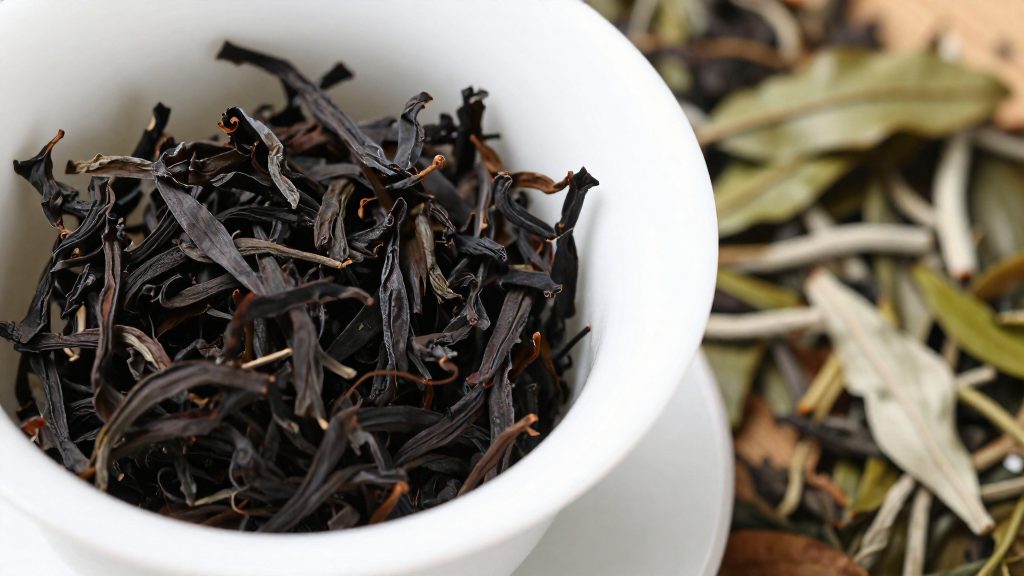
Loose leaf or tea bags: which has more caffeine?
Neither format has a fixed caffeine advantage. The amount in your cup depends mainly on how much dry leaf goes into the water and how easily that leaf releases its compounds. A bag and a spoonful of whole leaf can deliver different amounts even when both contain the same type of black tea.
Leaf size changes how quickly caffeine is released
Many tea bags contain fannings and dust, the small pieces left after whole leaves are sorted. Smaller particles have more surface area per gram, so water reaches their soluble compounds faster. During the same steep, a gram of fannings can give up caffeine more quickly than a gram of whole leaf. Particle size therefore affects extraction, but it does not decide the total dose on its own.
Leaf quantity per cup sets the dose
Loose-leaf tea is usually measured by volume, a scoop or teaspoon, and leaf density varies widely, so the dry weight per cup can differ a lot between teas. A bag holds a set amount, but that amount still varies between brands. Compare the formats by grams of dry leaf per cup, not by container type.
| Format | What sets the dose | How to check it |
|---|---|---|
| Loose leaf | Dry weight you measure into the pot or infuser | Weigh the leaf on a kitchen scale |
| Tea bag | Dry weight of the leaf inside each bag | Read the label or the manufacturer’s data |
Check the bag weight on the product label
Look for the net weight of the box or pouch and the number of bags, then divide to get the approximate grams per bag. Compare bags from the same brand and style.
Decaf and low-caffeine tea options
Decaffeinated black tea is the lowest-caffeine option among black teas. According to Nutrition Advance (2026-07-13), a cup of decaffeinated black tea contains under 2 mg of caffeine. Other sources may report slightly higher residual amounts, so treat this as an approximate figure. Other choices, such as herbal infusions, depend on their ingredients, so the label is the only reliable check.
| Option | Caffeine figure | What to check |
|---|---|---|
| Decaffeinated black tea | Under 2 mg per cup (Nutrition Advance, 2026-07-13) | Per-cup caffeine data from the manufacturer |
| Herbal infusion | No figure in this context | Ingredient list for black, green or other tea leaves |
Decaf black tea: reading the figure
- The under-2 mg value is a reference point, not a guarantee for every brand. Decaffeination methods and residual caffeine can differ between products.
Herbal infusions: the label test
- A product called “herbal” can still contain tea leaves. Blends may include black or green tea, so check the ingredient list before assuming the cup is caffeine-free.
- Plant-only ingredient lists do not state a caffeine figure.
Daily caffeine limits in Canada
Health Canada (2025) recommends a maximum daily caffeine intake that depends on the person’s group. The limits are set per day, so each cup of tea counts toward a daily total that also includes any other caffeine you consume.
| Group | Recommended daily maximum |
|---|---|
| Adults | 400 mg |
| Pregnant people, people planning pregnancy, and breastfeeding people | 300 mg |
| Children and adolescents | 2.5 mg per kg of body weight |
For children and adolescents, the limit scales with weight. For example, a child weighing 30 kg has a maximum of 75 mg per day (30 × 2.5).
How to check a day of tea against the limit
- Find the caffeine value for your tea.
- Multiply the number of cups by the caffeine per cup, using the same steep time and tea quantity you actually brew.
- Add any other caffeinated drinks or foods you eat that day.
- Compare the total with the limit for your group.