The gongfu tea-to-water ratio is expressed as grams of tea leaf per 100 ml of water. Tea Guardian’s measurements guide suggests starting at about 5.7 g per 100 ml, calculated from 8 g of leaf in 140 ml. Hey China gives a wider range of 3 to 6 g per 100 ml. Both figures are starting points to adjust from, not fixed rules.
What is the gongfu tea-to-water ratio?
To express any recipe in this form, use this formula: grams of leaf ÷ millilitres of water × 100.
| Source | Stated reference | Ratio per 100 ml |
|---|---|---|
| Tea Guardian (Leo Kwan) | 8 g of leaf in 140 ml, as a starting point to experiment from | About 5.7 g |
| Hey China | 3 to 6 g of leaf per 100 ml of water | 3 to 6 g |
Reconciling the two references: The 5.7 g figure from Tea Guardian falls inside Hey China’s 3 to 6 g range, near its upper end. Choosing a value within the range therefore fits both references. Each source presents its figure as a guide, so the exact amount depends on the leaf and on how strong you want the cup to be.
Comparison with Western-style brewing: Hey China contrasts the gongfu ratio with Western-style brewing at 0.5 to 2 g per 100 ml. The gongfu range holds more leaf per 100 ml than Western-style brewing, and Hey China pairs it with many short infusions.
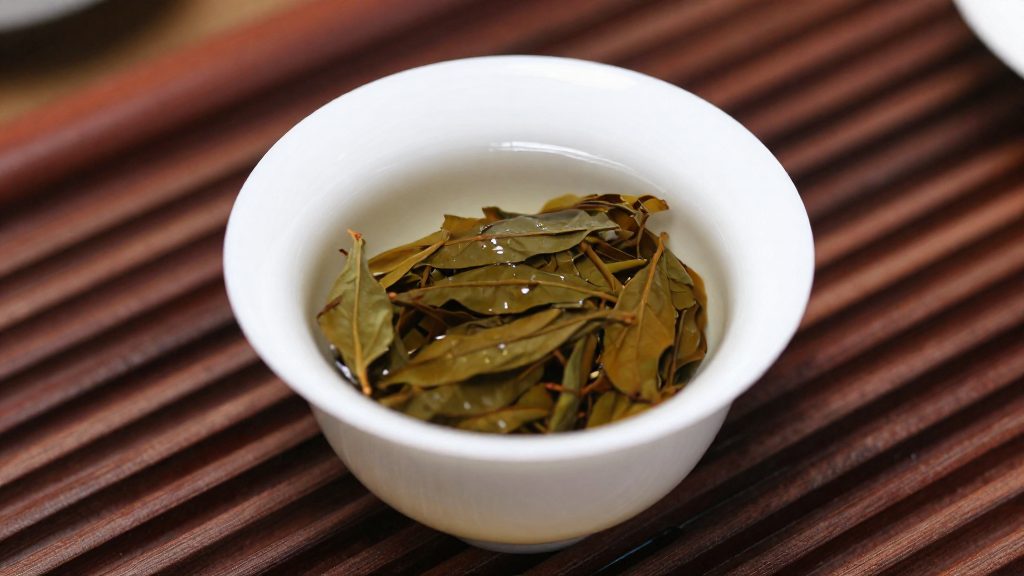
Grams per 100 ml by tea type
Blogs and forums give per-type ratio ranges for gongfu brewing. None of the figures below come from an official body or a published standard, so treat them as unverified starting points, not established values.
| Tea type | Reported ratio (blog or forum figure) | Status |
|---|---|---|
| Green and white | About 3–4 g per 100 ml | Unverified |
| Oolong and pu-erh | About 5 g per 100 ml | Unverified |
| Rolled oolong | 6–8 g per 100 ml | Unverified |
These unverified reports put green and white at the lower end and rolled oolong at 6–8 g, partly above Hey China’s 3 to 6 g range. The sources I checked give no per-type values, so treat this pattern as unconfirmed.
Why gongfu uses more leaf than Western brewing
Gongfu brewing uses a higher leaf charge per volume of water than Western-style steeping because it runs several short infusions from the same leaves.
| Method | Leaf per 100 ml | Source |
|---|---|---|
| Western-style | 0.5 to 2 g | Hey China (2020) |
| Gongfu, stated range | 3 to 6 g | Hey China (2020) |
| Gongfu, starting point | about 5.7 g (8 g in a 140 ml gaiwan) | Tea Guardian (Leo Kwan) |
Why short steeps need a denser charge
A Western steep keeps the leaf in contact with water for longer, so the cup can build strength over time. A gongfu steep is much shorter, so each one extracts less from the leaf. A higher leaf charge supplies enough material for every short steep to produce a cup with body.
Leaf expansion and water contact per steep
Each steep gives the water a brief contact window with the leaf. As the leaves unfurl over the first steeps, they expose more surface to the water. The denser charge compensates for the shorter contact in each steep.
How much tea fits in a gaiwan or small teapot?
Calculate the charge from the vessel’s working volume, the amount of water it holds when you brew, not the rated capacity printed by the maker. Fill the vessel to the level you brew at, pour that water into a measuring jug, and record the millilitres. Use that figure in the formula below.
Converting grams per 100 ml into a full-vessel charge
Use this formula:
grams = grams per 100 ml × working volume in ml / 100
Tea Guardian (Leo Kwan), on an undated page, suggests 8 g in a 140 ml gaiwan, about 5.7 g per 100 ml. Hey China (2020) gives 3 to 6 g per 100 ml for gongfu brewing. The published values differ, so treat the Hey China range as a bracket rather than a single target.
| Ratio (g per 100 ml) | Source | Charge at 100 ml working volume | Charge at 140 ml working volume |
|---|---|---|---|
| 3.0 | Hey China (2020), lower bound | 3.0 g | 4.2 g |
| 5.7 | Tea Guardian (Leo Kwan), starting point | 5.7 g | 8.0 g |
| 6.0 | Hey China (2020), upper bound | 6.0 g | 8.4 g |
Rolled versus whole leaf
Bulk density varies with leaf cut, so the same weight can occupy a different volume. A charge that fills a vessel neatly for one tea may sit low or overflow for another. Weigh the charge, place it in the vessel, and note how it fills the space before the first infusion.
Why a scale beats a spoon
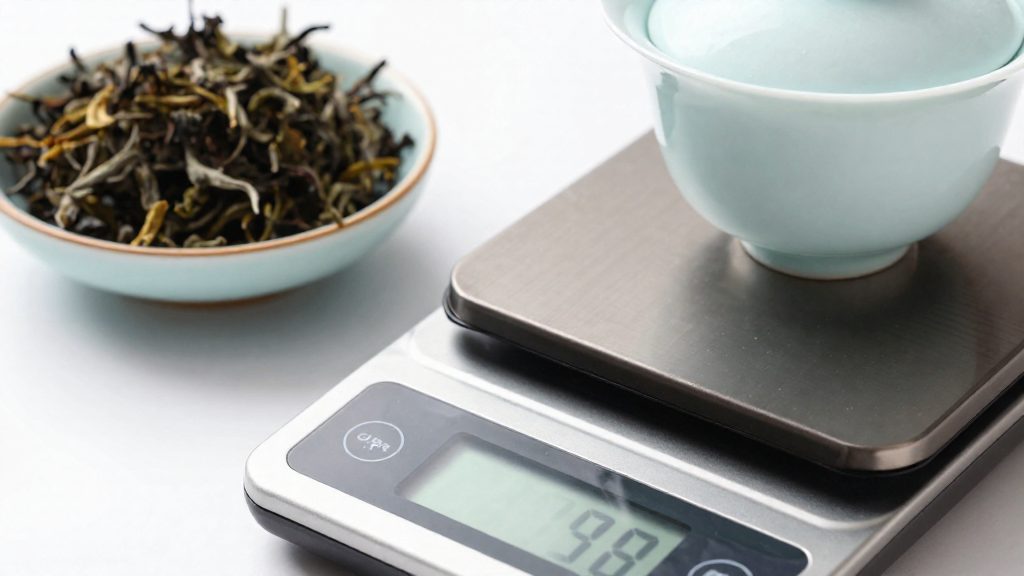
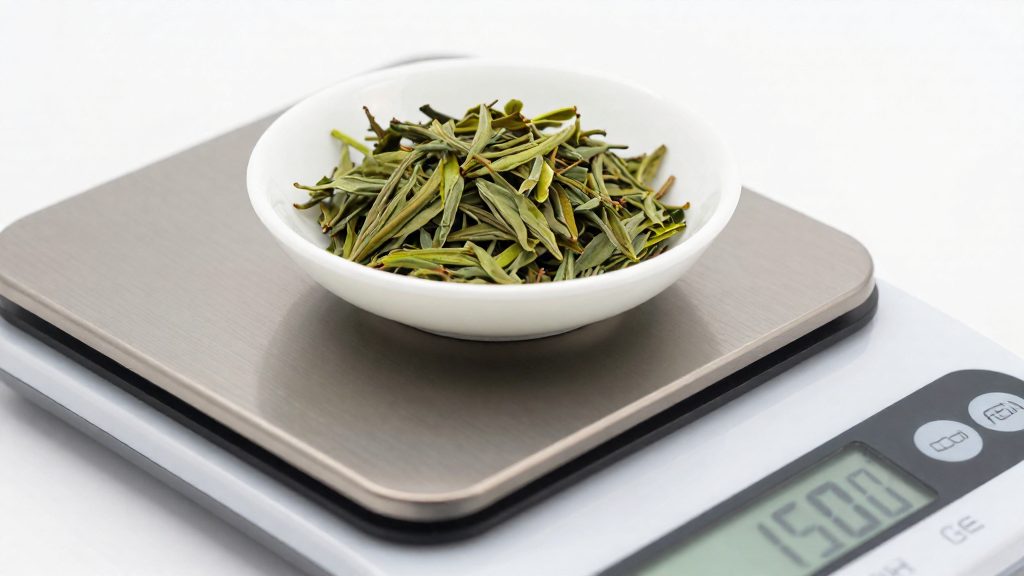
A spoon measures volume, and the mass of leaf that fills a given volume changes with the tea. Weighing in grams makes a gongfu session repeatable: the same mass of leaf in the same vessel gives the same starting point each time.
Volume spoon variance across tea densities
Leaf density varies by style. A tightly rolled oolong, a compressed pu-erh cake broken into pieces, and a light, loosely curled green tea can each fill one spoon with noticeably different masses. Matcha changes with how it has settled and been packed. Two spoonfuls of one tea can therefore brew at different strengths, and a spoon that suited one tea will not carry over to another.
Scale resolution
Scales differ in their smallest displayed step. A scale that reads in whole grams rounds small adjustments, so a dose a little higher or lower may show the same figure. A finer step gives more control when you change the dose between sessions. Check the display increment in the manufacturer’s manual before choosing a model.
Tare and vessel weight
The vessel adds mass, so zero the scale with the vessel in place and weigh each component in turn:
| Step | Action | Display shows |
|---|---|---|
| 1 | Place the empty gaiwan or pitcher on the scale and press tare (or zero) | 0 |
| 2 | Add dry leaf | Leaf mass only |
| 3 | Press tare again with the leaf inside | 0 |
| 4 | Pour in water | Water mass only |
How do you adjust the ratio to taste?
Adjust the ratio by changing only the leaf mass, and keep the water volume, water temperature and infusion time fixed. Hey China gives a gongfu range of 3 to 6 g of leaf per 100 ml of water. Tea Guardian’s measurements guide (Leo Kwan) suggests starting with 8 g of leaf in a 140 ml gaiwan, about 5.7 g per 100 ml. Brew at that starting point, taste the cup, and then move the leaf mass in small steps.
Change one variable per session
- Brew at your starting ratio and write down the leaf mass, vessel volume and infusion time.
- Taste the infusion and identify the most prominent fault.
- Change only the leaf mass for the next session. Keep the vessel and every other setting identical.
- Compare the two cups before making any further change.
Because each session tests one change, you can tell which adjustment caused the difference in the cup.
Read the taste signals
| Taste signal | Direction | Adjustment |
|---|---|---|
| Bitterness | Reduce | Use less leaf next session |
| Astringency (dry, puckering finish) | Reduce | Use less leaf next session |
| Thin body | Add | Use more leaf next session |
| Weak aroma | Add | Use more leaf next session |
Bitterness and astringency can indicate too much leaf for the chosen vessel, though temperature and infusion time also play a part. Thin body and weak aroma can indicate too little leaf. Increase or decrease in small steps rather than making a large jump, so you can see where the cup balances.
Short infusions: timing as you go
Because each pour is short, you set timing from one infusion to the next and end the session when the cup stops giving you enough flavour.
Preheating the vessel
Hey China (2020) advises preheating the vessel before the first infusion. Fill the gaiwan or teapot with hot water, swirl it to warm the walls, and pour the water out before adding the leaf. Pouring that water into the cups warms them too.
Stepping through successive infusions
Use the brewing instructions on your tea’s packaging for the first infusion, then adjust by taste.
| Stage | What you do | Adjust when |
|---|---|---|
| First infusion | Pour off the water quickly and taste the liquor | The cup is weak: extend the next pour slightly |
| Middle infusions | Keep each pour short and repeat | The flavour is balanced: keep the timing steady |
| Later infusions | Lengthen each pour gradually | The cup thins or the leaf stops releasing aroma: consider ending |
If you extend the timing and the cup turns harsh, go back to the previous timing for the next pour.
Tasting cues for ending a session
End the session when these signs appear:
- Thin liquor: the colour is pale and the mouthfeel is watery.
- Faint aroma: the lid or the empty vessel releases little scent after a pour.
- Rising bitterness or astringency: the taste turns harsh even though you kept the pour short.