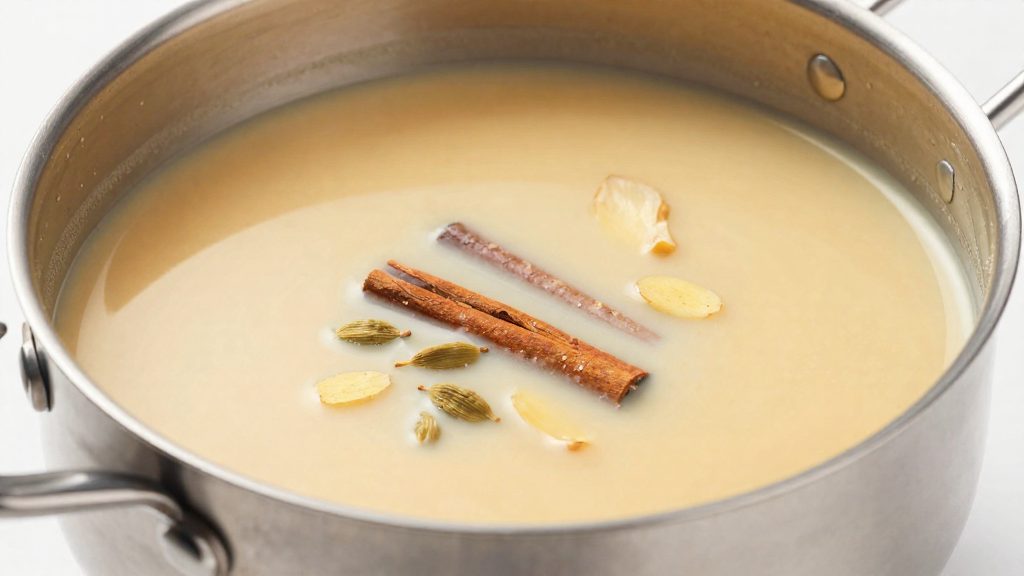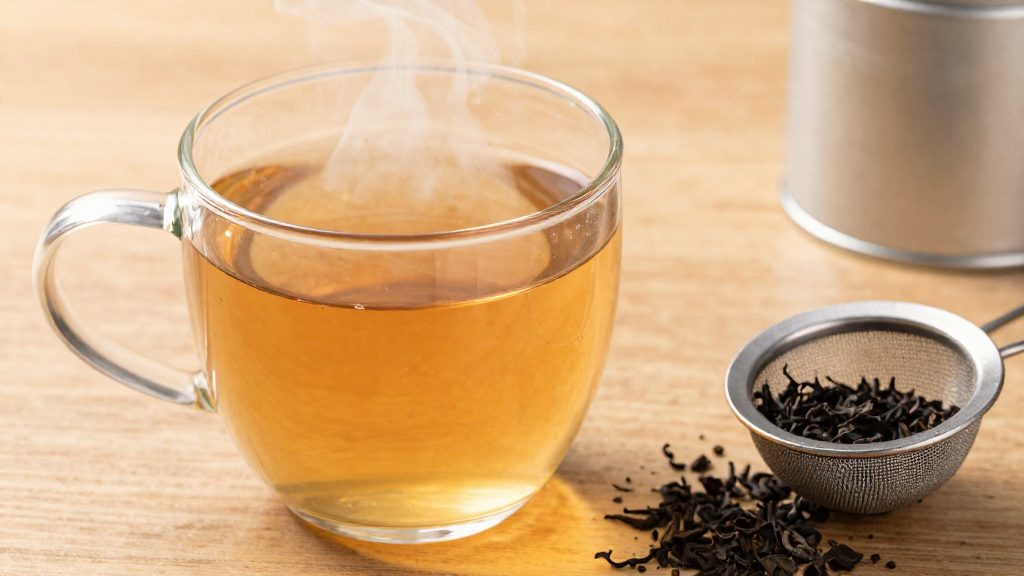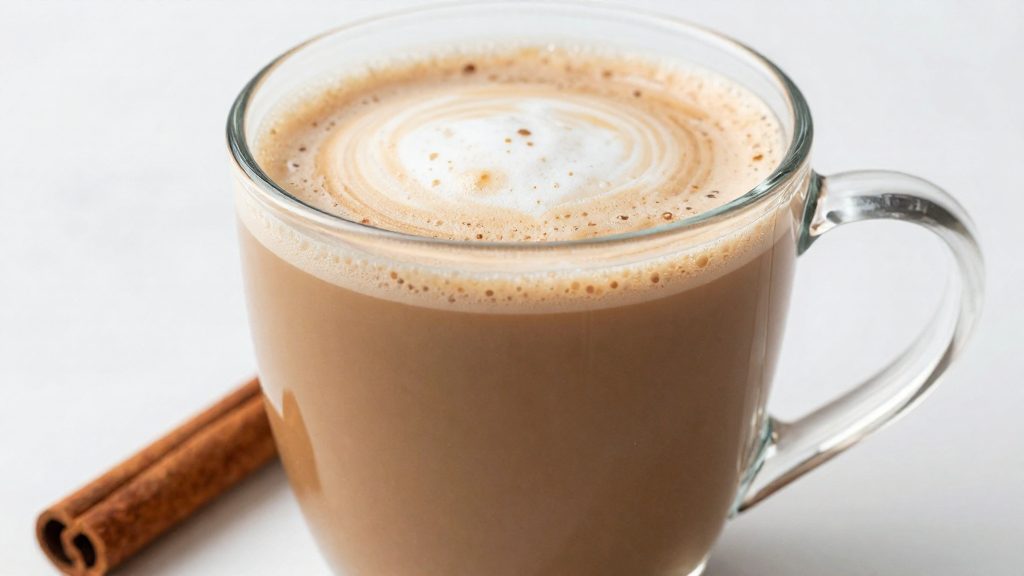
A dirty chai is a chai latte with one 1 oz (30 mL) espresso shot added. The standard build pairs ½ cup chai concentrate with ½ cup milk, then adds the espresso. Remove the shot and the drink becomes an ordinary chai latte made from the same concentrate and milk. The espresso is therefore the only element that separates the two drinks.
What makes a chai latte ‘dirty’?
A dirty chai is defined by its espresso shot, not by any change to the spiced tea base. The shot is the coffee component, and it is the element a plain chai latte lacks.
Standard build
| Component | Amount | Role in the drink |
|---|---|---|
| Chai concentrate | ½ cup | Spiced tea base |
| Milk | ½ cup | Dilutes and softens the concentrate |
| Espresso | 1 oz (30 mL) | The “dirty” element |
According to The Tea Cup of Life, the concentrate and milk are paired 1:1 by volume, and one 1 oz (30 mL) espresso shot completes the drink.
Why the shot is the dirty element
- The shot is the only coffee component.
- The shot changes the flavour profile. Espresso adds coffee character on top of the spices and black tea in the concentrate. This is the reason the drink is called “dirty.”
Difference from an ordinary chai latte
| Element | Dirty chai | Ordinary chai latte |
|---|---|---|
| Chai concentrate | ½ cup | ½ cup |
| Milk | ½ cup | ½ cup |
| Espresso | 1 oz (30 mL) | None |
Because the two drinks share their tea base and milk, any substitute for the espresso must be judged against this plain chai latte.
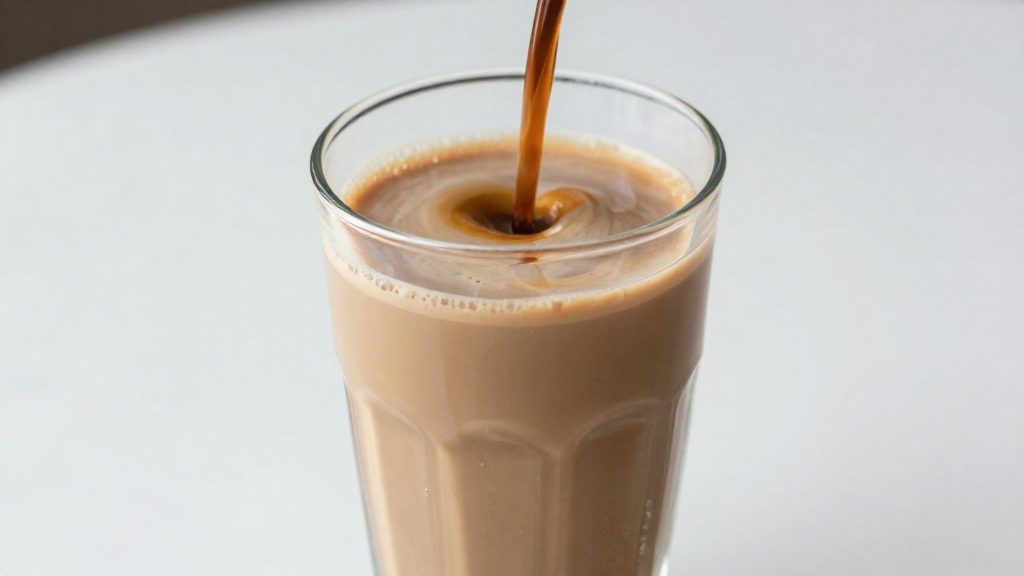
Can you make a dirty chai without espresso?
You can make a version without an espresso shot, but the only options verified in the sources are coffee-based stand-ins. No tea-only substitute could be verified, so a drink with no coffee at all is simply a plain chai latte. Home Grounds (2026) names three stand-ins: a moka pot or AeroPress brew of 2 oz (about 60 mL), or 1 tsp of instant espresso powder dissolved in 2 oz of hot water. Each one adds a coffee note to the chai, so none of them is a tea-only substitute.
| Stand-in | Amount | Preparation |
|---|---|---|
| Moka pot coffee | 2 oz | Brewed in a moka pot, poured into the chai concentrate and milk |
| AeroPress coffee | 2 oz | Brewed in an AeroPress, poured into the chai concentrate and milk |
| Instant espresso powder | 1 tsp | Dissolved in 2 oz hot water, then combined with the chai and milk |
Why these taste thinner: Home Grounds (2026) notes that these coffee stand-ins taste thinner than espresso. A moka pot or AeroPress brew is less concentrated than an espresso shot, so the coffee flavour sits more lightly under the spices. Instant espresso powder gives a more uniform flavour but still lacks the body of a shot.
Working method:
- Brew or dissolve the coffee component first, so it is ready when the chai is poured.
- Add it to the chai and milk in the same way you would add the shot.
- Taste before adjusting sugar, since the lighter coffee changes the balance.
Limits: If you want a drink with no coffee at all, make a plain chai latte: the chai concentrate and milk without any added shot. Check the label of any instant powder you buy, since the product itself will state whether it contains coffee.
Ingredients for a strong chai base
Because the coffee stand-ins taste thinner than a true espresso shot, the concentrate carries more of the drink, so the choice of black tea and spices matters. Home Grounds (2026) builds its concentrate from six spices (cinnamon, cardamom, cloves, peppercorns, fennel and ginger) and a black tea base. Oh, How Civilized (2026) uses pre-blended chai tea bags as a shortcut. Both are food blogs rather than tea specialists.
Black tea: loose Assam or bags
Home Grounds (2026) lists two equivalent options for the same batch:
- 4 black tea bags: the count is fixed, so the strength is set by the bag count.
- 4 tsp loose Assam: the amount is adjustable by spoonful, which gives more control over strength.
If you use bags, confirm on the label that they contain black tea. Chai blends can include other ingredients, and a pre-spiced blend already fixes the spice profile for you.
Spice selection
Each spice adds a different note to the base. The flavour descriptions below are general tasting terms.
| Spice | Usual form | Flavour contribution |
|---|---|---|
| Cinnamon | Stick or ground | Warm, woody |
| Cardamom | Whole pods | Aromatic, citrusy |
| Cloves | Whole | Pungent, intense |
| Peppercorns | Whole | Sharp, peppery |
| Fennel | Seeds | Sweet, anise-like |
| Ginger | Fresh slices or ground | Hot, fresh |
As general guidance (not from the cited sources), use a small number of strong spices, such as cloves and peppercorns, so they don’t overpower the tea. Cracking cardamom pods exposes more of the seeds to the liquid.
Whole versus ground spices
The form of each spice determines how quickly it gives up flavour:
- Whole spices release flavour gradually, giving a more controlled base.
- Ground spices release flavour faster and leave fine particles that cloud the concentrate. They give a stronger, less predictable base that is hard to correct once brewed.
How to brew the chai concentrate
The concentrate is made in two heat stages: the spices simmer first, then the tea steeps after the pot leaves the heat. According to Home Grounds (2026), simmering the spices in 2½ cups water for 10 minutes, then steeping four black tea bags off the heat at about 203°F (95°C) for 4 minutes, yields about 2 cups of concentrate. That is enough for four drinks.
| Stage | Method | Figure |
|---|---|---|
| Simmer | Spices in 2½ cups water over heat | 10 minutes |
| Steep | Four black tea bags added after removing the pot from the heat | 4 minutes at about 203°F (95°C) |
| Yield | Liquid after straining | About 2 cups |
Bring the water and spices to a simmer and hold it there for the full 10 minutes. Then turn off the heat before adding the tea. Home Grounds (2026) steeps the tea off the heat at about 203°F (95°C).
Remove the tea bags, then strain the liquid through a fine sieve to catch the spice fragments. The strained concentrate is the base for the drink. Dividing the 2 cups among four drinks gives ½ cup per serving.
Hot dirty chai latte steps
A hot dirty chai is built in layers: chai concentrate first, then milk, then the espresso element on top.
Pour order
| Step | Element | Standard amount |
|---|---|---|
| 1 | Chai concentrate, poured into the cup | ½ cup |
| 2 | Milk, heated and frothed | ½ cup |
| 3 | Espresso element, added last | 1 oz (30 mL) |
Pour the concentrate first, then the milk, then the espresso element so it sits on top of the drink.
Frothing milk to latte texture
Heat the milk and froth it until it forms a fine microfoam: a smooth, glossy foam with small bubbles, rather than large, stiff bubbles. The single-cup shortcut below specifies whole milk for this step. Pour the frothed milk into the concentrate, letting the foam settle on top.
Single-cup shortcut
According to Oh, How Civilized (2026), this single-cup shortcut makes a 16-oz drink from a small batch of concentrate:
- According to Oh, How Civilized (2026), place 3 chai tea bags in ⅓ cup of water at 200°F (93°C).
- Cover and steep for 5 minutes.
- Stir in 1 tbsp sugar.
- Add about 1½ cups of frothed whole milk.
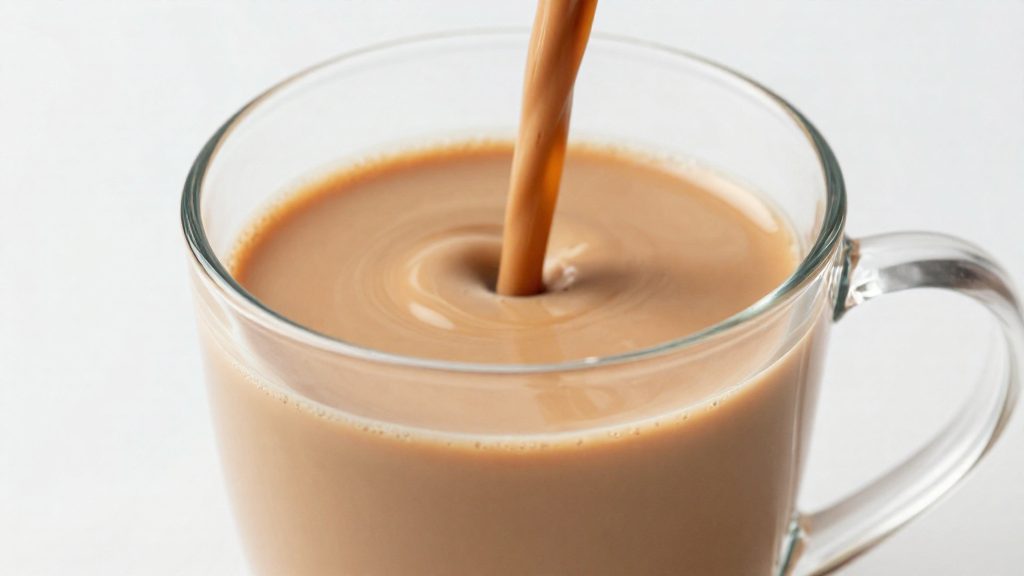
Iced version
An iced chai built on concentrate is assembled cold. Chill the concentrate completely before it meets ice. Warm liquid melts ice quickly and thins the drink before the first sip.
Chilling the concentrate
- Refrigerate until the concentrate is fully cold, not just cooled. Check that it is cold to the touch before pouring.
Ice melt and dilution
Ice dilutes the drink as it melts, so brew the concentrate stronger than you would drink it hot. Taste after the first few sips and adjust the concentrate or milk from there.
Glass size and ice quantity
Check the volume before you add ice. The quick small-batch method (Oh, How Civilized, 2026) uses ⅓ cup of brewed tea and about 1½ cups of frothed milk for a 16-oz drink. Those two amounts already total about 1⅚ cups, which leaves little room for ice. For an iced version, use a larger brew and less milk, or a glass that holds more than 16 oz.
- Glass: choose one with headroom above the 16-oz liquid volume so the ice and milk do not overflow.
- Ice: fill the glass to a consistent level so the finished drink reaches the same strength every time.
- Order: pour the cold concentrate over the ice first, then add the milk.
How much caffeine is in it?
Caffeine in a plain chai latte made without any coffee comes only from the tea; the coffee stand-ins above add their own caffeine. The blog figures below are estimates, not lab measurements, and they vary with serving size and recipe.
| Item | Caffeine figure | Source and status |
|---|---|---|
| Espresso shot, 1 oz (30 mL) | About 64 mg | Oh, How Civilized (2026), blog estimate |
| Chai, per ounce | About 10 mg | Oh, How Civilized (2026), blog estimate |
| Chai alone, per drink | About 47 mg (serving size not stated) | Home Grounds (2026), blog estimate |
| Single dirty chai, with espresso | About 110 mg | Home Grounds (2026), blog estimate |
| 16-oz dirty chai, with espresso | Roughly 120 to 180 mg | Oh, How Civilized (2026), blog estimate |
The blog figures use different bases and cannot be compared directly: one gives about 10 mg per ounce of chai, and the other gives about 47 mg per drink with no serving size stated. Do not multiply the per-ounce figure by the full volume of a milk-based drink. Both come from food blogs, not from a primary source, so treat them only as rough, unverified estimates.
Variables that shift the total
- Tea variety: Caffeine content differs between black, green and other teas, and between individual black teas.
- Serving size: The 10 mg per ounce figure means a larger cup holds more caffeine. A 16-oz drink contains far more than a single ounce.
- Leaf or bag quantity: More leaf or more bags in the same water raises the caffeine per cup.
Checking the label
- Look for a caffeine line on the tea packaging or the manufacturer’s website.
- Note the serving size listed, since many labels use a per-cup or per-gram basis.
- If the label gives no caffeine figure, contact the manufacturer directly.
Storage and make-ahead tips
The chai concentrate is the component you can prepare in advance. According to Home Grounds (2026), the refrigerated concentrate keeps up to four days, so one batch can cover several weekday drinks. Cool it, then refrigerate it in a sealed container.
Portioning concentrate for weekday assembly
You can divide the concentrate before it goes in the fridge or measure it into a clean jar in advance. Keep the jar in the same spot so the measure is always the same.
- Portion size: ½ cup concentrate per drink.
- Milk: prepare it fresh each day, separate from the concentrate.
- Assembly: measure the concentrate, warm it if needed, then add frothed milk.
Reheating concentrate gently before mixing with milk
Cold concentrate can be used straight from the fridge, but warming it first gives a more even cup. Pour only the ½ cup you need into a small saucepan or microwave-safe mug. Heat it over low heat or in short microwave bursts, stirring between bursts, until it is warm. Do not reheat the whole container each morning. Repeated heating and cooling of the same batch shortens its usable life, so portion first and reheat only the portion you will drink.