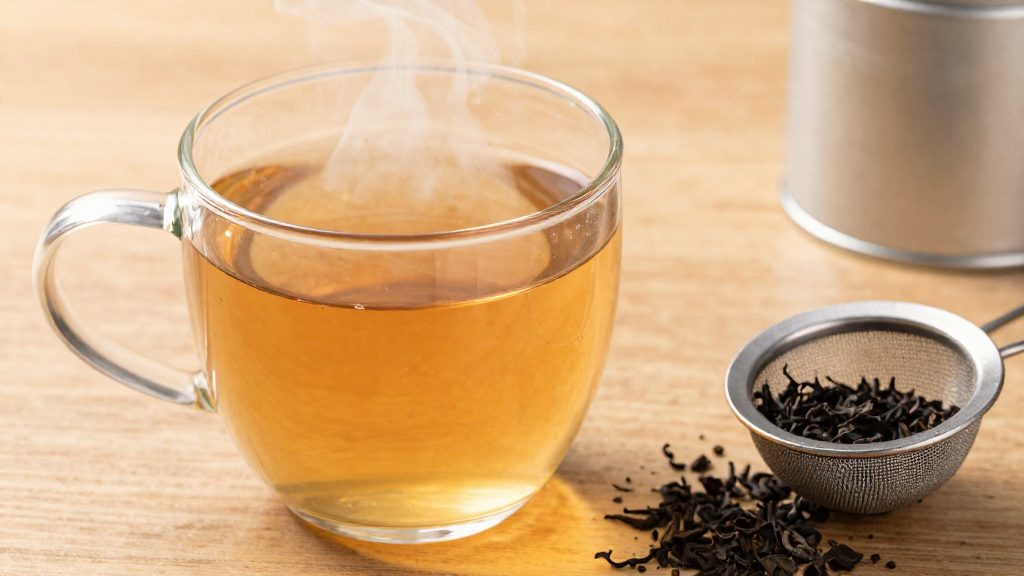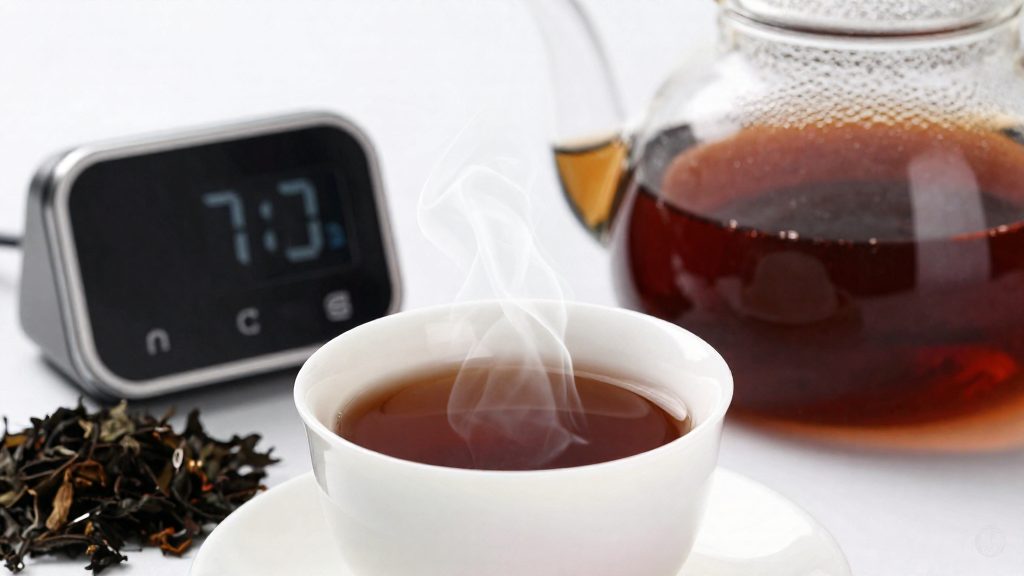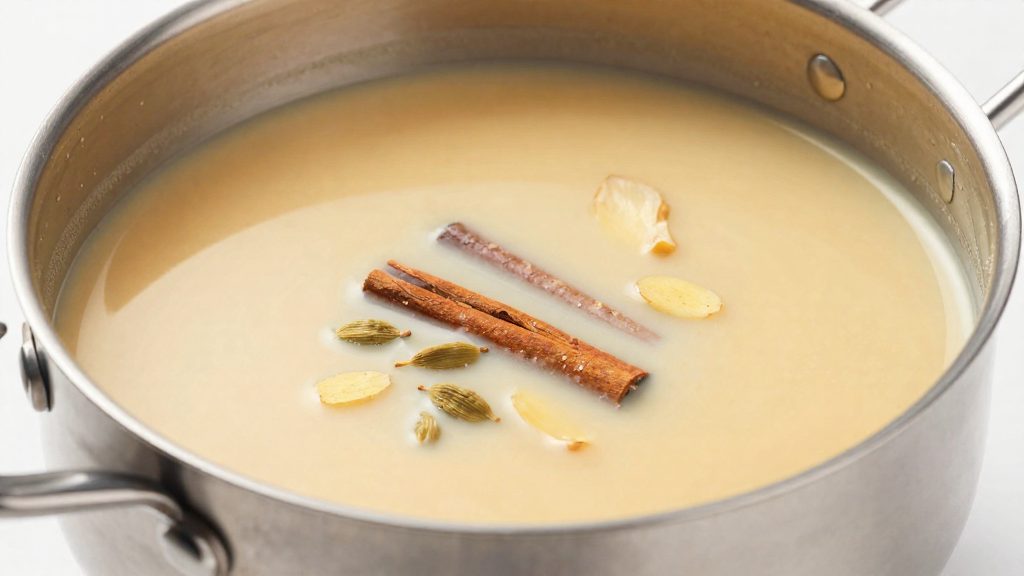
Masala chai is black tea simmered with milk and whole or cut spices in one pot, so the tea, spices and milk are cooked together. According to Imbibe (2022), a homemade version uses 4 cups of water, 1 cup of whole milk and 2 tablespoons of Assam tea or 4 black tea bags for four servings. Western chai concentrates and syrups are made in advance and diluted, so their flavour is set before they meet the milk. That difference in method, rather than a single fixed recipe, separates brewed masala chai from those products.
What Makes Masala Chai Authentic?
Tea boiled with milk and spices
Masala chai is cooked, not steeped in a separate cup. The spices are simmered in water first, and the milk and tea go in afterwards. The two published methods below both keep the tea in contact with the milk and spices.
| Step | Imbibe (Jaisinghani recipe, 2022) | Rishi Tea & Botanicals (prepared blend) |
|---|---|---|
| Water | 4 cups | 1 cup |
| Milk | 1 cup whole milk | 1 cup milk |
| Tea | 2 tablespoons Assam or 4 black tea bags | 2 tablespoons of the blend |
| Spices | 1 tablespoon ginger purée, 8–10 lightly crushed green cardamom pods, ½ teaspoon lightly crushed black peppercorns | Cinnamon, cardamom, ginger, black pepper and cloves, included in the blend |
| Heat | Spices simmer 10–12 minutes; milk and tea added; tea simmers 20–30 seconds, then steeps covered off heat for 3–4 minutes | Bring to a boil, simmer 5 minutes, sweeten to taste, strain |
The quantities apply only to each source’s own recipe. Neither is a universal milk-to-water ratio or brewing time.
Regional and household variations
Spice combinations, milk ratios and brewing sequences differ between published recipes, and no single authentic formula is established. Imbibe’s version relies on ginger, green cardamom and black pepper, while Rishi’s blend adds cinnamon and cloves. Serving also varies: Tetley’s US recipe allows honey, milk or cream to taste and can be served hot or chilled. Treat any recipe as one version, then adjust spices, milk and sweetener to your own taste.
Why concentrates and syrups differ from brewed chai
A brewed chai extracts flavor during simmering, so the spices and tea release their aromas into the milk in the pot. A concentrate or syrup is prepared earlier and diluted, which means the balance of its ingredients is fixed before you use it. Because of this, a brewed chai’s strength and sweetness depend on the quantities you choose in the pot. Check the manufacturer’s label for dilution instructions before adding milk or water to any concentrate.
Which Black Tea Works Best?
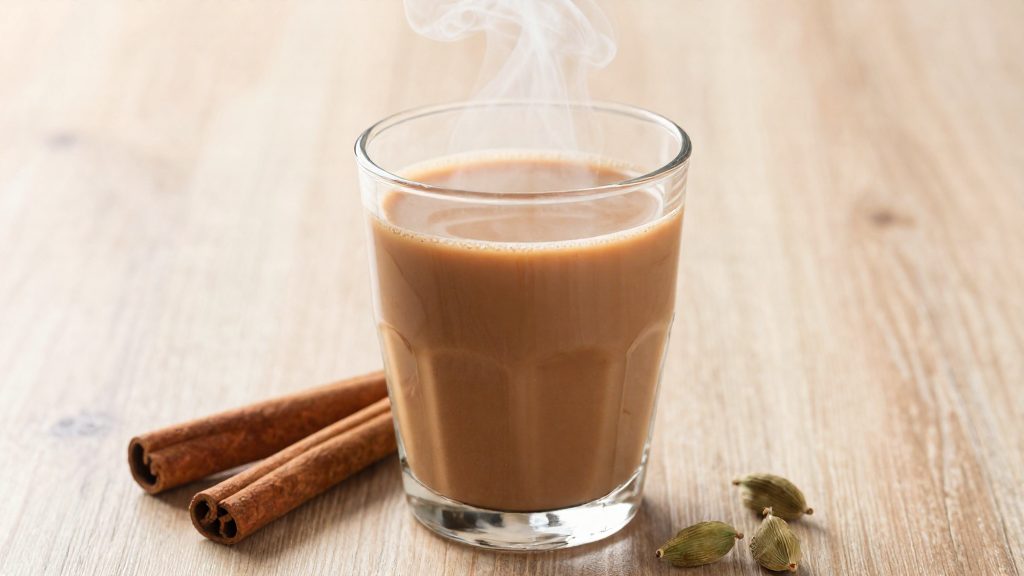
For boiled masala chai, CTC black tea is the style the sources name as the traditional choice. Serious Eats (2023-10-25) describes it as producing a robust, malty brew suited to boiling, which matters when the tea simmers in the same pan as the spices and milk. Imbibe’s recipe by Anita Jaisinghani (2022-08-24) calls for Assam tea instead, so Assam is the leaf to pick if you follow that method.
Check the pack label for the words “CTC.” If it says CTC, expect the robust, malty character described for boiling. If it does not, judge the tea as a general black tea and taste the first cup, since a stronger base is what carries spices and milk.
The two descriptions overlap for Assam. Imbibe names Assam, and Serious Eats ties the malty profile to CTC leaf. An Assam sold as CTC fits both descriptions. An Assam sold in another cut style may not, so read the label before assuming its character.
Strong black tea is the base for milk-based chai in both recipes. Imbibe adds milk to the spiced water before adding the tea.
| Leaf option | Stated fit | Source |
|---|---|---|
| CTC black tea | Traditional chai choice; robust, malty brew suited to boiling | Serious Eats, 2023-10-25 |
| Assam tea | Named as the tea in Jaisinghani’s masala chai recipe | Imbibe, 2022-08-24 |
Choose Your Chai Spices
Masala chai starts with black tea and a set of aromatic spices, and the spice mix is where recipes differ most. The core spices are green cardamom, ginger, black pepper, cinnamon, and cloves. Rishi Tea & Botanicals lists all five in its masala chai blend. Anita Jaisinghani’s recipe, published by Imbibe, uses green cardamom, ginger, and black pepper with measured amounts. Because recipes vary, treat these proportions as a starting point rather than a fixed formula.
Measured Spices in the Imbibe Recipe
| Spice | Form | Amount (Imbibe, 2022-08-24) |
|---|---|---|
| Green cardamom | Lightly crushed pods | 8–10 pods |
| Ginger | Purée | 1 tablespoon |
| Black pepper | Lightly crushed peppercorns | 1/2 teaspoon |
Cinnamon and Cloves
Cinnamon and cloves appear in the Rishi blend (Rishi Tea & Botanicals), but no measured amount is given for them in that context. Rishi’s quantities apply to its prepared blend, not to a homemade mix. Add small amounts of each to your first batch, then adjust on later brews.
Whole Versus Preground Spices
According to Serious Eats (2023-10-25), whole spices generally keep their aromas longer than preground spices, and it recommends them for a more aromatic chai. Buy pods, sticks, and peppercorns whole, store them in a sealed container, and crush only the amount each batch needs.
Lightly Crushing Pods and Peppercorns
Imbibe specifies lightly crushed cardamom pods and black peppercorns. Press each pod with the flat of a knife or in a mortar until the casing splits and the seeds show. This exposes the seeds to the simmering liquid without grinding them to powder, which is not what the recipe calls for.
Ingredients, Ratios, and Simple Tools
For four servings, Imbibe’s homemade recipe by Anita Jaisinghani (August 2022) uses four cups of water, one cup of whole milk, and two tablespoons of loose Assam tea, or four black tea bags. The batch is one cup of milk to four cups of water, which gives a 1:4 milk-to-water ratio for this recipe only.
| Component | Amount for four servings |
|---|---|
| Water | 4 cups |
| Whole milk | 1 cup |
| Loose Assam tea | 2 tablespoons |
| Black tea bags (alternative) | 4 bags, one per serving |
Loose leaf or bags: Imbibe permits four tea bags in place of the loose tea. Serious Eats (October 2023) discourages bags for its boiling method. Both positions are published, so choose the format that suits the method you follow.
Tools: Imbibe lists a saucepan and strainer as the only tools for its recipe. The strainer separates the leaves, or the bags, from the liquid before serving.
Prepared blends: Rishi Tea & Botanicals specifies 2 tablespoons of its prepared blend, 1 cup of water, and 1 cup of milk. Those amounts belong to that blend and do not replace the four-cup Imbibe batch.
Plant-based milk: This section does not verify how plant-based milks behave in this batch. Check the carton for heating instructions before substituting.
How to Make Masala Chai
The stovetop method below follows Jaisinghani’s recipe: simmer the spices in water, add milk, add the tea, simmer briefly, then steep off the heat under a lid. Each stage has a distinct job: the spices release flavour into the water, the milk rounds out the body, and the short covered steep extracts the tea without drawing out bitterness.
Step 1: Simmer the Spices
Combine the water with the spices in a saucepan, bring to a boil, then reduce the heat to the lowest setting, cover, and simmer for 10–12 minutes before adding milk or tea. In Jaisinghani’s recipe the spice mixture includes 1 tablespoon ginger purée, 8–10 lightly crushed green cardamom pods, and 1/2 teaspoon lightly crushed black peppercorns.
Step 2: Add the Milk
Once the spiced water has simmered, add the milk and a few sprigs of mint or basil; bring the mixture just to a boil before adding the tea, watching closely for boil-over. Jaisinghani’s recipe uses 1 cup whole milk for 4 cups of water. Keep the heat moderate and stay beside the pan: milk-containing chai can overflow the saucepan as it approaches a boil (Imbibe, 2022-08-24).
Step 3: Simmer the Tea
Add the black tea and let the mixture simmer for 20–30 seconds. This short boil is the only time the tea sits in the hot liquid with the heat on.
Step 4: Steep Off the Heat
Remove the pan from the heat, cover it, and steep for 3–4 minutes. Covering the pan keeps the aroma in the liquid. Strain the chai into cups, then serve.
| Stage | Duration | Ingredients added |
|---|---|---|
| Spice simmer | 10–12 minutes | Water, ginger purée, cardamom, black peppercorns |
| Milk addition | Until heated, watching for boil-over | Whole milk |
| Tea simmer | 20–30 seconds | Black tea (Assam or CTC) |
| Covered steep | 3–4 minutes, off heat | None |
The times and quantities above come from Jaisinghani’s recipe only.
Adjust Milk, Sweetness, and Spice
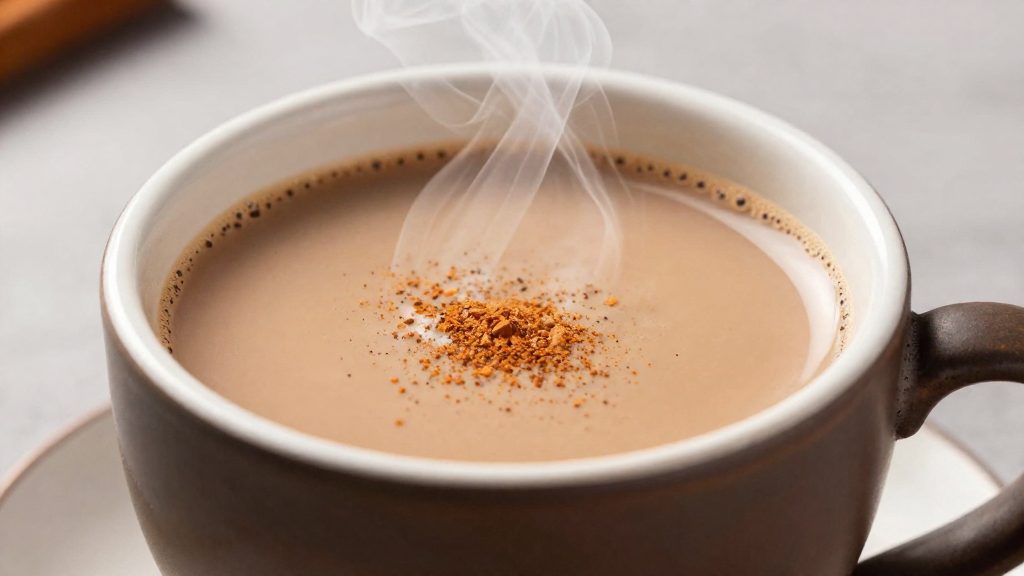
Once the base brew is set, three variables can be tuned without changing the method: the milk, the sweetener, and the amounts of pepper and cardamom. The sources do not agree on one formula. Imbibe’s recipe by Anita Jaisinghani (2022-08-24) uses 4 cups water with 1 cup whole milk, while Rishi Tea & Botanicals gives 1 cup water with 1 cup milk for its own prepared blend.
Milk, Honey, or Cream
Tetley USA’s masala chai recipe lets you add honey, milk, or cream to taste and serves the drink hot or chilled. Imbibe’s recipe specifies whole milk. The sources did not verify how plant-based milks behave in this method, so check the product label for heating instructions before using one in the saucepan.
| Milk or addition | Source | Quantity given |
|---|---|---|
| Whole milk | Imbibe (2022-08-24), Jaisinghani’s recipe | 1 cup for 4 cups water |
| Milk | Rishi Tea & Botanicals, prepared blend | 1 cup for 1 cup water |
| Honey, milk, or cream | Tetley USA | To taste, no amount given |
Pepper and Cardamom
Jaisinghani’s spice mixture is a practical baseline: 1 tablespoon ginger purée, 8–10 lightly crushed green cardamom pods, and 1/2 teaspoon lightly crushed black peppercorns. Adjust one spice at a time in small steps:
- Black pepper gives a sharp, warm bite. Increase it for heat, reduce it for a softer cup.
- Cardamom adds a floral, sweet note. Increase the pod count for more aroma, reduce it if the cup tastes perfumed.
Sweetening in the Pot or in the Cup
Rishi’s method adds the sweetener after the simmer and before straining: bring to a boil, simmer for 5 minutes, sweeten to taste, then strain. Sweetening in the pot lets the sugar or honey dissolve fully into the hot liquid, so the whole batch tastes uniform.
If people at the table want different levels of sweetness, skip the pot and stir sweetener into each cup after straining. This keeps each serving adjustable.
Avoid Bitter or Weak Chai
Bitter, astringent chai and thin, flat chai usually come down to two variables: how long the tea leaves stay in hot liquid, and how hard the mixture boils. Long boiling draws out more tannins, which produces bitterness and a dry finish. A very short tea stage leaves the cup under-extracted. Milk-based chai adds two more risks at the stove: boil-over and scorching or curdling on the pan base.
Over-extraction: bitter, dry cups
Keeping the tea at a rolling boil for longer than the recipe calls for pushes the cup toward harshness. Add the tea at the stage your recipe specifies, then keep the subsequent heat no higher than needed to hold a simmer.
Under-extraction: weak, thin cups
Jaisinghani’s method, published by Imbibe (2022-08-24), adds the tea after the milk and herbs and simmers it for only 20–30 seconds. That short window is the reference point for a brief tea stage, so a flat cup often means the tea did not get enough contact time or the tea quantity was low for the volume. Imbibe’s quantities are 2 tablespoons Assam or 4 black tea bags for 4 cups water and 1 cup milk.
Bag use alone does not explain a weak cup.
Do not transfer timings between products. Rishi Tea & Botanicals specifies a 5-minute simmer for its prepared masala chai blend (2 tablespoons blend, 1 cup water, 1 cup milk). That timing applies to that blend, not to loose black tea added to spices.
Boil-over, scorching and curdling
Scorching occurs when milk sits on the hot base without movement, and curdling is linked to milk held at high heat. Practical controls:
- Use a saucepan with clear headroom above the liquid.
- Lower the heat as foam begins to rise, and lift the pan briefly off the burner if it climbs.
- Stir along the base during the milk stage to keep solids from settling and burning.
- Avoid a hard, sustained boil once the milk is in.
Diagnosis table
| Symptom | Likely cause | Fix |
|---|---|---|
| Bitter, dry, puckering finish | Over-extraction from prolonged boiling | Shorten the boil; add tea at the stage your recipe specifies |
| Thin, flat flavor | Under-extraction from a short tea stage or low tea quantity | Check tea quantity against your recipe; follow its tea-stage timing |
| Foam rising to the rim | Boil-over as milk nears a boil | Use a larger pan, reduce heat, stay nearby |
| Burnt taste or dark specks on the base | Scorched milk | Use moderate heat and stir the base |
| Grainy or separated texture | Milk overheated | Avoid hard boiling once milk is added |