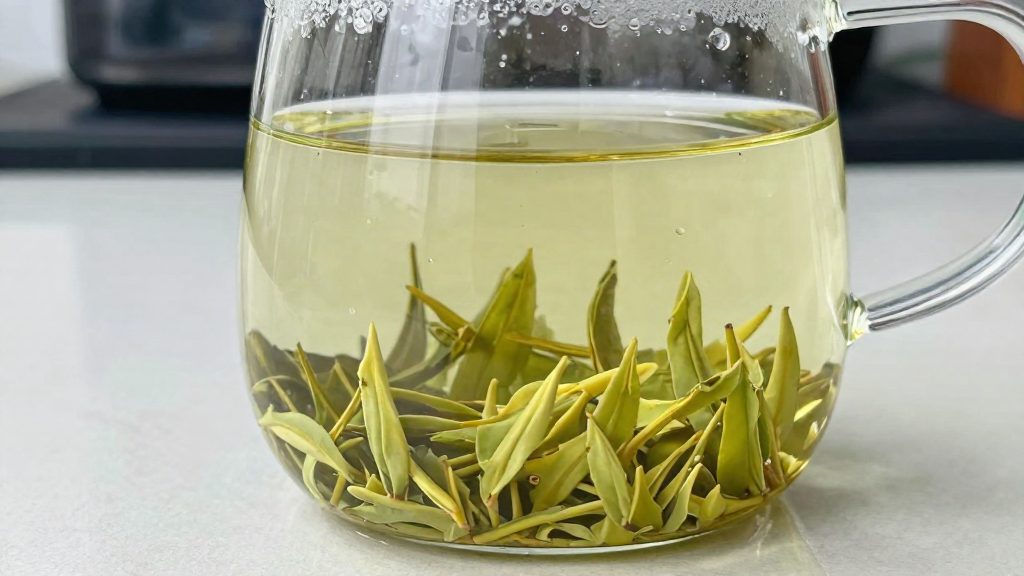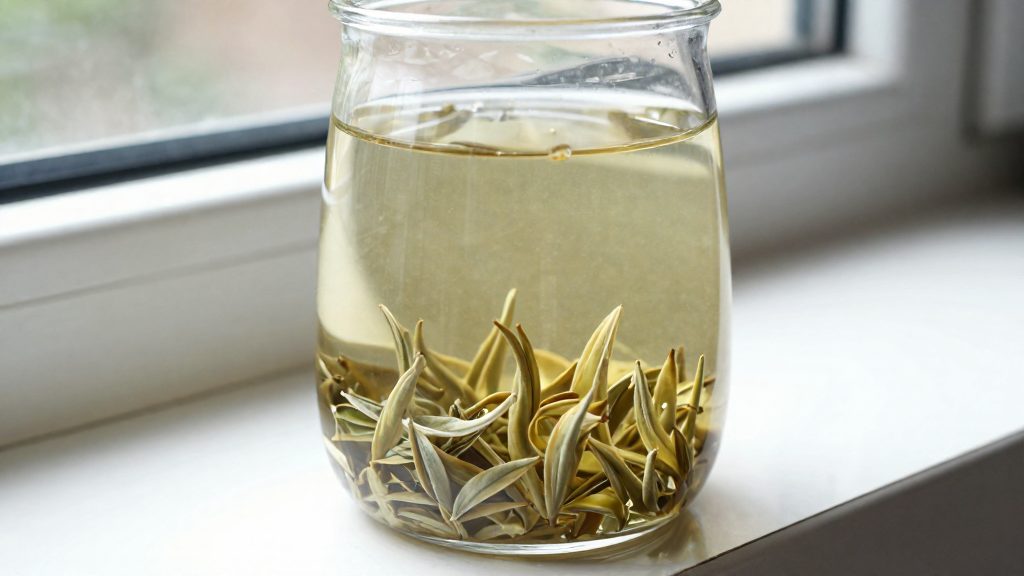
Cold brew white tea is white tea steeped in cold or room-temperature water in the refrigerator for hours, not brewed with hot water. Harney & Sons (2021) recommends 2 tablespoons of loose-leaf tea per 32 US fluid ounces of water, steeped for 6 to 12 hours in the refrigerator. The Tea Spot (2014) suggests cold-brewing White Peony (Bai Mu Dan) or Silver Needles in a pitcher or mason jar. The method is simple: the leaves release flavor slowly in cold water, and the result is served chilled.
What Is Cold Brew White Tea?
Cold extraction versus hot brewing
Cold extraction replaces heat with time. The water stays cold or room temperature, and the leaves steep in the refrigerator rather than in a hot cup or pot. The recipes below differ clearly on this point:
| Source | Water | Steeping time | Container |
|---|---|---|---|
| Harney & Sons (2021-06-24) | Cool water; fresh, filtered | 6–12 hours, refrigerated | Clean brewing container |
| The Tea Spot (2014) | Cold water | Minimum 2 hours, refrigerated | Pitcher or mason jar |
| Art of Tea | 20-second bloom at 175–180°F, then cold steeping | 24 hours | Not specified |
The Art of Tea method begins with a hot-water bloom, so it combines a short hot step with a long cold steep. Harney & Sons describes brewing directly with cool water and no hot step.
How white tea leaf character affects cold steeping
The Tea Spot (2014) names two white teas for cold brewing: White Peony (Bai Mu Dan) and Silver Needles. How leaf structure changes the cold-brew result is not established, so treat the choice as a starting point rather than a tested comparison. The Tea Spot describes cold-brewed white tea as smooth and sweet on the palate.
For loose leaves, you can place them in an infuser inside the pitcher or let them float freely. Harney & Sons (2022-06-10) advises removing freely floating leaves afterward with a fine-mesh sieve or another filter.
Cold brew versus iced tea
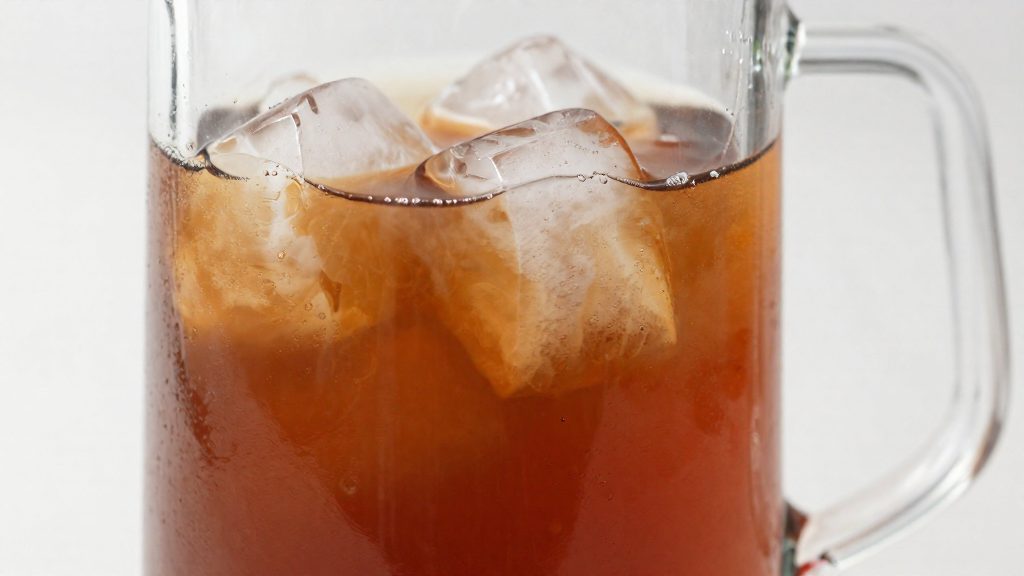
Iced tea is usually brewed with hot water and then chilled or poured over ice. Cold brew skips the hot step: the tea is steeped cold from the start and served chilled. Both are served cold, so the difference lies in how the liquid is made, not in how it is served.

Which White Tea Should You Use?
For cold steeping, The Tea Spot (2014) names two white teas: White Peony (Bai Mu Dan) and Silver Needles (Bai Hao Yinzhen). The same source describes cold-brewed white tea as smooth and sweet on the palate. Choose between them by flavour preference and what your supplier stocks.
Checking leaf grade before you buy
Silver Needle consists of young buds, while White Peony includes buds and leaves. Check the seller’s description for the tea type and its stated grade. Buds are the tender tips of the plant, and whole leaves are the larger, unbroken pieces. Read the product description for three things:
- Whole leaves versus broken or fannings, which affects how the leaf sits in the water and how easily it strains out
- The stated tea type, to confirm you have White Peony or Silver Needles and not a blend
- The packaging date or harvest information, if listed
Compare the product descriptions directly and rely on each seller’s own grade labels rather than a general rule.
Ingredients, Equipment, and Tea-to-Water Ratio
For a cold brew white tea batch, Harney & Sons recommends 2 tablespoons of loose-leaf tea per 32 US fluid ounces of water in its general cold-brew method (Harney & Sons, 2021-06-24). That guidance is not specific to white tea, so use it as a starting point. The Tea Spot suggests White Peony (Bai Mu Dan) and Silver Needles as white teas for cold brewing (The Tea Spot, 2014).
| Item | Specification | Source |
|---|---|---|
| Loose-leaf white tea | 2 tablespoons per 32 US fl oz of water | Harney & Sons (2021-06-24), general cold-brew method |
| Water | Fresh and filtered; cold or room temperature when added | Harney & Sons (2021-06-24) |
| Container | Clean; a pitcher or a mason jar | Harney & Sons (2021-06-24); The Tea Spot (2014) |
| Infuser or filter | Leaves can go in an infuser or loose in the pitcher | Harney & Sons (2022-06-10) |
| Lid or cover | Cover refrigerated tea so it does not absorb refrigerator odors | Harney & Sons (2022-06-10) |
Container choices
A pitcher and a mason jar are both named as cold brew vessels for white tea (The Tea Spot, 2014). With loose leaves, the choice affects cleanup. Leaves in an infuser come out with the infuser. Leaves brewed freely in the vessel need a fine-mesh sieve or another filter to remove them afterward (Harney & Sons, 2022-06-10).
How to Make Cold Brew White Tea
Cold brewing white tea means steeping loose leaves in cold water inside a pitcher or mason jar, then letting the refrigerator hold the temperature while the tea steeps. Harney & Sons (2021) gives a general cold-brew ratio of 2 tablespoons of loose-leaf tea per 32 US fluid ounces (about 946 ml) of water, which works as a starting point for a standard pitcher. The Tea Spot (2014) suggests White Peony (Bai Mu Dan) and Silver Needles for this method.
Step 1: Load the leaves
Loose leaves can go in one of two places:
| Option | Leaf placement | Removal step |
|---|---|---|
| Infuser | Leaves sit inside a basket or infuser that is submerged in the pitcher | Lift the infuser out when the steep is finished |
| Direct in pitcher | Leaves float freely in the water | Strain through a fine-mesh sieve or another filter |
Harney & Sons (2022) confirms that leaves can brew in either way. Use the infuser if you want to avoid straining, and use a fine-mesh sieve if you add the leaves directly.
Step 2: Add the water
Use a clean container and fresh, filtered water. Harney & Sons (2021) states that the water can be cold or at room temperature when added, so no heating is required for its general method.
Step 3: Refrigerate the pitcher
Cover the pitcher before placing it in the refrigerator. Harney & Sons (2022) recommends covering refrigerated brewed tea so that it does not absorb refrigerator odors.
Steep times vary by source:
- Harney & Sons (2021): 6–12 hours in the refrigerator
- The Tea Spot (2014): a minimum of 2 hours in the refrigerator
- Art of Tea: 24 hours, using the hot-water bloom method above
There is no single agreed steep time. Shorter steeps give a lighter cup, and longer steeps extend the time in the refrigerator. The Tea Spot (2014) describes cold-brewed white tea as smooth and sweet on the palate, which is the profile to look for when you judge when the tea is ready.
How Long Should White Tea Steep?
Cold-brew white tea has no single agreed steeping time. Harney & Sons (2021-06-24) recommends steeping in the refrigerator for 6–12 hours. The Tea Spot (2014) gives a minimum of 2 refrigerated hours. Art of Tea uses 24 hours in a method that begins with a hot-water bloom. Each figure belongs to its own recipe, so choose the window that matches the method you follow.
| Source | Steeping time |
|---|---|
| Harney & Sons (2021-06-24) | 6–12 hours, refrigerated |
| The Tea Spot (2014) | Minimum of 2 hours, refrigerated |
| Art of Tea | 24 hours |
How the Methods Differ
- Harney & Sons describes brewing directly with cool water. The container should be clean, and the water should be fresh and filtered, either cold or at room temperature when added. Loose leaves can sit in an infuser or float freely in the pitcher. Free leaves should be strained out afterward with a fine-mesh sieve or another filter.
- Art of Tea starts with a hot-water bloom. The source specifies 20 seconds at 175–180°F for white or green tea before the longer steep. This is a hybrid of hot and cold steps, not a pure cold brew.
A bloom is not a required step across these sources. Harney & Sons skips it, while Art of Tea includes it. Do not treat the two as interchangeable instructions.
The 2-hour and 24-hour figures are not backed by a food-safety limit in these sources. The Tea Spot’s minimum and Art of Tea’s 24 hours describe steeping time, not how long refrigerated tea stays safe to drink. For storage limits, follow the manufacturer’s instructions on the tea packaging.
Straining, Serving, and Flavor Variations
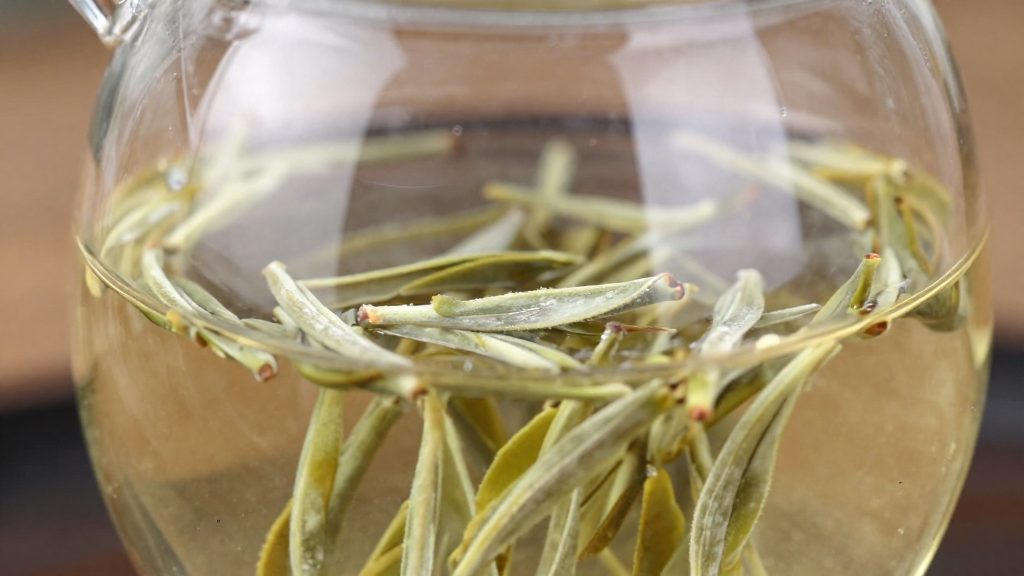
Once the steep is finished, remove the leaves completely before serving. Loose leaves can brew directly in the pitcher, and Harney & Sons advises removing them afterward with a fine-mesh sieve or another filter (Harney & Sons, 2022-06-10). If you used an infuser, lift it out and drain it. Pour the liquid through the sieve into a clean jug or glass, or over a paper coffee filter set in a funnel, so that fine particles do not end up in the cup.
Serving over ice works well because the tea is already cold. Fill the glass with ice, then pour the strained tea over it. Ice melts and adds water, so the first sips are usually more concentrated than the last. To control this, use less ice for a stronger glass, or pre-chill the tea and add a smaller amount of ice. The Tea Spot describes cold-brewed white tea as smooth and sweet on the palate (The Tea Spot, 2014), so you can judge the dilution by taste and adjust the ice level on the next batch.
Flavor additions are best added after straining, to the glass or the jug, rather than left in the pitcher with the leaves. Fresh herb sprigs such as mint, or thin slices of citrus, can be stirred in and removed when the flavor is right. For chilled tea, use a liquid sweetener that mixes easily into the cold brew. Avoid mixing new additions into a batch you plan to keep, since the flavor of fresh garnish changes over time.
Storage and Common Brewing Problems
Cold-brewed white tea keeps best when it stays covered and cold, and dry leaves stay fresh when they are shielded from moisture and light. Most cold brew faults trace back to three things: the strength of the ratio, how long the leaves stay in the water, and whether the leaves are removed. Harney & Sons (2021) gives a starting ratio of 2 tablespoons of loose-leaf tea per 32 US fluid ounces of water, which you can adjust for your taste.
Refrigerated Tea and Odor Absorption
Brewed tea picks up smells easily, so it should be covered in the refrigerator. Harney & Sons (2022) recommends covering refrigerated brewed tea so it does not absorb refrigerator odors. Use a lidded pitcher or a sealed mason jar, and keep strong-smelling foods such as onions or fish in separate containers.
Harney & Sons says refrigerated tea keeps for several days. No independently validated food-safety limit is established in the sources, so treat that time as a quality guideline rather than a safety rule. Check local food-safety guidance for your situation.
Storing Dry White Tea
Dry white tea should be kept in an airtight container, away from humidity and light. Store it at room temperature in a cool, dry cupboard rather than near a sink, a stove or a sunny window. Keep the container closed between uses, and avoid opening it while the kettle is steaming nearby, since moisture in the air can reach the leaves.
Keep white tea in its original packaging only if it is resealable. Otherwise, transfer it to a dark, opaque container. Check the manufacturer’s storage instructions on the product label, since they may differ by blend.
Troubleshooting Cold Brew Results
Adjust one variable at a time so you can tell which change made the difference.
| Symptom | Adjustment to try | Source |
|---|---|---|
| Weak flavor | Increase the leaf quantity from the 2 tablespoons per 32 US fl oz starting ratio, or steep longer within the refrigerated range | Harney & Sons (2021) gives 6–12 hours; The Tea Spot (2014) gives a minimum of 2 hours |
| Harsh or bitter taste | Remove the leaves promptly, reduce the steeping time, or use less leaf | Harney & Sons (2022) on removing loose leaves |
| Cloudy appearance | Start with a clean container and filtered water, and strain loose leaves out after steeping | Harney & Sons (2021) on container and water |
Steeping time is not standardized. Art of Tea uses 24 hours in a method that begins with a hot-water bloom of 20 seconds at 175–180°F, while Harney & Sons describes brewing directly in cool water. These are separate recipes, so do not mix their steps.
Cold brewing does not guarantee a result free of bitterness. If your cup tastes harsh, first shorten the steep. If a later batch still tastes harsh, try reducing the leaf quantity while keeping the steeping time unchanged.
Removing Loose Leaves
Loose leaves can brew in an infuser or directly in the pitcher. If they float freely, remove them with a fine-mesh sieve or another filter once the tea reaches the strength you want (Harney & Sons, 2022). Leaving them in the pitcher lets the brew continue to extract, which makes it harder to control strength.