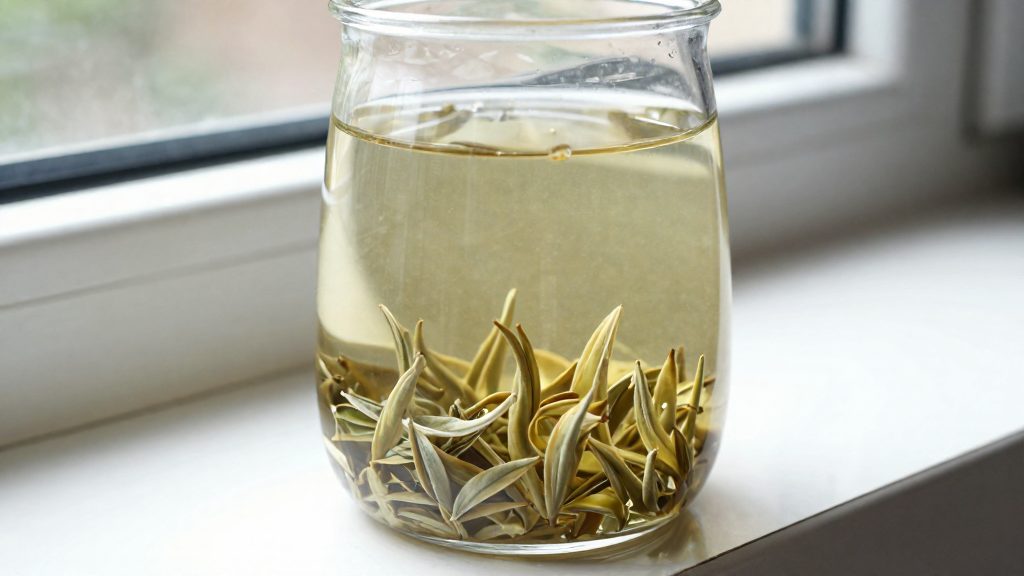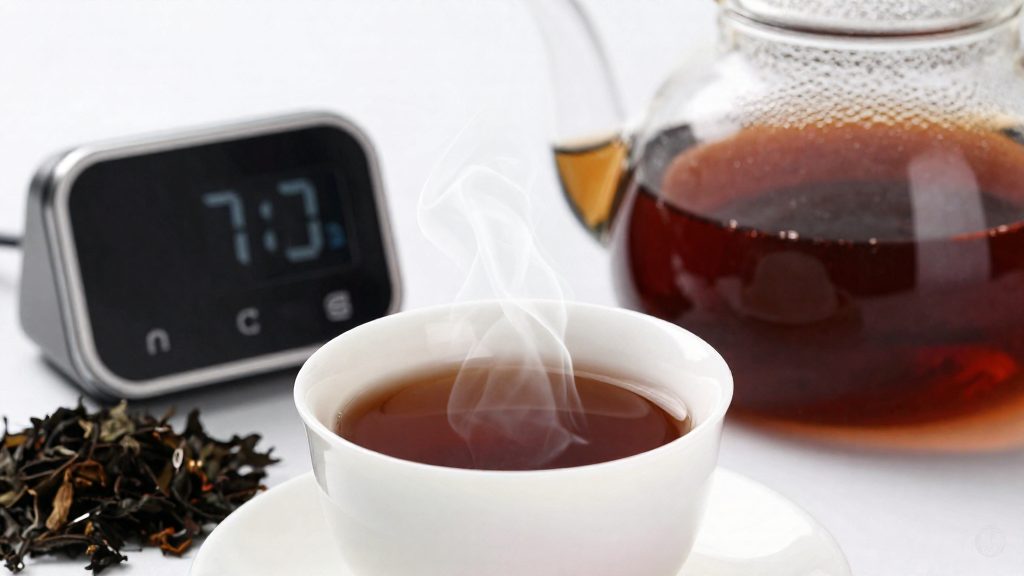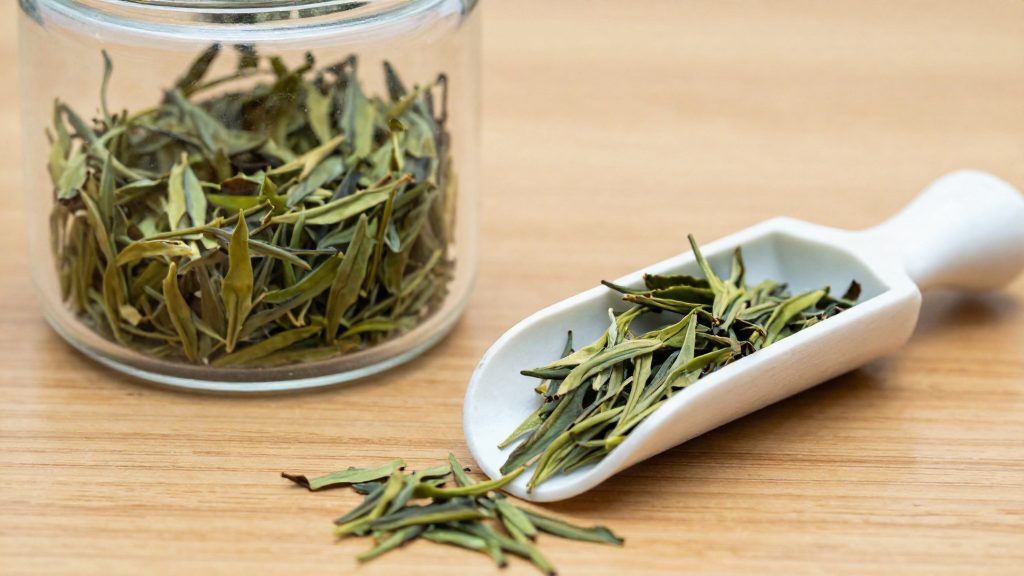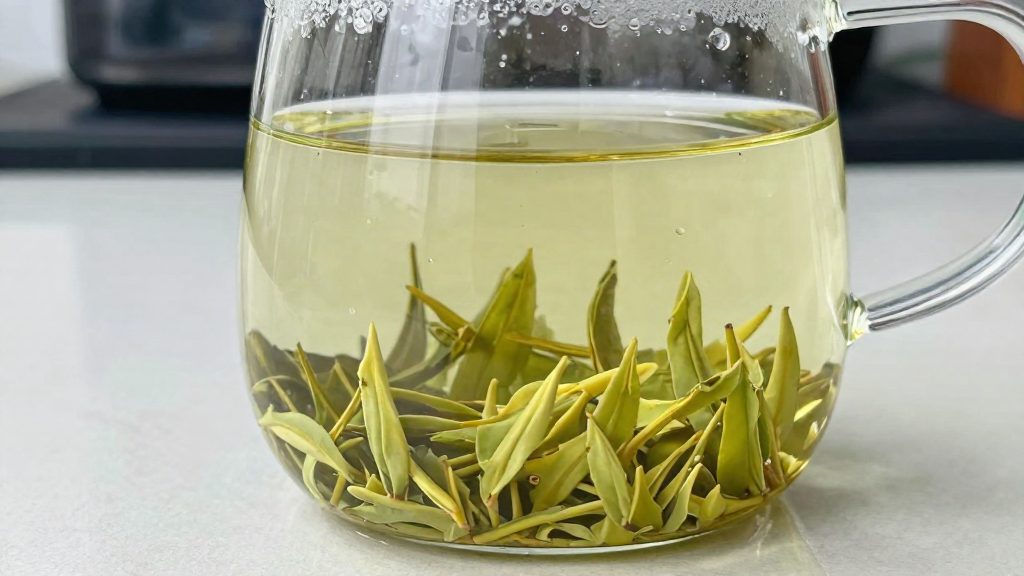
Green tea cold-brewed overnight has no single best steep time. Published guidance ranges from about 2 hours to 12 hours, and the right point depends on the product you use and the strength you want. Rishi gives a general 2–4 hour window for loose-leaf green tea, while Harney & Sons recommends 6–12 hours for its Fresh Brew pouches; these recommendations do not establish a universal timing difference between loose leaf and pouches.
How long should green tea steep overnight?
Each publisher gives a different window, and each applies to a different set of conditions:
| Source | Stated timing | Conditions |
|---|---|---|
| Rishi Tea & Botanicals | Generally ready after 2–4 hours | Loose-leaf green tea in a covered vessel, refrigerated |
| Ohio State University Extension (2011-08-19) | Six hours to overnight | Refrigerator tea steeped in cold water; the time depends on the desired strength |
| Harney & Sons | 6–12 hours | Its Fresh Brew iced-tea pouches, steeped in cold water in the refrigerator |
A practical approach for loose leaf is to start at the shortest window, 2 hours, and taste. If the cup is too light, steep for longer and taste again. Longer steeping gives a stronger cup, so the extra time is for adjusting strength, not for a fixed result. Note the time you chose so you can repeat it with the same leaf and vessel.
Choosing green tea for cold brewing
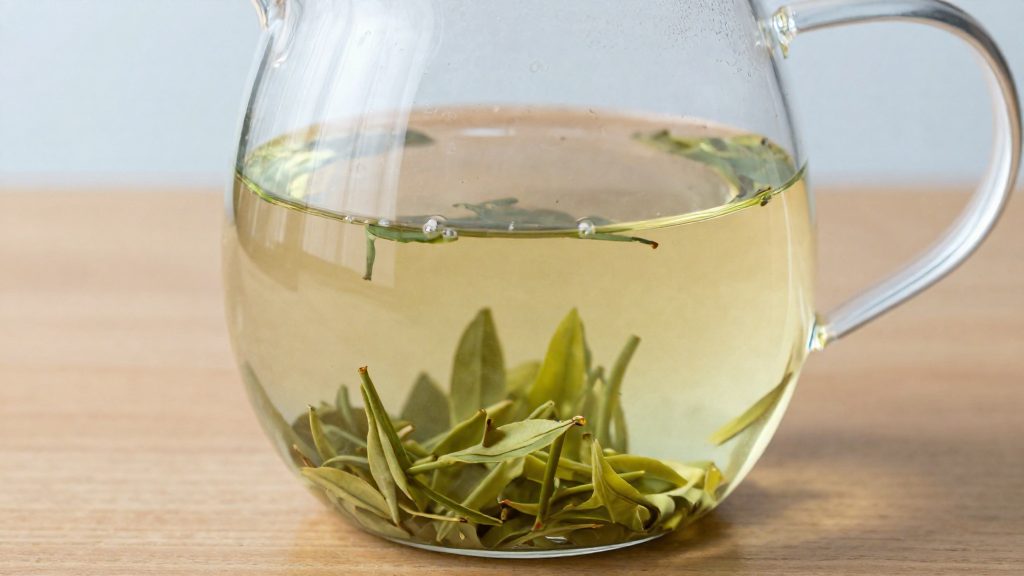
Green tea can be cold brewed, but the style and grade on the label affect the result as much as the steep time does. Leaf form determines how quickly compounds leave the leaf, so two green teas steeped in the same container overnight can produce noticeably different cups. Choose the style first, then judge the strength by tasting.
Whole leaf versus broken leaf
Broken leaf has more cut edges and more surface in contact with water, so it generally releases flavor faster than whole leaf. Whole leaf opens more slowly and may need more time to reach the same strength. In a cold steep, a broken-leaf grade can taste finished sooner, while a whole-leaf grade may stay pale for longer.
Sencha, gyokuro and Chinese pan-fired styles
Japanese styles such as sencha and gyokuro, and Chinese pan-fired greens, carry different style names. Read the style name and grade on the pack rather than assuming one style behaves like another. Use the label to compare the leaf form and grade, then steep a small test batch.
| Label item | Where to find it | Why it matters for a cold steep |
|---|---|---|
| Style name | Front of the pack | Identifies the family, so you can match it to the producer’s brewing guidance |
| Leaf form or grade | Ingredient or product description | Shows whether the leaf is whole or broken, which sets how fast it extracts |
| Harvest season | Back or side of the pack | Gives a basis for judging leaf age |
Harvest season and leaf age indicators
A printed harvest season is the clearest age indicator on green tea packaging. If the package does not give a harvest year and season, ask the seller about the tea’s age and storage history; consult the producer’s brewing instructions separately when choosing a steeping time.
Tea ratios, water, and simple equipment
A repeatable cold-brew green tea base starts with a fixed leaf-to-water measure, filtered water and a clean vessel. Rishi Tea & Botanicals uses 2–3 tablespoons of loose-leaf tea per 1,000 mL of cold filtered water in a covered vessel, and the same base can be scaled by keeping that ratio constant. Because the source gives a volume-based measure rather than a weight, the amount of leaf will vary with how tightly the leaves are packed, so start at the lower end and adjust after tasting.
Measuring the leaf
- Use 2 tablespoons for a lighter cup and 3 tablespoons for a stronger one, both per 1,000 mL.
- Keep the ratio fixed when you change batch size: a 500 mL jar takes roughly half the amount used for 1,000 mL.
- Do not convert tablespoons to grams unless the weight of your specific tea is known, since the same spoon holds different masses of leaf depending on leaf cut and rolling.
Water quality
Rishi’s recipe specifies cold filtered water. Water quality affects the flavor of cold-brewed tea, and its mineral composition can also change how compounds extract from the leaves. Use filtered or bottled water that you would also drink plainly, and avoid water with a strong chlorine or mineral taste, since those notes carry through the cold brew unchanged.
Vessel preparation
Rishi notes that a covered pitcher or food-safe glass jar with a fine-mesh strainer can replace a dedicated cold-brew teapot. Before every brew:
- Wash the pitcher or jar with hot water and detergent, then rinse thoroughly.
- Sanitize it, following the manufacturer’s instructions for the sanitizer you use.
- Air-dry or dry with a clean cloth before adding leaf and water.
Ohio State University Extension (2011-08-19) recommends regularly washing, rinsing and sanitizing tea-making equipment, which applies directly to the vessel used for overnight steeping.
The overnight refrigerator brewing method
Refrigerator brewing steeps loose-leaf green tea in cold water inside a refrigerator instead of at room temperature or in the sun. Ohio State University Extension (2011) recommends making refrigerator tea by steeping tea in cold water, and it is the method the steps below follow. The vessel needs a lid and a strainer, and the whole steep stays in the refrigerator until the tea is separated from the leaves.
Step-by-step setup
- Choose the vessel. Keep a fine-mesh strainer ready for the separation step.
- Add the leaves and cold filtered water. Place the loose-leaf tea in the vessel and fill it with cold filtered water.
- Cover the vessel. Rishi Tea & Botanicals recommends refrigerating the covered brewing vessel, so a lid is part of the setup and not an optional extra.
- Place the vessel in the refrigerator. Set the covered vessel in the refrigerator for the full steep. Do not move it to the counter during steeping.
- Separate the tea from the leaves. Once the flavor is balanced to your taste, Rishi Tea & Botanicals recommends pouring the tea through the strainer. The tea can then be served with or without ice.
Why refrigerate, and why not sun tea
| Method | Condition | Source |
|---|---|---|
| Refrigerator brewing | Covered vessel kept in the refrigerator | Rishi Tea & Botanicals |
| Sun tea | Steeping in warm conditions outdoors | Ohio State University Extension (2011), discouraged |
Ohio State University Extension (2011) discourages sun tea because its brewing conditions allow bacterial growth. Refrigeration is the alternative that keeps the steep cold.
The two sources differ in scope. Ohio State’s guidance addresses household brewing directly. SDSU Extension’s guidance is written for processors and recommends heat treatment before refrigeration when pathogen reduction of the leaves is unknown. For home steeping, refrigeration lowers the risk that warm conditions create, but it does not sterilize the tea.
Can you use green tea bags?
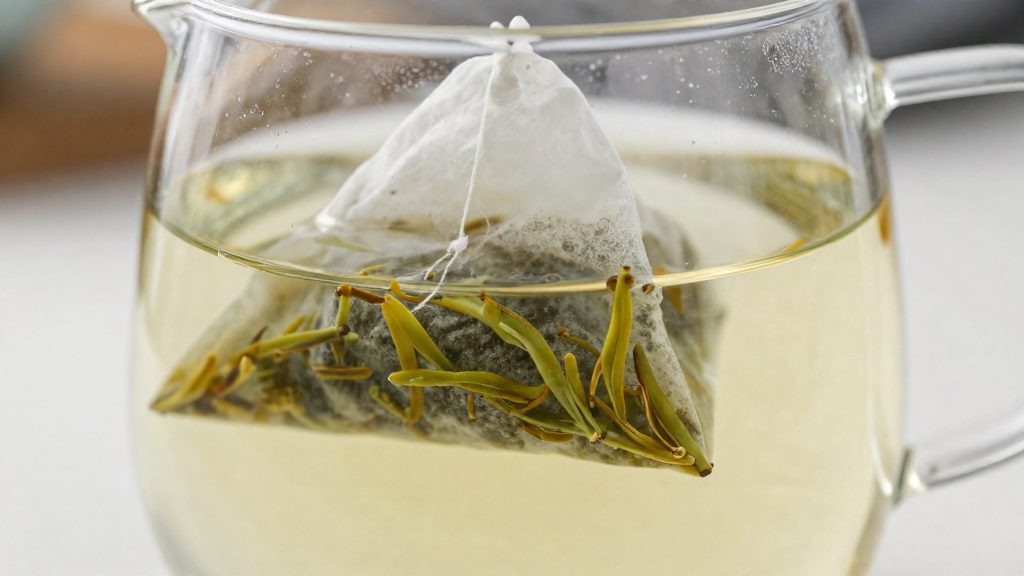
Pouches sold for cold brewing have the clearest support. Harney & Sons says its Fresh Brew iced-tea pouches are steeped in cold water in the refrigerator. For ordinary green tea bags, the sources do not establish overnight cold steeping, so the product label is the deciding factor.
Bag fill and leaf surface area affect how the tea extracts. Leaf that is packed tightly in a bag expands less and gives water less contact with the leaf surface. Leaf that is loosely filled or cut finer gives water more surface to work on. Because the sources give no bag-size or surface-area figures, treat any bag as an unmeasured variable and judge it by how it tastes, not by a count of bags.
Ohio State University Extension (2011) and Rishi Tea & Botanicals both describe loose leaf or general tea, not bags, so neither confirms bag use on its own.
Pouch products labeled for cold or iced brewing are the most direct option.
Straining, serving, and adjusting the flavor
Rishi Tea & Botanicals advises separating the brewed tea from the leaves once the flavor is balanced, and says the tea can then be served with or without ice. Straining is a single step: pour the liquid through a fine-mesh strainer into a second clean vessel.
Tasting for balance before removing the leaves
The sources give no sensory scale or flavor target for green tea, so the check is your own taste. Before straining, lift a small sample with a clean spoon or cup and taste it. Compare it with your previous check, and strain only when the cup tastes the way you want.
No source establishes that overnight steeping always improves green tea’s flavor, so do not assume that more time means a better cup. Taste at each check and make the decision from the cup itself.
Straining into a second vessel
- Set the fine-mesh strainer over a clean jar or pitcher.
- Pour the whole batch through in one pass, so the leaves do not stay in the liquid.
- Cover the vessel before refrigerating it.
Serving with or without ice
| Serving style | What changes | Practical step |
|---|---|---|
| Served as brewed, no ice | The tea is poured at the strength you judged before straining | Taste once more before pouring |
| Over ice | Melting ice adds water and lowers the strength | Taste after the ice has melted and adjust before serving more |
The sources do not give a dilution ratio for ice, so use your own taste to decide how much ice suits your cup.
How to store dry green tea leaves
Dry green leaves lose aroma and freshness through contact with air, heat, light and moisture, and they absorb smells from nearby foods. Storage before brewing comes down to keeping the leaves sealed, dark, dry and apart from strong odors. The same habits apply to any loose-leaf green tea, whatever you plan to brew later.
| Factor | Effect on dry green leaves | Practical measure |
|---|---|---|
| Air (oxygen) | Gradual loss of aroma | Use a tight lid and reseal the container after every scoop |
| Heat | Speeds up the loss of aroma and flavor | Keep the container away from stoves, dishwashers, radiators and sunny windows |
| Light | Fades leaf color and dulls aroma | Use an opaque tin, ceramic jar or sealed opaque bag |
| Moisture | Dampness dulls flavor and can leave musty notes | Keep the container dry and measure with a dry spoon |
| Strong odors | Leaves absorb nearby aromas | Store apart from spices, garlic, onions or coffee beans |
Choosing the container
An airtight, opaque container addresses two factors at once. Its lid limits air exchange, and its walls block light. Tins, ceramic canisters with a rubber or silicone seal, and opaque foil-lined pouches with a resealable closure all meet this requirement. A clear glass jar works only if it is kept inside a closed cupboard, since the light it admits is the problem.
Frequently asked questions
Can I brew green tea hot and then chill it instead?
Harney & Sons notes that iced tea can be brewed hot before chilling, but cold brewing requires separate instructions. Hot-brewed iced tea is a different method from the overnight refrigerator steep described above, so follow the timing and temperature for the method you choose.
How long can cold-brewed green tea stay in the refrigerator?
No verified refrigerated shelf life exists for homemade cold-brew green tea, so do not treat any number of days as a safety limit. Keep the strained tea sealed and cold, and check the manufacturer’s label or your local food-safety authority for storage limits.
How much caffeine does overnight cold-brewed green tea contain?
No verified caffeine figure exists for this overnight method, because caffeine content depends on the leaf grade and the quantity used. Check the producer’s product information for the specific tea, since the strength you judge by taste does not indicate caffeine.