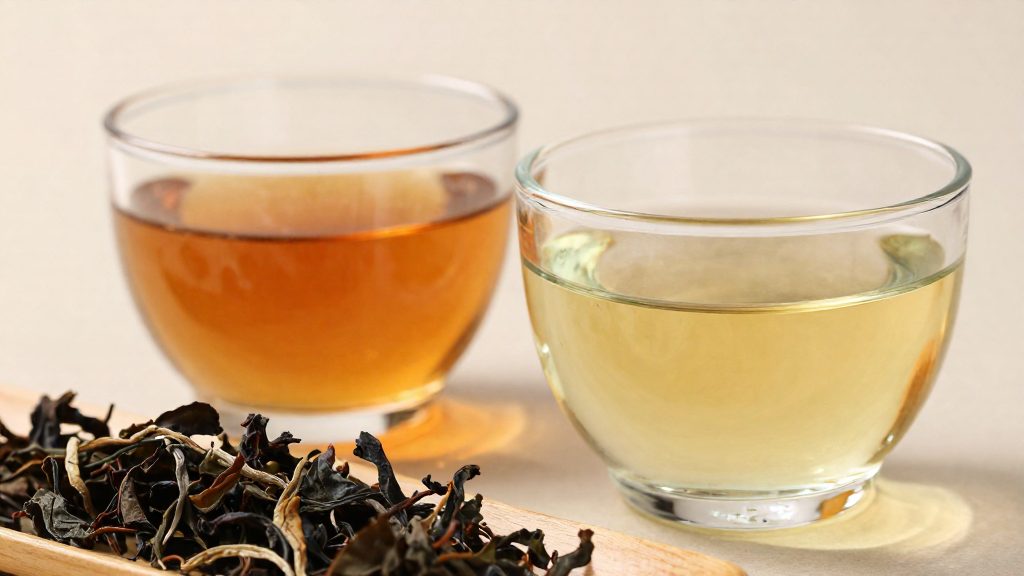
Oolong does not reliably contain more caffeine than green tea. The Linus Pauling Institute at Oregon State University describes the caffeine contents of oolong and green tea as comparable (2016), and no accepted source establishes a universal ranking in which oolong always comes out higher. A particular oolong may contain more or less caffeine than a particular green tea.
Does Oolong Have More Caffeine Than Green Tea?
Two points hold for both teas:
- Same plant: Green and oolong teas both come from Camellia sinensis.
- Natural caffeine: Both green tea and oolong naturally contain caffeine (Stash Tea).
Because oolong does not always contain more, the tea type name alone does not predict how strong a cup will be. Two oolongs, or two green teas, can differ from each other, and the same applies across the two categories. If you are comparing caffeine between two specific teas, look at each product’s own information rather than assuming the category settles the question.
Caffeine Figures and Their Limits
A published caffeine number is only as useful as the test behind it. The accepted sources do not give a verified per-cup figure that lets you compare oolong with green tea directly, and a figure for one product cannot be assigned to another. Before you rely on any number, check what was measured, in which tea, and how it was prepared.
Brand statements describe guidance, not measurements
Stash Tea states that it does not test its teas for caffeine content, so its guidance does not establish measured caffeine amounts for individual Stash products. Its list of factors that affect caffeine in a cup (brewing temperature, steeping duration, ingredients, serving size and growing conditions) explains what changes the result, but it does not supply the result itself.
Why one product’s figure does not transfer
Leaves from different producers, harvests and processing lines can therefore differ, so a number for one brand’s tea says little about another brand’s tea of the same type.
| Source of figure | What it establishes | What it does not establish |
|---|---|---|
| Stash Tea (2020) | Variables that affect caffeine in a cup | Measured caffeine for Stash products |
| Linus Pauling Institute, Oregon State University (2016) | Green tea and oolong are described as comparable in caffeine; brewing time, quantities and leaf or bag form can influence the finished drink | Exact milligram amounts per cup for any named tea |
| Boros et al. (2016), single commercial-sample study | Mean caffeine per gram of tea in that sample set | A cup amount, or a ranking that applies to all oolong or green tea |
Reading caffeine statements on a label
- Confirm the unit. Check whether the figure is per serving, per gram of dry leaf or per liter of infusion.
- Confirm the preparation. Look for the water amount, steep time and whether the tea is loose leaf or bagged, since these change the drink.
- Request the test method. If a number matters to you, ask the manufacturer for its test method and lab data. If none is available, treat the statement as guidance only.
Why Caffeine Varies Between Teas
Processing method is the step that separates the tea types. Green and oolong production use different methods, but the Linus Pauling Institute (2016) describes their caffeine contents as comparable, so the difference in processing does not produce a reliable gap in caffeine.
Growing conditions are a separate variable. Because growing conditions vary from one harvest and garden to another, two packs of the same tea type can differ.
| Factor | Effect on caffeine in the cup | Source |
|---|---|---|
| Plant species | Green and oolong both come from Camellia sinensis | Linus Pauling Institute (2016) |
| Processing method | Produces the different tea types; green and oolong contents described as comparable | Linus Pauling Institute (2016) |
| Growing conditions | Listed as one influence on the caffeine in the cup | Stash Tea (2020) |
How Does Brewing Affect Caffeine?
Brewing changes how much of the leaf’s caffeine ends up in your cup. Linus Pauling Institute at Oregon State University (2016) lists brewing time, the amounts of tea and water, and whether the tea is loose leaf or bagged as factors that can influence the caffeine content of the finished drink. Stash Tea (2020-02-26) adds brewing temperature and serving size.
| Variable | What the sources say | Source |
|---|---|---|
| Steeping time | Longer steeping can raise caffeine extraction into the cup | Linus Pauling Institute (2016); Stash Tea (2020-02-26) |
| Water temperature | Listed as a factor affecting caffeine in a cup; no measured effect per degree is given | Stash Tea (2020-02-26) |
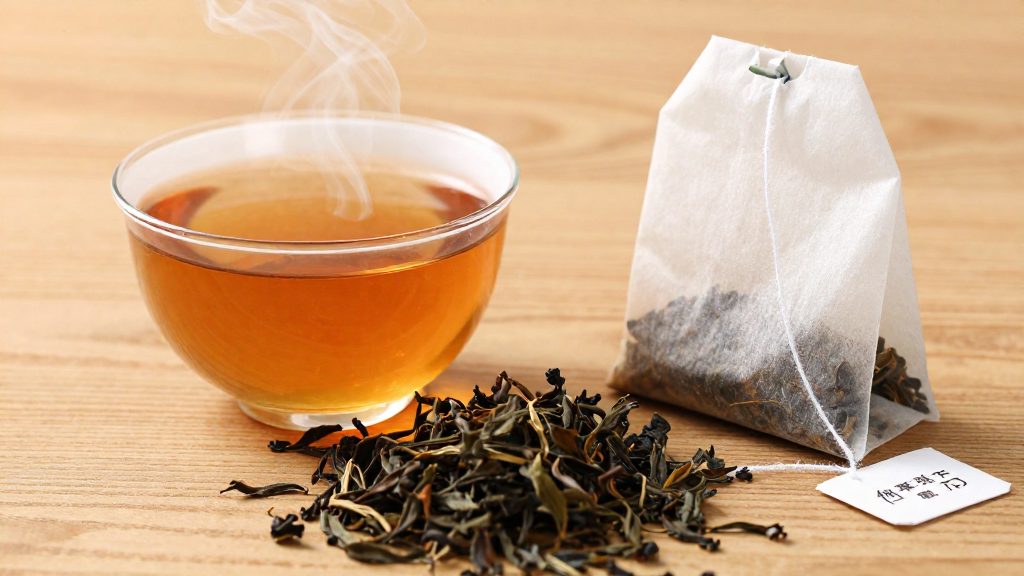
| Leaf format (loose leaf or bagged) | Can change the finished caffeine content; no fixed difference is established | Linus Pauling Institute (2016) |
Steeping time
Caffeine moves from the leaf into the water over the course of the infusion, so a longer steep generally delivers more caffeine per cup. The sources do not give an exact figure for how much a given change in time alters the result.
Water temperature
Brewing temperature is one of the listed variables, but the sources do not quantify its effect. Keeping the temperature constant across a comparison makes the other variables easier to isolate.
Leaf format
Whether the tea is loose leaf or bagged can change the caffeine in the finished cup. Use the same format for both teas when comparing them, because switching formats alone can shift the result.
Comparing Equal Servings at Home
Using the same dry leaf weight and water volume controls two brewing variables, but it does not reveal which tea contains more caffeine. That comparison requires measured caffeine results for the teas prepared under the stated conditions. Caffeine in the cup depends on how much tea goes into the water and how much water is used, so unequal inputs can make the comparison meaningless. Linus Pauling Institute at Oregon State University (2016) lists the amounts of tea and water among the factors that influence caffeine in the finished drink.
| Variable | How to control it | Why it matters |
|---|---|---|
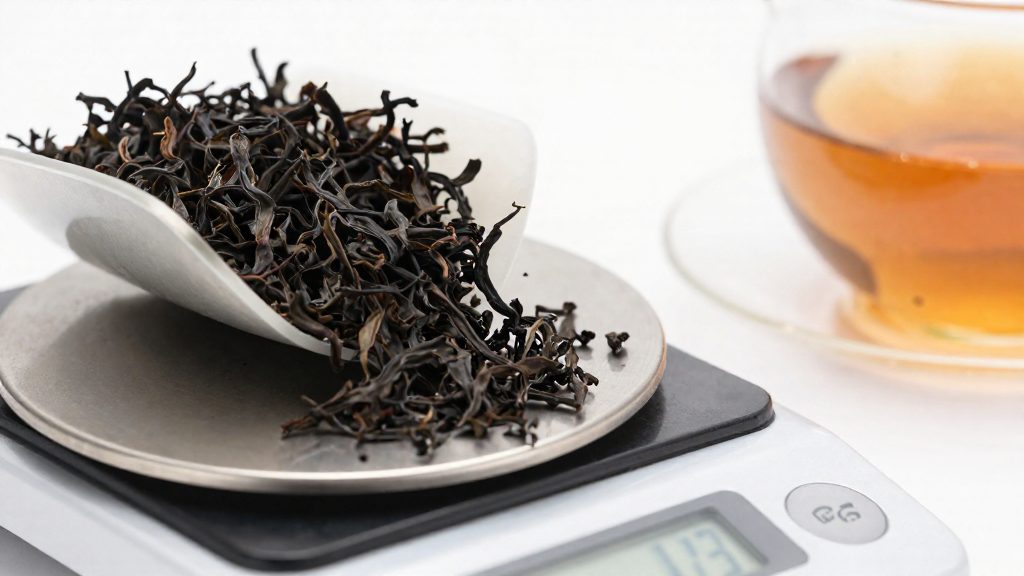
| Dry leaf | Weigh in grams on a kitchen scale, using the same weight for each tea | Sets the amount of tea available to release caffeine |
| Water | Measure in millilitres with a graduated jug, using the same volume for each tea | Sets the dilution of the infusion |
| Vessel | Use the same teapot, gaiwan, or cup for each brew | Keeps the leaf-to-water relationship and cup size constant |
Weighing by mass matters because leaf density varies with the tea and how it is cut and rolled. A scoop or spoon measures volume, which does not reliably match mass across teas.
Results are also sensitive to serving size. Stash Tea identifies serving size as a factor affecting caffeine in a cup, so a larger cup of the same tea contains more caffeine than a smaller one. Record the millilitres for every brew so that any difference you observe can be attributed to the tea rather than to the cup.
Per-gram data shows why the baseline should be by dry weight. In a study by Boros et al. (2016), published in a journal outside tea-specialist literature, mean caffeine was 19.31 mg/g for oolong and 16.28 mg/g for green tea. These are mass-normalized values for the commercial samples tested, not milligrams per cup, and they do not establish a general ranking for all oolong and green teas.
Does Decaf Tea Still Contain Caffeine?
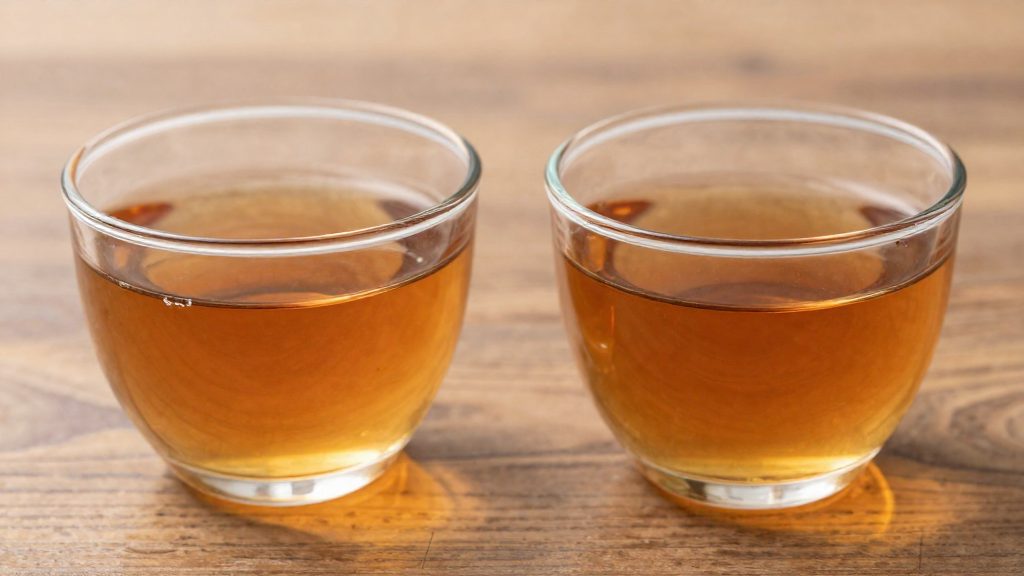
A decaf tea is not caffeine-free. According to Stash Tea (2020), decaffeination does not remove all caffeine, and decaffeinated green tea can retain some. A decaf label therefore signals reduced caffeine, not zero, and the word alone does not tell you how much remains.
What decaffeination leaves behind
- Residual caffeine: decaffeinated green tea can keep some caffeine after processing.
Reading packaging claims
- Method: check whether the label or product page names the decaffeination method.
- Caffeine statement: look for an explicit caffeine statement. Wording such as “decaf” or “decaffeinated” describes processing, not a measured amount.
- Testing: Read any brand’s caffeine claim against whether the brand says it tests its tea.
Choosing Between Oolong and Green Tea
Caffeine is rarely the deciding factor between these two teas. The choice usually comes down to flavour, leaf appearance and the equipment you already own.
Flavour and leaf appearance
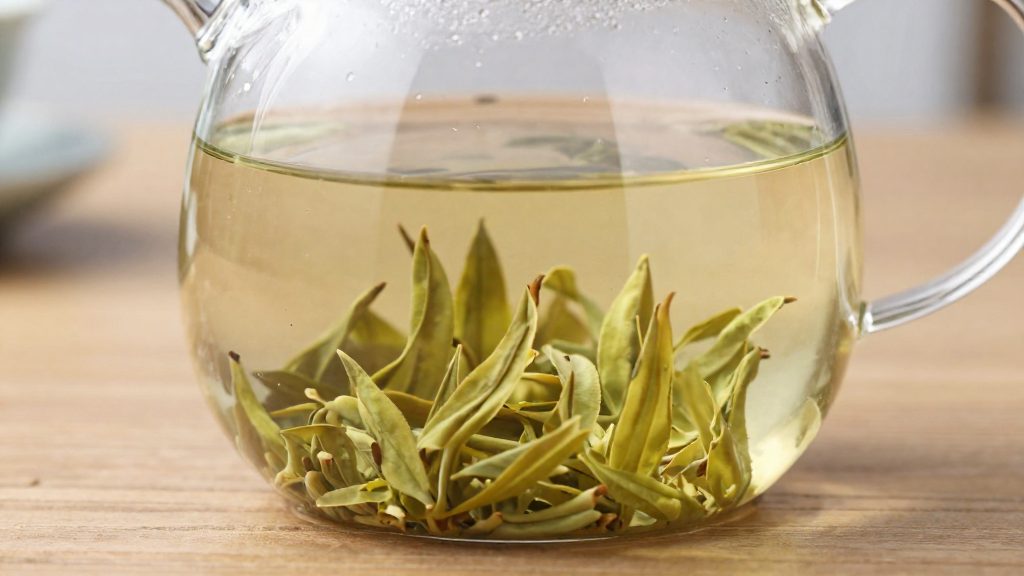
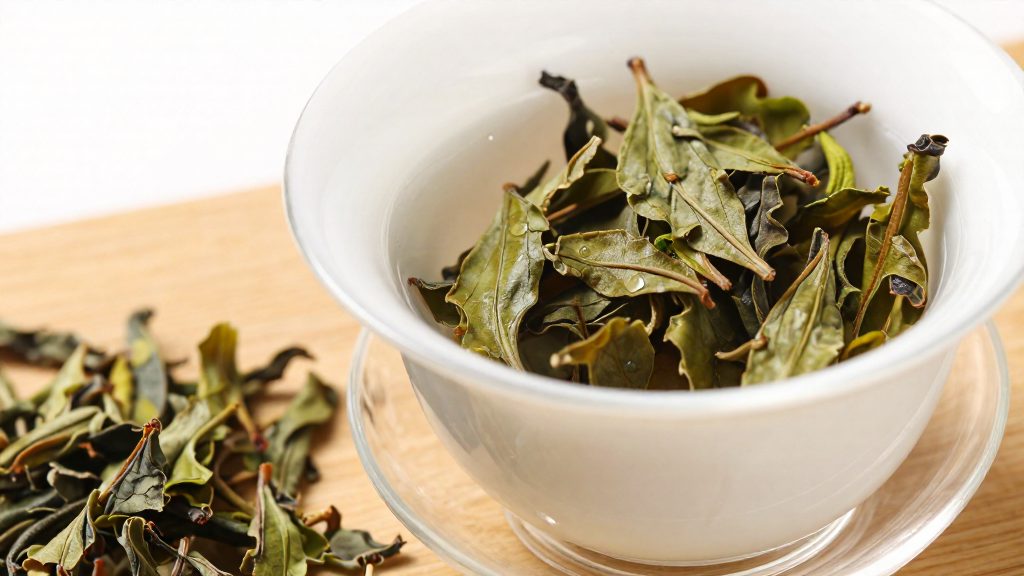
Green and oolong differ mainly because of how they are processed. Green tea is not allowed to oxidise much, which keeps its leaves closer to their fresh colour. Oolong is partly oxidised, and its leaves show a mix of green and darker, browned edges. In the cup, the two styles tend to separate as follows:
| Feature | Green tea | Oolong tea |
|---|---|---|
| Processing | Minimal oxidation | Partial oxidation |
| Leaf colour | Mostly green | Green with browned or darker edges |
| Typical cup character | Fresh, vegetal, grassy | Floral, fruity or toasty, depending on the style |
Oolong’s flavor varies with its processing, so tasting different styles can help you find one you prefer. Tasting the two side by side is the quickest way to see which profile you prefer.
Matching the tea to your equipment
- Gaiwan or small teapot: Both work well. Oolong, especially rolled or twisted leaf, rewards multiple short infusions, because the leaves unfold over several steeps.
- Infuser basket or mesh strainer: Choose this for green tea if you want a single, light steep. Oolong leaves are larger and need room to expand, so use a basket with space for them to open.
- Kettle with temperature control: A kettle that holds set temperatures suits both styles, since each tea is sensitive to heat. Follow the brewing temperature recommended on each tea’s package.
Choosing decaf or herbal options
If you want less caffeine, the two main routes are different:
- Decaffeinated tea: Choose decaf if you want the flavour of green or oolong with less caffeine. Check the product label for any stated caffeine content.
- Herbal infusions: These are not made from Camellia sinensis and so are a different category of drink. For a caffeine-free cup, choose an herbal infusion labeled caffeine-free and check its ingredients: some herbal infusions naturally contain caffeine even without tea leaves.