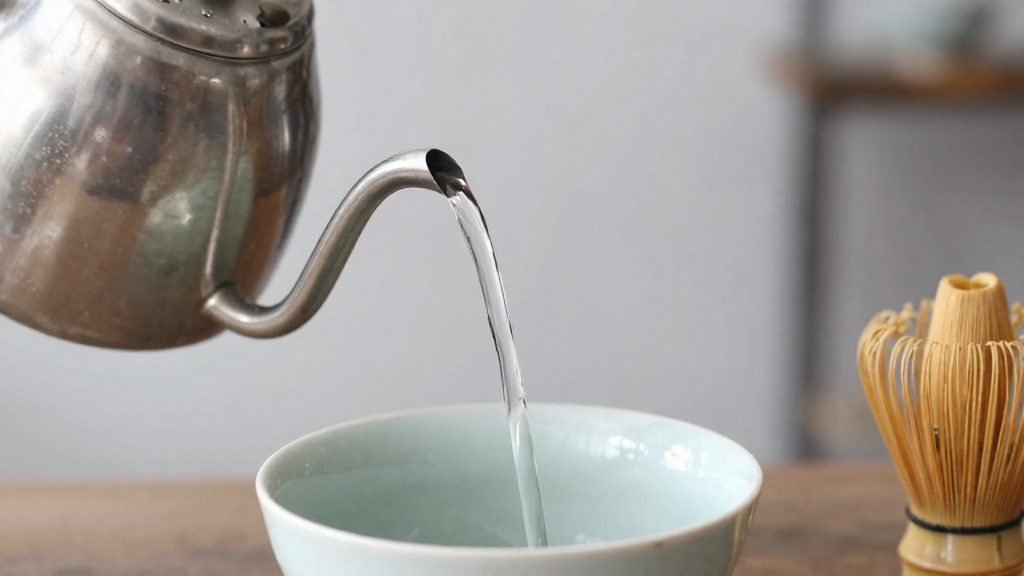
For usucha, the two producers compared here recommend different temperatures. Hugo Tea Company suggests 165–170°F (about 74–77°C) for a 1.5–2 g dose in 70–80 mL of water, while Ippodo Tea specifies 176°F (80°C) for its Organic Matcha, using 2 g in 60 mL. Neither figure is a universal standard, so the right target depends on the product you buy and the recipe its maker publishes.
What temperature should your kettle reach?
Producer recommendations compared
| Producer | Product and recipe | Matcha | Water | Water temperature |
|---|---|---|---|---|
| Hugo Tea Company | Usucha | 1.5–2 g | 70–80 mL | 165–170°F (about 74–77°C) |
| Ippodo Tea | Organic Matcha (sifted) | 2 g | 60 mL | 176°F (80°C) |
Ippodo whisks vigorously for 15 seconds.
The 175°F threshold claim
Some online sources state that water above 175°F damages matcha’s amino acids. This unverified claim has not been independently confirmed, and Ippodo’s own recipe calls for 176°F, just above that threshold. Do not use this uncorroborated threshold as a brewing rule; follow the producer’s recipe.
Choosing your target
Start with the instructions printed on your matcha’s packaging or on the manufacturer’s website. If none exist, the two published recipes above give you a starting range. Your kettle needs to reach the temperature you choose, so confirm the reading with a thermometer rather than relying on the display alone.
Do you need a gooseneck spout?
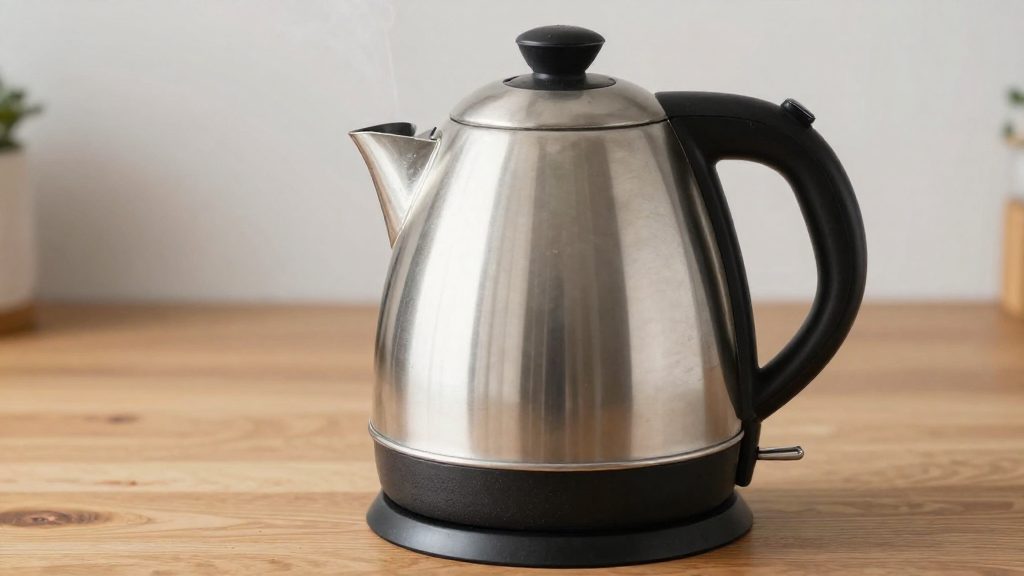
A gooseneck spout is not required for matcha. Spout shape changes how precisely you can add water to the bowl. Fellow distinguishes wide spouts for quick pouring from precision gooseneck spouts for slow pouring. For a short, measured pour, the question is whether the spout lets you control the flow.
Wide spouts for quick pouring
Wide spouts release water in a larger, faster flow. Fellow positions them for quick pouring. When you add a fixed volume to a matcha bowl, a fast flow makes it harder to stop exactly at the target, so a wide spout works best if you measure the volume in a separate container first.
Precision gooseneck spouts for slow pouring
Fellow describes gooseneck spouts as the precision option for slow pouring. A slower flow gives you more stream control, which helps when the target is 60 mL or 70–80 mL rather than a full cup.
| Spout type | Pouring style (per Fellow) | Fit for a small matcha pour |
|---|---|---|
| Wide spout | Quick pouring | Fast flow; harder to stop at a set volume |
| Gooseneck spout | Slow, precise pouring | Slower flow; easier to hit a small target volume |
Controlling the stream into the bowl
Stream control matters more than spout style alone. Use these steps with either spout:
- Pour the measured water in one steady stream rather than a splash.
- Stop the pour when the bowl reaches the target volume, then begin whisking.
Compare temperature controls and presets
Fellow’s temperature-controlled kettles set a target temperature from the base, so you can choose the water temperature before you heat it. Fellow’s comparison lists both an all-purpose and a gooseneck temperature-controlled kettle, each with a 0.9 L capacity and a selectable increment of 0.5°F. A half-degree step lets you enter fractional targets, such as 165.5°F, that whole-degree settings cannot.
The two Fellow models differ in how they show units:
- Stagg EKG: A switch on the base selects a Fahrenheit or Celsius display unit (Fellow, 2026-10-07). The Ippodo Organic Matcha recipe gives 176°F (80°C), so you can read the same target in either unit.
- All-purpose temperature-controlled kettle: Fellow’s comparison lists the 0.5°F increment for this model. The sources do not describe a unit switch for it, so check its manual before you buy if you need Celsius.
Check capacity and minimum fill
The water volume for matcha comes from the recipe, not from the kettle, and producer recipes are not universal standards, so the same tea may suit a different volume. The kettle’s capacity is its maximum fill; the amount you heat must also meet the manufacturer’s minimum fill, even for one serving.
| Item | Volume | Source |
|---|---|---|
| Fellow all-purpose and gooseneck temperature-controlled kettles | 0.9 L (900 mL) capacity | Fellow |
A 900 mL kettle holds about 11 to 15 times the 60–80 mL single-serving volumes (900 ÷ 80 = 11.25; 900 ÷ 60 = 15). A full fill is therefore only useful for multiple bowls. For one bowl, heat at least the manufacturer’s minimum fill, then measure out the water required by your recipe.
Minimum fill level
To find yours:
- Check the minimum marking in the kettle’s manual or on the inner wall, and do not heat below it if the manufacturer specifies one.
- If no minimum is marked, check the manual or contact the manufacturer to confirm the minimum heating volume before use. This confirms the amount without guesswork.
When is temperature hold useful?
A temperature hold is useful when you whisk several bowls in one sitting and want the water to stay at the same setting between servings. The Stagg EKG from Fellow has an optional hold mode that maintains the selected temperature for 60 minutes while the kettle stays on its base, according to Fellow (2026-10-07). That 60-minute figure applies to the Stagg EKG. Other kettles may hold temperature differently or not at all.
Holding water for repeated servings
- Hold mode suits a session with more than one bowl. You heat the water to the set temperature once and draw from it for each serving.
- The hold works only while the kettle remains on its base, so keep it there between servings.
- The hold is limited to 60 minutes. For a longer session, reheat the water when the window ends.
Preheating the bowl
Hugo Tea recommends warming the matcha bowl with hot water, then discarding that water before you start, to stabilize the temperature during whisking (Hugo Tea Company). Warm the bowl first, then pour the water for whisking from the kettle.
Choose comfortable pouring and clear controls
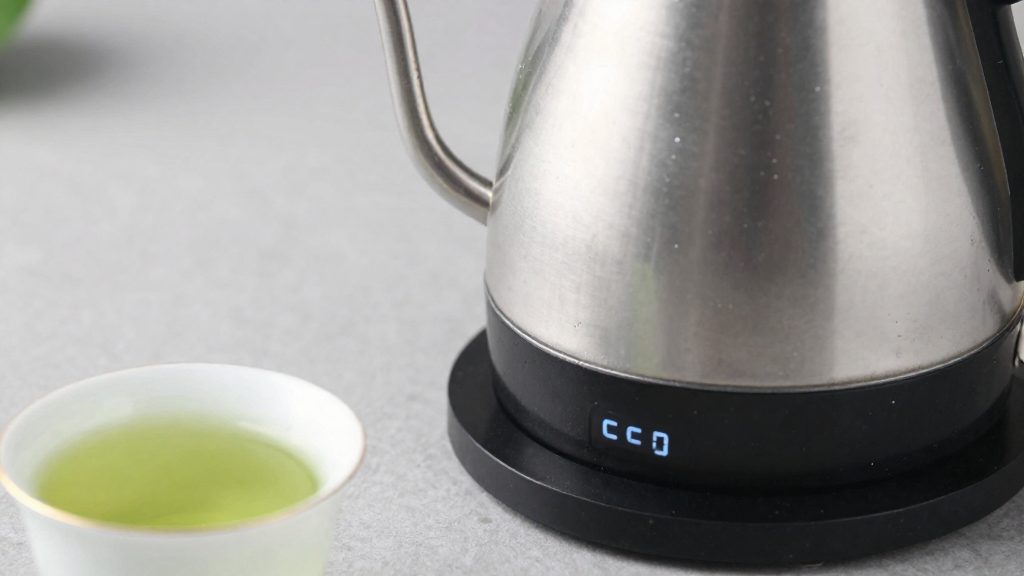
A matcha kettle is used for slow, controlled pours, so the handle, the weight when full, and the placement of the controls all affect how steady your pour is. Check these before buying, because a kettle that feels awkward empty can be hard to tilt once it holds water.
Handle grip and weight during slow pours
- Handle grip: Hold the empty kettle and check that your thumb and fingers rest comfortably on the handle without strain. Then tilt it slowly, as you would for a pour into a bowl.
- Full weight: Test the handle with water in the kettle, since the load changes when you tilt. A handle that feels secure when empty may still feel unsteady at a full level.
- Base contact: Confirm the kettle sits stably on its base before you lift it, so you are not steadying a shifting body during the pour.
Display and button placement on the base
Controls on the base should be readable from the position where you stand while preparing matcha. On the Stagg EKG, according to Fellow (2026-10-07):
| Control | Location | Documented function |
|---|---|---|
| Display unit | Switch on the base | Selects Fahrenheit or Celsius display |
| Hold mode | Base controls, while the kettle stays on its base | Maintains the selected temperature for 60 minutes |
Before buying, check the manufacturer’s manual for the exact button labels and their positions on the base, and make sure the display can be read at your working height.
Lid opening and water level visibility
- Lid opening: Choose a kettle where the lid opens wide enough to fill it without tilting the body.
- Level visibility: Look for a clear window or clearly printed level markings that you can read while the kettle is on its base.
Plan for cleaning and descaling
Clean the kettle after each use and descale it on a schedule set by your water. Hard water leaves more mineral scale, and scale on the interior and heating element can change how the kettle heats and how its readout behaves. Keeping the interior clean helps you trust the temperature you pour at.
Descaling frequency and water hardness
Scale builds up faster with water hardness, the mineral content of your tap water. Your water utility can usually tell you your local hardness level, so ask them if you do not know it. Softened water can reduce scale buildup; filtered water does so only if the filter reduces the minerals responsible for scale. Check the manufacturer’s instructions for a recommended descaling interval, and inspect the interior regularly for white or grey deposits, which signal that descaling is due.
Interior cleaning of the kettle and lid
| Task | When | Method |
|---|---|---|
| Rinse interior | After each use | Empty the kettle and rinse with fresh water. Do not leave water standing. |
| Wipe lid and rim | Regularly | Use a soft cloth to clear residue from the lid underside, rim and spout opening. |
| Dry lid open | After each use | Leave the lid ajar so the interior dries and does not hold odours. |
Avoid abrasive pads on the interior, since scratches give scale more places to cling.
Manufacturer’s descaling instructions and approved agents
Follow the manufacturer’s instructions for descaling, including the agent to use, the dilution and the rinse procedure. If the manual names no agent, contact the manufacturer or the relevant local service before using a product, rather than guessing. After descaling, run several fill-and-discard cycles with fresh water so no agent taste or residue reaches your tea.