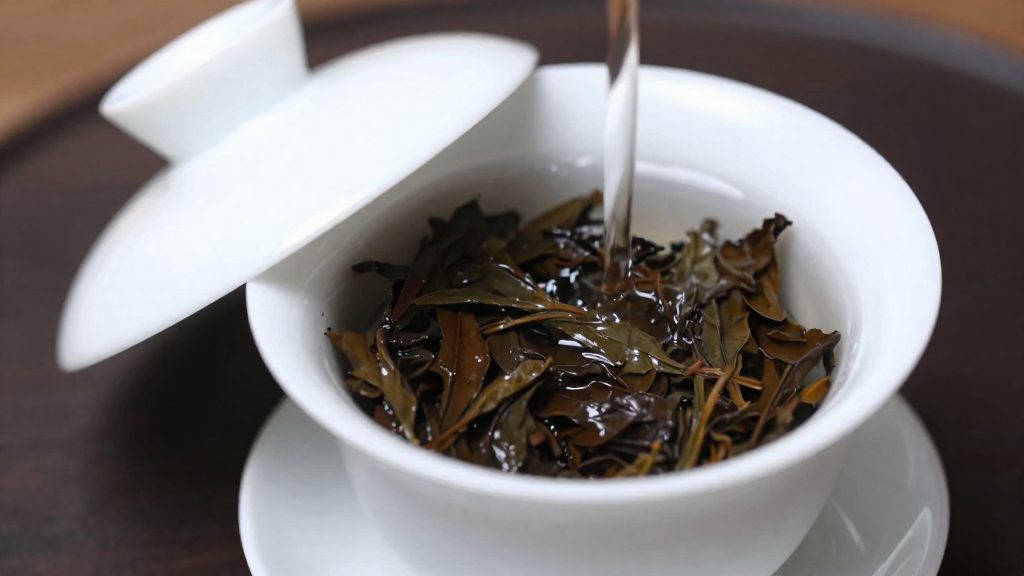
A gaiwan suits oolong because its short, repeated infusions let you follow how the leaves open and change across a session. Spirit Tea (2021-02-01) describes gaiwan brewing as using relatively little water and short, repeated infusions to experience changes in a tea’s character. Instead of extracting everything into one long pot, you taste each steep and can see the cup shift from one infusion to the next.
Why brew oolong tea in a gaiwan?
Short steeps follow the leaf as it opens
Successive steeps let you match each cup to the leaf’s stage. Passenger (2020-07-30) gives a general gongfu recipe of 4 grams of tea in filtered water at 205°F, with successive infusions of 15, 30, and 45 seconds. The lengthening times let each later infusion draw on leaves that have had longer to open. The guide does not specify the gaiwan’s capacity, so treat these timings as a starting pattern, not a fixed rule for every vessel.
| Successive infusion | Steep time (Passenger, 2020-07-30) |
|---|---|
| 1 | 15 seconds |
| 2 | 30 seconds |
| 3 | 45 seconds |
Small water volumes make changes easy to compare
Small water volumes keep each cup small. You can taste consecutive infusions in quick succession without finishing a full pot before trying the next one. Note how the leaves look and how the flavor changes at each step, since that is the information the method is designed to show.
Why multiple steeps beat a single pot
Infusion time is one of several variables. In a single pot, these variables blend into one cup. In a gaiwan, you can taste the result of each change separately, which makes it easier to find the strength you prefer for a given oolong.
What equipment do you need to get started?
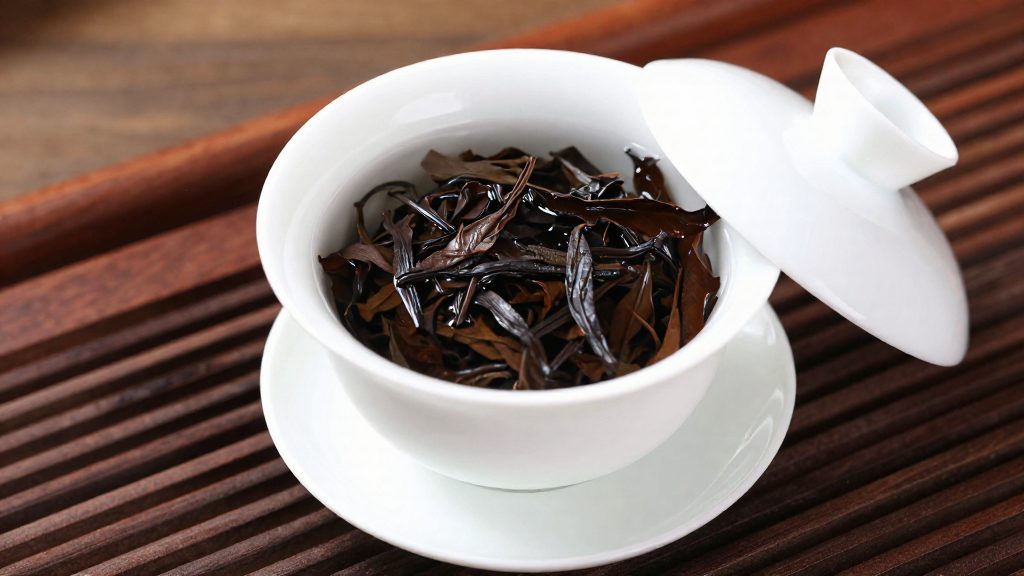
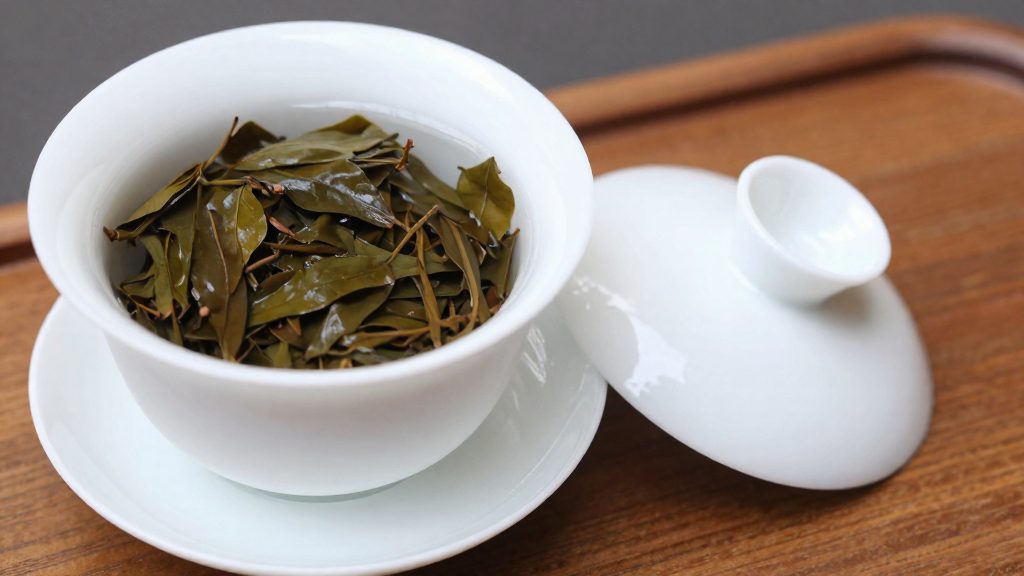
A gaiwan is a three-part vessel, and a consistent session depends on knowing what each part does and adding a few basic tools around it. The core set is a gaiwan, a fairness pitcher, small tasting cups, a digital scale and a timer. According to Rishi Tea & Botanicals, the vessel is made of a lid, a bowl and a saucer, and each part has a distinct role during brewing.
Anatomy of a gaiwan: lid, bowl and saucer
- Bowl: holds the dry leaf and the water. Its wide opening lets the leaves unfurl fully.
- Lid: sits on top of the bowl during steeping. Per Rishi Tea & Botanicals, the lid can also hold back leaves while the brewed tea is poured out.
- Saucer: a base that holds the assembly steady and catches drips. It is also the part you lift the vessel by when the bowl is hot.
Matching the three parts to one another matters. A lid that sits loosely on its bowl lets heat and aroma escape during steeping, so choose a set where the lid fits snugly over the rim.
Fairness pitcher and small tasting cups
A fairness pitcher (also called a serving pitcher or gongdaobei) receives the brewed tea from the gaiwan and holds it at a single, even strength. Pour everything into the pitcher first, then distribute from it into the cups. This keeps the infusions consistent from the first cup to the last.
Small tasting cups let you judge each infusion by aroma and colour in a modest volume. Using several small cups rather than one large mug makes it easier to compare how the tea develops across successive steeps.
Digital scale and timer for repeatable measurements
A digital scale lets you weigh the dry leaf in grams, which is more repeatable than measuring by spoon or by volume. Rishi describes fill levels by dry-leaf volume rather than weight, so a scale gives you a more precise way to record a session.
A timer keeps each steep at a set duration.
| Tool | Purpose in a session |
|---|---|
| Gaiwan (lid, bowl, saucer) | Steeping vessel and pouring control |
| Fairness pitcher | Evens out strength across infusions |
| Small tasting cups | Lets you compare each steep |
| Digital scale | Weighs dry leaf in grams |
| Timer | Holds each steep to a set duration |
How much oolong should your gaiwan hold?
Gaiwan fill levels are a volume measure, and they depend on how the oolong is rolled. Rishi Tea & Botanicals recommends filling the gaiwan about 20% with dry ball-rolled oolong or about 60% with dry twist-rolled oolong. Both figures refer to dry-leaf volume in the bowl before any water is added, not the amount of liquid the vessel holds.
Spirit Tea (2021) uses weight instead. It recommends starting with 3 to 5 grams of leaf in its own gaiwan, and using shorter infusions when you add more leaf. That dose applies to Spirit Tea’s vessel, so it does not carry over to a gaiwan of a different size.
| Reference | Measure | Value | Scope |
|---|---|---|---|
| Rishi Tea & Botanicals | Dry-leaf volume | About 20% of the bowl | Ball-rolled oolong |
| Rishi Tea & Botanicals | Dry-leaf volume | About 60% of the bowl | Twist-rolled oolong |
| Spirit Tea (2021) | Dry-leaf weight | 3 to 5 grams | Starting dose in its own gaiwan |
Converting fill levels into grams
Because fill levels describe volume and grams describe weight, you need to measure your own gaiwan to convert one into the other:
- Place the gaiwan on a kitchen scale that reads in grams and tare it to zero.
- Add dry oolong until the bowl looks about 20% full for ball-rolled leaf, or about 60% full for twist-rolled leaf.
- Read the weight.
- Repeat the check for each new oolong, since leaves of different densities fill the same space with different weights.
Spirit Tea’s 3-to-5-gram starting dose applies to its own gaiwan; if you increase the leaf quantity while keeping your vessel and water amount unchanged, shorten the infusions and adjust to taste.
Passenger’s general gongfu recipe uses 4 grams of tea but does not state the gaiwan’s capacity, so it cannot be turned into a ratio for your vessel. These sources do not establish a universal grams-per-100-mL ratio for brewing oolong in a gaiwan.
Choosing water temperature for your style of oolong
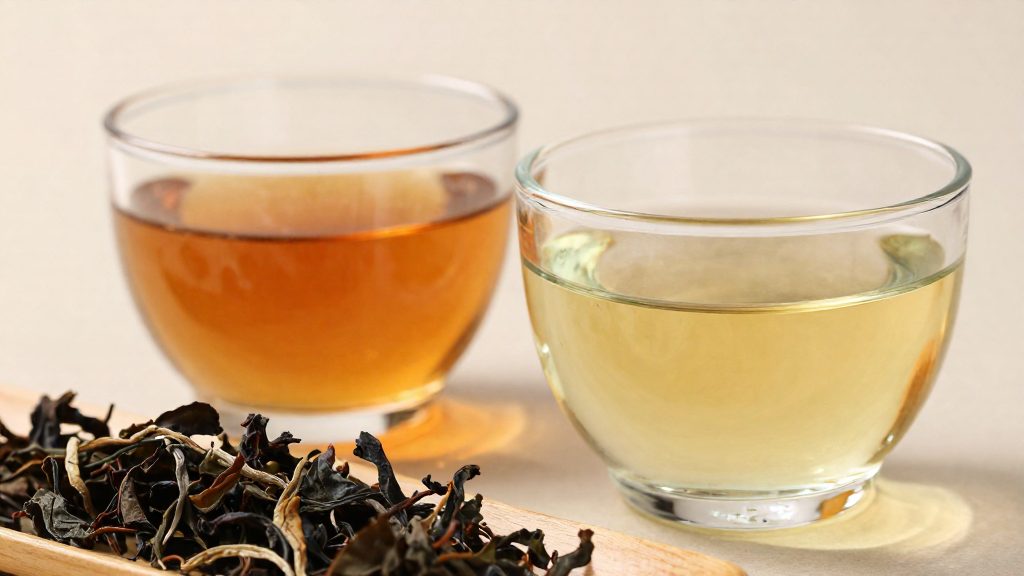
Harney & Sons frames the choice as a range of 180–212°F, with cooler water for lighter oolongs and hotter water for darker ones. Starting from 205°F and adjusting in either direction is a practical way to compare how a given leaf responds.
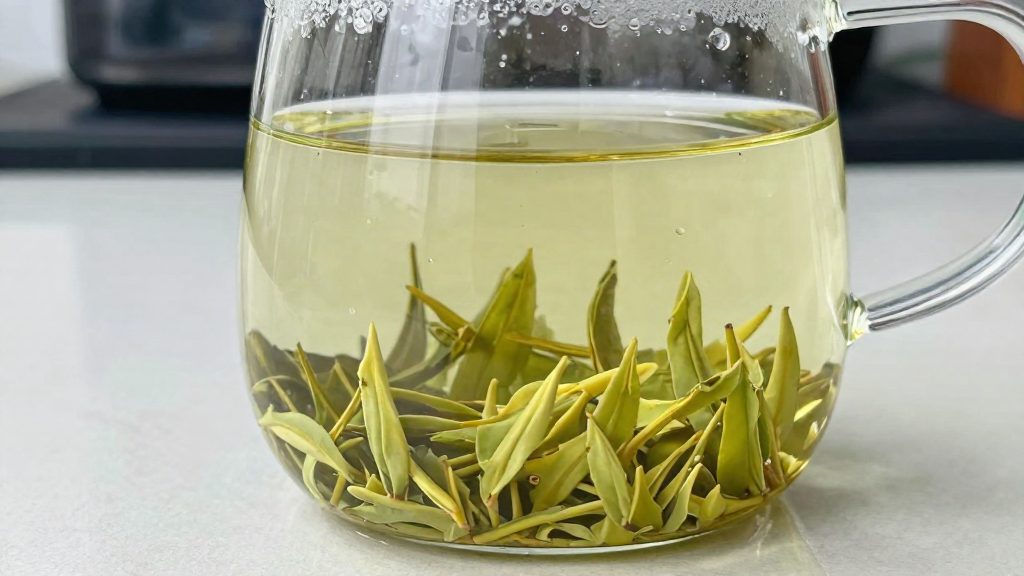
Lighter, green-style oolongs are the group that Harney & Sons associates with cooler water. Stay toward the lower end of the 180–212°F range, so the leaf releases its fresher, more vegetal notes without turning bitter. Lightly oxidized oolongs with a green look in the cup fall into this group, and a cooler setting is the first thing to test on them.
Roasted, darker oolongs are the group Harney & Sons associates with hotter water. Moving toward the upper end of the range helps draw out the deeper, toasted flavors these leaves carry.
Brewing oolong in a gaiwan step by step
A gaiwan brew of oolong follows a fixed sequence: warm the vessel, rinse the leaves when the tea calls for it, then run a series of short, timed infusions. Rishi Tea & Botanicals describes the warm-up as prewarming the gaiwan and teacups with freshly boiled water, then discarding that water before the tea goes in. Each infusion uses the same vessel and water routine, and keeping these steps in the same order makes results easier to compare from session to session.
Prewarm the gaiwan and cups
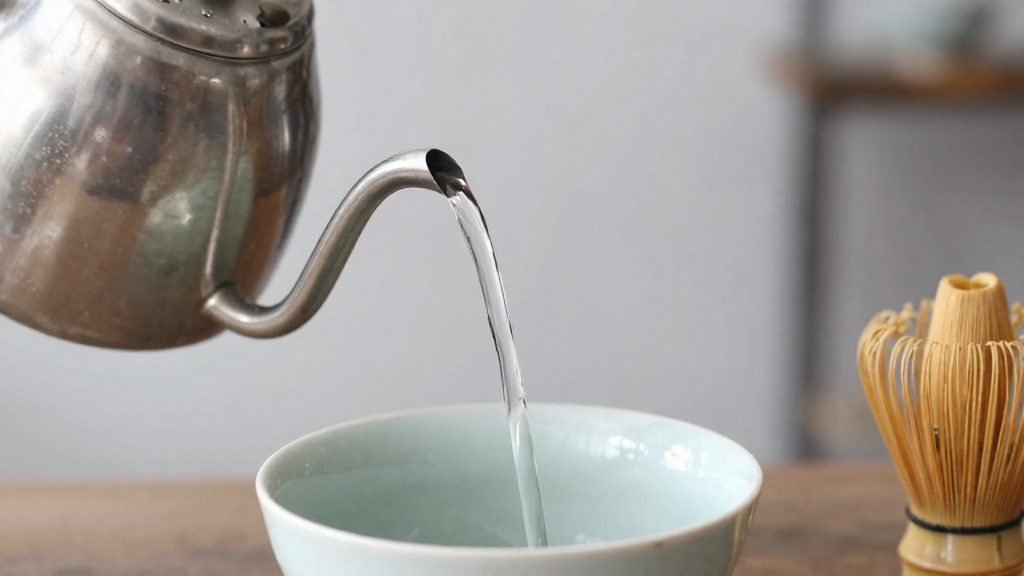
- Pour freshly boiled water into the gaiwan and the teacups.
- Discard the water once the vessels are warm.
- Add the dry leaf only after this step, so the heat is already in the bowl.
Rinse baked oolong
Rishi recommends a rinse specifically for baked oolong: briefly cover the leaves with hot water, then discard that liquid immediately before brewing. The rinse is not presented as a requirement for every oolong. Spirit Tea’s gaiwan instructions do not include it, so check the instructions that came with your tea if you are unsure whether the rinse applies.
Timed infusions
Treat the first three steep times as a starting point for tasting: lengthen the time if the cup tastes weak, shorten it if the cup tastes harsh. Passenger notes that tea quantity, water temperature, or infusion time can each be adjusted to change strength, so change one variable at a time.
Pouring comfortably and keeping leaves under control
Pouring from a gaiwan depends on holding the lid in place while the liquor passes around its edge. Rishi Tea & Botanicals describes a three-finger grip in which the thumb and middle finger rest on the bowl’s rim and the index finger rests on the lid, with a small opening left for decanting. The lid stays put, and the gap it leaves is the only route for the tea to leave the bowl.
| Finger | Position | Role while pouring |
|---|---|---|
| Thumb | Bowl rim | Steadies the bowl and sets the tilt |
| Middle finger | Bowl rim, opposite the thumb | Balances the bowl against the thumb |
| Index finger | Lid | Keeps the lid seated so the leaves stay under it |
Keep the lid secure and the decanting gap narrow, then adjust the tilt as the liquid level falls until the infusion has drained into the pitcher. Keep the tilt shallow. A steeper angle lets wet leaves slide toward the opening. Neither source specifies a pouring angle; adjust the tilt and lid opening to retain the leaves while draining the infusion completely into the pitcher.
The sources disagree on pour speed. Rishi describes a swift decant, while Spirit Tea advocates a gradual pour to limit agitation of the leaves. Because the leaves change between infusions, comparing consecutive steeps will not isolate the effect of pour speed; prioritize a secure grip, a controlled pouring gap and complete decanting.
Adjusting later infusions for flavor and strength
Later infusions in a gaiwan are tuned by changing one variable at a time: leaf quantity, water temperature, or infusion time. According to Passenger (2020), adjusting any of these changes the strength of the brew, so the same leaves can be made lighter or heavier without changing the vessel.
Strength levers
| Lever | Adjustment | Effect on the cup |
|---|---|---|
| Leaf quantity | More leaf in the same vessel | Stronger cup |
| Water temperature | Hotter water | More extraction, so a fuller and stronger cup |
| Infusion time | Longer steep | More extraction, so a stronger cup |
Extending later steeps when flavor fades
When a steep turns thin, extend the next infusion in small steps rather than changing several settings at once. Taste after each change and stop extending once the cup stops improving. Passenger’s gongfu settings are a general starting point, and the sources do not give a fixed step length for every oolong, so the adjustment depends on the tea.
Judging when leaves stop releasing flavor
Taste each infusion and compare it with the one before. When the cup is flat or watery even after a longer steep, the leaves have released most of their flavor. You can also look at the wet leaves to see how fully they have opened. The sources do not give a fixed number of flavorful infusions, so check the seller’s brewing notes for the specific tea.