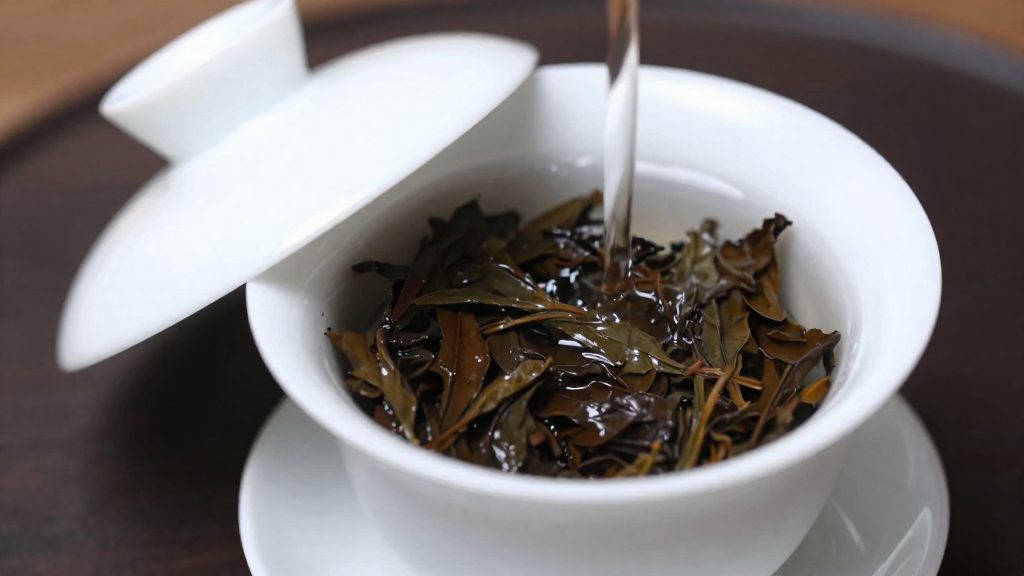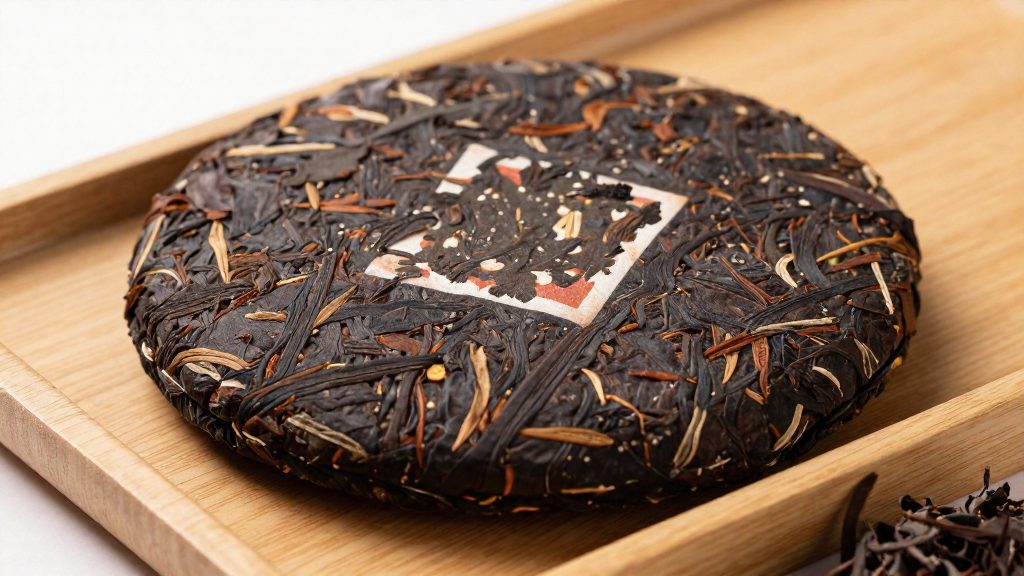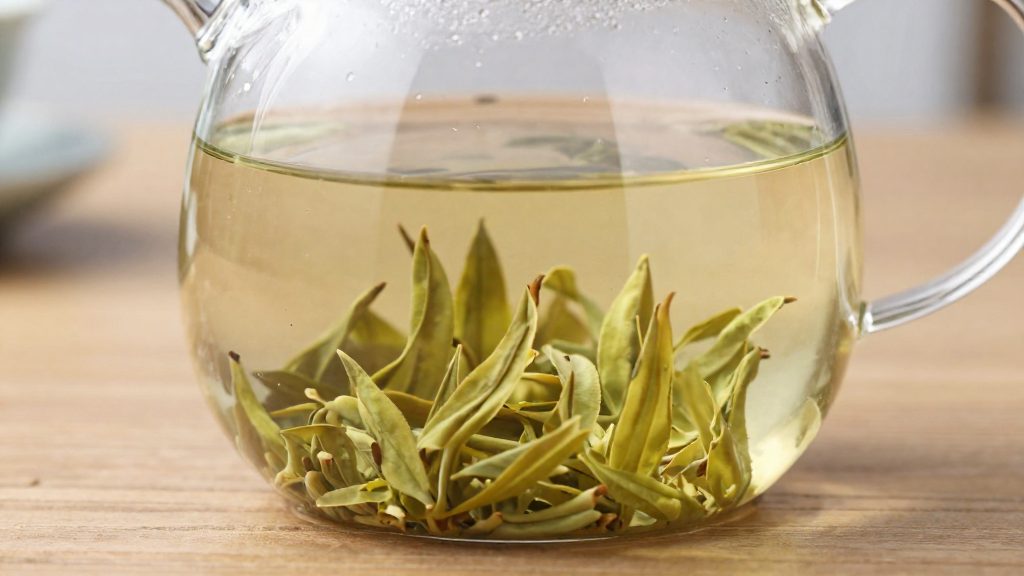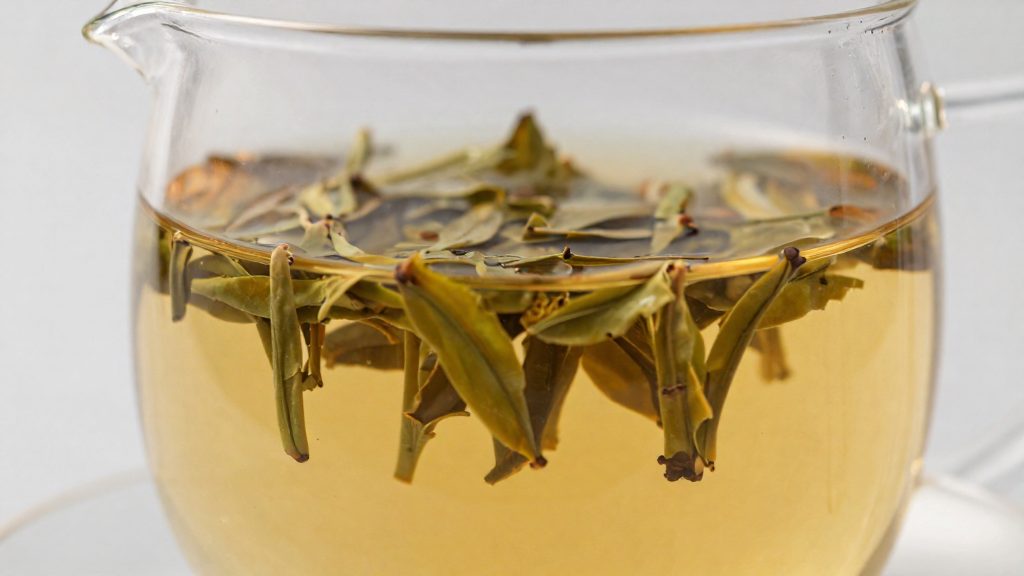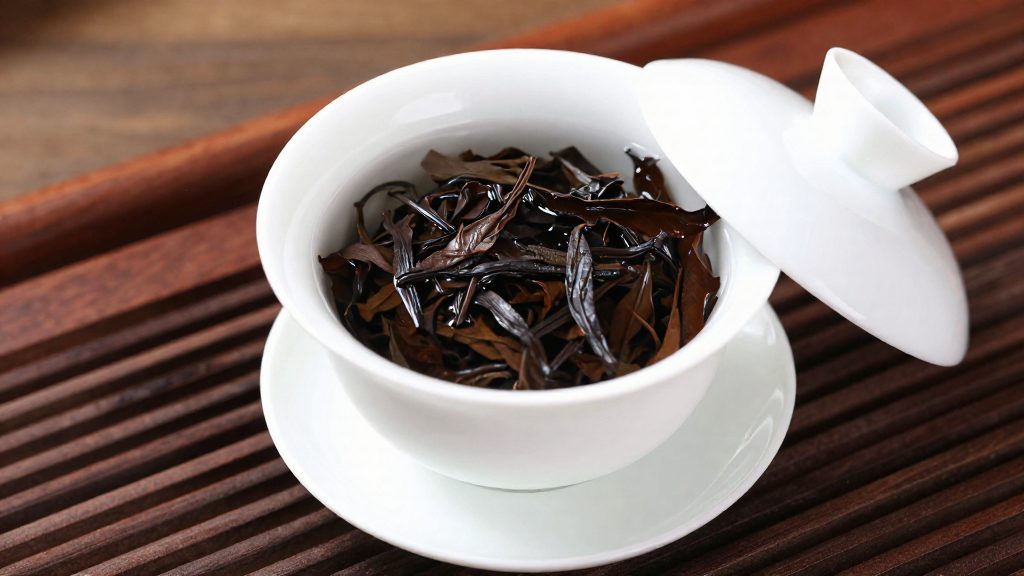
For this setup, use a porcelain gaiwan, equipment to heat water, a gram scale, and a cup. A fairness pitcher helps distribute the liquor evenly among cups, while an optional strainer catches leaf fragments. For compressed cakes, have a tea pick ready. You also need to know whether the cake is raw (sheng) or ripe (shu, also written shou) before you start, because these are the two basic types of pu-erh. Check the label or seller listing for this term first.
What Do You Need to Start?
Porcelain gaiwan as a flavor-neutral vessel
TeaDB describes a porcelain gaiwan as a flavor-neutral vessel suitable for brewing pu-erh (TeaDB, 2014-05-24). Because the vessel adds no taste of its own, the flavor you notice comes from the tea. You can use the same porcelain gaiwan for pu-erh, green, oolong, and other teas; clean it between sessions to remove residue.
Pitcher and strainer for the liquor
For this brewing method, decant the liquor (the brewed tea) into a cup or a fairness pitcher. A pitcher is useful when sharing an infusion among several cups. Pour all the liquor into the pitcher first, then divide it among cups, so every cup has the same strength. Place a strainer over the cup or pitcher to catch leaf fragments.
| Equipment | Role |
|---|---|
| Porcelain gaiwan | Brewing vessel, flavor-neutral per TeaDB |
| Pitcher | Holds the liquor so each cup pours from the same batch |
| Strainer | Stops leaf fragments from reaching the cup |
Telling raw sheng from ripe shu before brewing
The two basic types are raw (sheng) and ripe (shu), with ripe also written as shou (TeaDB, 2014-05-24). Match the term on the label or listing to the type before you begin:
| Term on label or listing | Type |
|---|---|
| Sheng, raw | Raw (sheng) |
| Shu, shou, ripe | Ripe (shu or shou) |
If the label uses neither term, contact the seller or check the manufacturer’s brewing instructions before you choose a method.
How Much Pu-erh Should You Use?
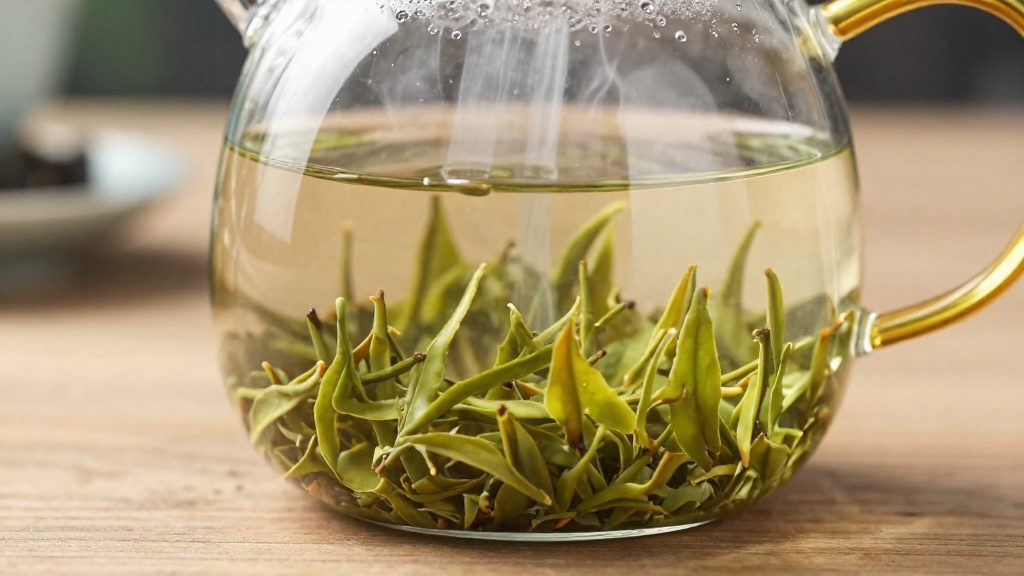
Pu-erh leaf dose is usually expressed as grams of tea per 100 mL of water, and published figures vary. Yunnan Sourcing’s brewing guide recommends 6 grams per 100 mL, while TeaDB’s gongfu starting method uses about 7 grams per 100 mL. Retailer TeaSource gives roughly 1 gram per US fluid ounce, a ratio that can be converted directly to grams per 100 mL for comparison. No single ratio is agreed, so treat any of these as a starting point and adjust to taste.
Gaiwan Capacity and Serving Size
TeaDB describes a porcelain gaiwan as a flavor-neutral vessel suitable for pu-erh and suggests a capacity of 60–120 mL for one or two people. The vessel’s volume sets the leaf dose: a 60 mL gaiwan needs less tea than a 120 mL one at the same ratio.
Scaling Leaf to Vessel Volume
To find the leaf weight, divide the vessel volume by 100 and multiply by the grams per 100 mL you have chosen. The table applies this to both ends of the TeaDB capacity range.
| Ratio source | Dose per 100 mL | Leaf for 60 mL gaiwan | Leaf for 120 mL gaiwan |
|---|---|---|---|
| Yunnan Sourcing | 6 g | 3.6 g | 7.2 g |
| TeaDB | approx. 7 g | 4.2 g | 8.4 g |
The leaf weights are calculated from the stated ratios, not published as separate recommendations.
Choose Your Water Temperature
For pu-erh, Yunnan Sourcing recommends boiling water at 212°F (100°C) in its brewing guide, and that is the reference point for this section. Both raw (sheng) and ripe (shu) pu-erh are brewed with this figure as the baseline. No separate temperature is agreed for young raw pu-erh.
Kettle Types
Kettles fall into two groups, and each reaches the reference temperature differently:
| Kettle type | How you set the temperature | Setting for pu-erh |
|---|---|---|
| Simple boil | Not adjustable; the kettle switches off at boiling | Let the water reach a full boil |
| Variable-temperature | Select a target temperature on the kettle | Select 212°F (100°C) |
A simple boil kettle needs no setup, which makes it the most direct route to the reference temperature. A variable-temperature kettle is useful if you brew several tea types, because the same kettle can hold lower settings for other teas. Its accuracy depends on the manufacturer’s calibration, so check the instructions for the stated tolerance before relying on the display.
Filtered Water
Pu-erh is sensitive to water character, so start with water you already find pleasant to drink. Chlorine or metallic notes in tap water can mask the earthy and sweet qualities of aged leaf. A filtered water source can clear those notes, but no mineral content is agreed as optimal for brewing pu-erh. Compare filtered and unfiltered water side by side in your own cups, and follow the filter manufacturer’s replacement schedule to keep the water consistent.
Separate and Weigh the Leaves
Separating the leaves is the first physical step with a compressed pu-erh cake or brick, and the way you do it sets how much of the leaf stays whole. Layer-by-layer separation is the method Yunnan Sourcing recommends: you lift off thin sections rather than prying out chunks, and you keep leaf breakage to a minimum, which the producer associates with bitterness.
Work over a clean tray or sheet of paper so that loose fragments are easy to collect. Set the cake on a flat surface, then insert a tea pick, a thin bamboo or metal tool, at the edge of the cake where the leaves seem to lift most easily. Gently work the pick under one layer and lever it up in small sections. Stop as soon as a piece resists, and switch to a neighbouring edge rather than forcing it.
To keep breakage down:
- Use a pick with a narrow tip and rotate the cake as you go, so you are never prying against the same weak spot.
- Lift small sections instead of large chunks. Smaller pieces open more evenly in the gaiwan.
- Keep the broken fragments separate from whole pieces and use them as a distinct portion, not mixed into the main dose.
- Avoid twisting or pressing the leaves between your fingers, which crushes the leaf structure.
Weighing the portion comes next. Place a small container, such as a glass or ceramic dish, on a gram scale, tare it to zero, then add the separated leaves until you reach the target weight. Weighing rather than eyeballing keeps each session repeatable, because the dose sets the strength of the infusion. Weigh to the nearest gram or better, and record the figure so you can adjust the next session.
Should You Rinse Pu-erh First?
A rinse is a short pour of hot water over the leaves before the first real steep. It wakes up the leaves and removes loose dust, but the sources do not agree on how many rinses to do or how long each should last. Treat the rinse as an optional step and adjust it to the tea in front of you.
The table below lists the rinse guidance from each source. Because the figures conflict, read them as a range rather than a rule.
| Source | Rinse guidance |
|---|---|
| TeaDB (2014-05-24) | Two rinses, or three for young ripe pu-erh |
| Yunnan Sourcing USA | One 20-second rinse for raw pu-erh; two 15-second rinses for ripe pu-erh |
| TeaSource | One 5-second rinse |
Discard the rinse liquid. Pour it out right away and do not drink it. The rinse is meant to clean and open the leaves, not to produce a cup. Pour it through the gap of the gaiwan lid, holding the lid to keep leaves in place, and let the vessel drain fully before you add water for the first steep.
Leaf form changes the approach. Compressed cakes need to be opened before any water touches them. Once the leaves are loose, the rinse is the same short pour. The sources do not give a separate rinse count for loose leaf, so a single quick pour is a reasonable starting point.
Brew, Decant, and Repeat
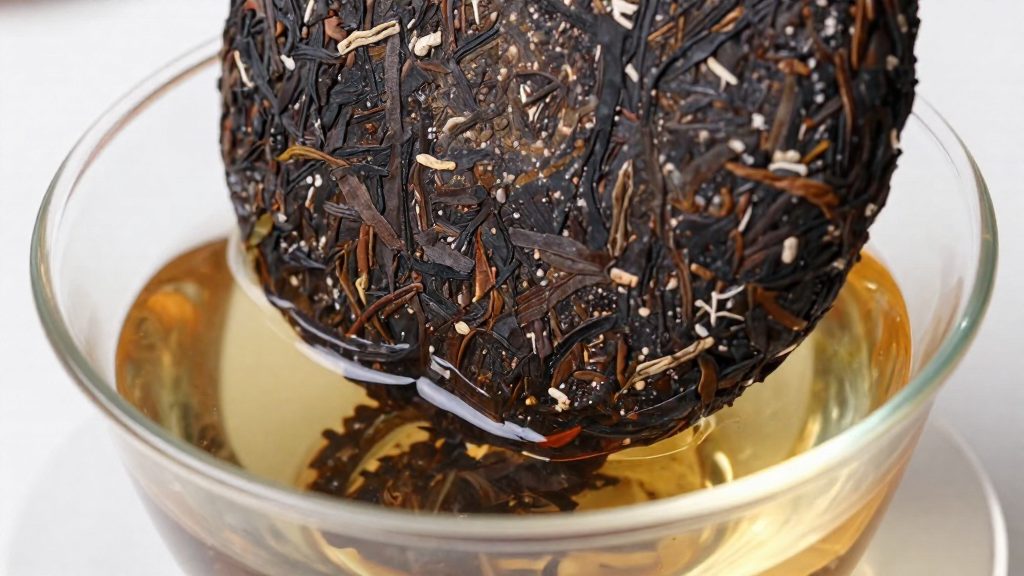
Once the cake is open, the gaiwan cycle is simple: add leaf, pour water, wait a short time, then pour the liquor out and serve. Under the TeaDB gongfu method, the starting dose is approximately 7 grams per 100 mL, with opening infusions of 0–15 seconds. Yunnan Sourcing’s guide uses 6 grams per 100 mL.
Opening infusions on compressed cake
Compressed pu-erh is tight, so the first infusions are the ones that begin to open the leaf. Keep the first steeps very short, in the 0–15 second range that TeaDB gives for its gongfu method. Pour, pour the liquor out right away, and let the next infusion start only after you have seen how the leaves respond. Short openings also keep the leaves from over-extracting before the cake has loosened.
Pouring off the liquor into a fairness pitcher
Pour the liquor from the gaiwan into a fairness pitcher, also called a gongdao bei, rather than straight into cups. The pitcher holds the batch in one place, so every cup gets a similar strength. Pour the liquor out fully each time so leaves do not sit in hot water and keep extracting.
Keeping the lid tilted to hold the leaves
When you pour, tilt the lid slightly off the bowl so the leaves stay back while the liquor flows out. Hold the lid with the edge against the rim and keep the gap narrow. This is a practical habit, not a rule from the sources, so adjust the angle to the size of the leaves in your gaiwan.
Adjust Each Steep to Taste
Once the first steeps are running, each later infusion needs its own timing. Yunnan Sourcing (undated guide) advises extending infusion times as the leaves yield less flavor, and it uses taste and liquor appearance to guide those changes. The liquor (the brewed tea) shows the leaves’ remaining strength, so the timing for each steep should follow what you see and taste rather than a fixed schedule.
Lengthen the Steep as the Leaves Weaken
Compressed pu-erh can grow stronger over the early infusions as the pieces open. Once the flavor begins to fade, lengthen subsequent steeps to taste. Extend the steep in small increments:
- Begin with the timing you chose for the opening steeps.
- If the liquor tastes thin or flat, add a few seconds to the next steep.
- Keep the same vessel, leaf dose and water, changing only the time, so you can attribute the difference to the timing.
- Record the time used for each steep so you can repeat a productive pattern.
Read the Liquor and Taste
Use the color and flavor of each cup to decide the next adjustment.
| Observation in the cup | Practical adjustment for the next steep |
|---|---|
| Pale liquor with little flavor | Lengthen the steep |
| Deep liquor with balanced flavor | Keep the same timing |
| Bitter or astringent taste | Shorten the steep |
These readings are a practical guide, not a measurement. Judge each steep against the one before it.
Where the Strongest Steeps Usually Fall
TeaDB (2014-05-24) explains that compressed pu-erh opens up across successive infusions, and that the strongest infusions often occur between the third and sixth steep. Expect the early steeps to be milder while the cake or brick is still opening. Count the total steeps before you judge a session: TeaDB describes 8–10 infusions as common, and Yunnan Sourcing gives 10–20. Those figures describe typical sessions, not a guaranteed count, since the tea, compression, dose, steep duration and taste all affect when the leaves are spent.