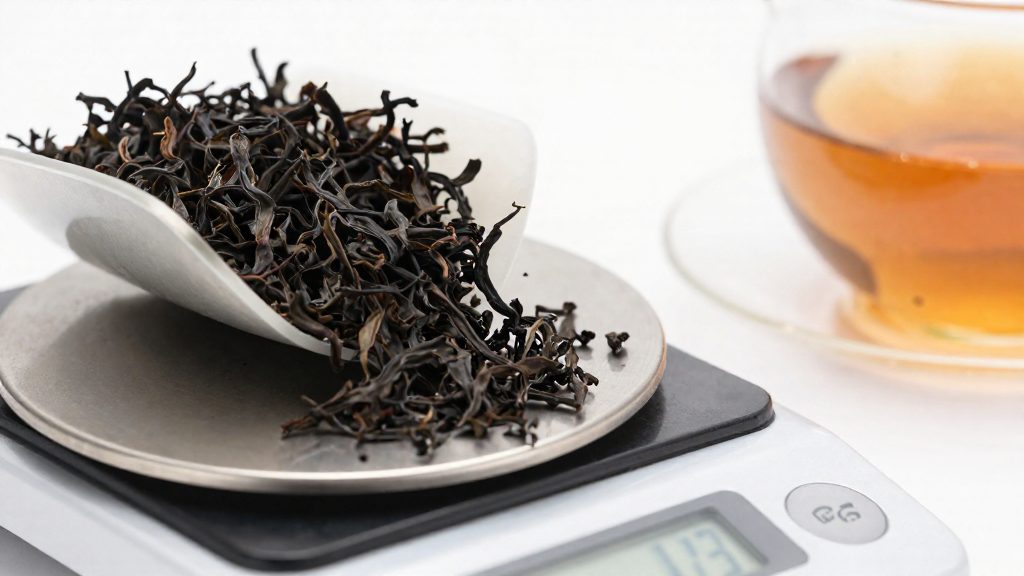
Teatulia recommends 2 grams of loose leaf tea per 8-ounce cup for its black, green, white, oolong and herbal teas. Harney & Sons recommends 2.5 grams of its English Breakfast tea per 8-ounce cup. No universal grams-per-cup figure has been established, so these numbers are manufacturer-specific starting points, not a general standard for all loose leaf tea.
How Many Grams Per Cup?
Brand benchmarks
| Brand | Tea | Amount per 8-ounce cup |
|---|---|---|
| Teatulia | Black, green, white, oolong and herbal teas | 2 grams |
| Harney & Sons | English Breakfast | 2.5 grams |
Teatulia applies its 2-gram figure across five tea categories. Harney & Sons gives its 2.5-gram figure for one blend only, so it should not be assumed to apply to other Harney & Sons teas.
Scaling for larger pots
Teatulia recommends increasing the leaf in proportion to the water volume. For a three-cup pot, it gives 6 grams, which matches its 2-gram-per-cup benchmark. To scale any brand’s figure, multiply the per-cup weight by the number of cups.
Why These Figures Are Manufacturer-Specific Starting Points
- Each brand sets its own figure. Teatulia and Harney & Sons publish different values for their own products, and the sources do not establish a common figure across brands.
- Teatulia’s ratio is not verified as an industry standard. Teatulia describes its ratio that way, but no official standard was found to support the label. Treat it as Teatulia’s own recommendation.
- Other categories lack established ratios. The sources do not establish suitable general ratios for matcha, pu-erh, gongfu-style brewing or cold brew. For these, check the product label or the manufacturer’s instructions.
What Size Is Your Cup?
Before weighing any tea, you need to know how much water your vessel holds. A gram figure only makes sense when the water volume behind it is known. Compare your mug’s water volume with the 8-US-fluid-ounce reference, using either fluid ounces or milliliters consistently.
Converting Mug Capacity
Use these conversions to match your vessel to the 8-ounce reference:
- 1 US fluid ounce is approximately 29.6 millilitres.
- 8 US fluid ounces is approximately 237 millilitres.
- Breville labels its cup as 8 ounces/250 millilitres in its manual. These are approximate volumes, not exact equivalents, so do not treat 250 ml as a precise US conversion of 8 ounces.
To convert a mug, multiply its capacity in fluid ounces by 29.6 to get millilitres, then divide by 237 to see how many 8-ounce reference cups it holds. A 12-ounce mug, for example, is about 1.5 reference cups, so the starting weight is 1.5 times the per-cup figure.
Reading Capacity From Labels
Manufacturers often print capacity on the base, handle or packaging. Check the stated figure first, since it may be given in ounces, millilitres or both. If the label gives only one unit, convert it using the factors above. For a teapot or gaiwan, the printed capacity usually refers to the full brim, which is more water than you should use for a single infusion, so measure the water you actually pour.
Filling to a Set Water Line
Fill the vessel to a marked line or a known volume before measuring the tea. Pour the water into a measuring jug first, note the volume, then transfer it to the mug. This step avoids overfilling, which changes the leaf-to-water ratio and can cause spillover during steeping.
Starting Ratios by Tea Type
Starting weights depend on the tea category and on the producer’s guidance. The sources used for this article do not establish general starting ratios for matcha or pu-erh; consult the specific product’s preparation instructions.
Camellia sinensis Teas: Black, Green, White and Oolong
| Tea | Producer | Starting weight | Conditions |
|---|---|---|---|
| English Breakfast (black) | Harney & Sons | 2.5 g per 8 oz cup | 212°F water, 5 minutes (Harney & Sons) |
| Black, green, white and oolong | Teatulia | 2 g per 8 oz cup | Manufacturer-specific (Teatulia) |
Adjust by taste after the first cup if a different blend or leaf grade needs a different weight.
Herbal Infusions
Teatulia’s 2-gram recommendation also covers its herbal teas, so no separate herbal dose is established. Herbal blends differ in botanical makeup and piece size, so the producer’s guidance for that specific blend is the reliable reference. If the label gives no weight, start with the producer’s figure for the nearest tea type and adjust by taste.
Matcha: Dose by Powder Weight
Matcha is dosed by the weight of the powder, not by leaf volume or spoon measure. Weigh the powder on a kitchen scale that reads in small increments.
Pu-erh: Weigh After Breaking
Dense pressed pu-erh cakes are not measured whole. Break off a piece with a pick or knife, then weigh the loose pieces you will brew. Weighing the intact cake gives a figure that does not match the tea you actually steep. Record the weight used so the next session can be repeated.
Why Teaspoons Can Be Misleading
A teaspoon measures volume, not mass, and the same volume of tea can weigh very different amounts depending on how the leaves are cut and shaped. That is why the manufacturer figures in this article are given in grams.
Leaf shape changes density. Teatulia explains that large, unrolled leaves occupy more space than tightly rolled or broken leaves (Teatulia). A spoonful of unrolled leaves therefore fills more of the spoon but may contain less tea by weight than a spoonful of tightly rolled or broken leaves. Two spoonfuls that look identical can differ noticeably in mass.
Broken and rolled leaves pack tighter. Because smaller and more compact pieces fill the gaps between one another, a spoon of broken or rolled tea holds more weight in the same volume. This is the reason a single volume measure cannot stand in for a weight for every tea.
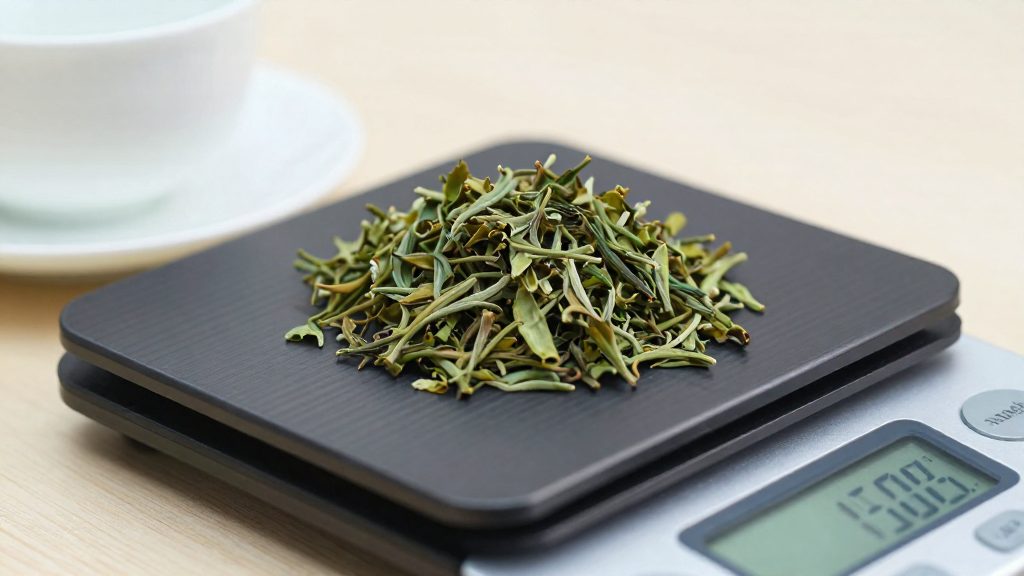
Weighing gives repeatable results. A gram scale removes the variable of leaf shape.
Scaling Up for Larger Mugs
Scaling a cup baseline to a pot is a matter of proportion. Teatulia recommends increasing the leaf quantity in line with the water volume, and gives 6 grams for a three-cup pot as its example. That figure is 3 × 2 grams, so it follows the 2-gram-per-8-ounce starting point Teatulia gives for its black, green, white, oolong and herbal teas. Apply the same method to other pot sizes: multiply the per-cup weight by the number of cups, using the same cup volume throughout.
Proportional scaling only holds if the water volume is measured as accurately as the leaf. Keep the cup size constant and check the pot’s stated capacity before you calculate.
| Step | Action |
|---|---|
| 1 | Measure the pot’s water volume in cups. |
| 2 | Multiply the per-cup weight by the cup count (for example, 2 g × 3 = 6 g). |
| 3 | Weigh the leaves on a gram scale. |
| 4 | Confirm the leaves fit the infuser or basket with room to open. |
Infuser capacity is the practical limit. Check the capacity stated by the teapot or infuser manufacturer, and do not overfill a basket to reach a larger batch. If you need more leaf than the basket holds, split the batch into two infusions rather than packing it tighter.
Adjusting Strength, Temperature, and Time
Cup strength depends on the leaf-to-water ratio, steep time and water temperature. Hotter water and longer steeps extract more from the leaf, while cooler water and shorter steeps produce a lighter cup. Breville’s Tea Maker uses fixed temperature presets for each tea category, so its settings work best as reference points for your own adjustments.
Breville category presets
| Tea category | Breville preset (°F) |
|---|---|
| Green tea | 175 |
| White tea | 185 |
| Oolong tea | 195 |
| Herbal infusion | 205 |
| Black tea | 212 |
Source: Breville (Tea Maker manual). Start with the preset closest to your tea, then change the temperature in small steps if the cup tastes too sharp or too flat.
Using a boiling-water benchmark
Harney & Sons recommends brewing its English Breakfast tea with 212°F water for 5 minutes. This pairs the hottest preset in the Breville list with a full five-minute steep. To soften a black tea, shorten the steep before lowering the temperature, so the leaf keeps its character.
How particle size changes timing
Breville notes that finer tea particles infuse faster than whole leaves. A broken-leaf or fine tea therefore reaches full strength sooner than a whole-leaf tea brewed at the same temperature, so check it earlier.
Measuring Tea for Iced Tea
Teatulia’s guidance for iced tea is to brew a concentrate at double strength and dilute it over ice. The recommendation is 4 grams of loose leaf in 8 ounces of hot water, poured over ice until the drink reaches approximately 16 ounces (Teatulia). Because the ice melts and dilutes the brew, the concentrate is made stronger than a standard hot cup so that the finished glass tastes right.
Brewing the Concentrate
Teatulia’s iced tea method uses twice the leaf of its standard hot cup.
| Step | Value | Source |
|---|---|---|
| Leaf weight | 4 grams | Teatulia |
| Hot water | 8 ounces | Teatulia |
| Final volume after pouring over ice | About 16 ounces | Teatulia |
Pouring Over Ice
Pour the hot concentrate over a full glass of ice. The aim is to reach about 16 ounces in total, which means the volume of ice you add affects the final strength. A larger glass alone does not change the tea’s strength. Ice dilutes the concentrate as it melts, so the final strength depends on how much melted ice or added water enters the drink.
Adjusting the Concentrate for Ice Dilution
If the finished iced tea tastes too light, the simplest adjustment is to increase the leaf weight in the concentrate rather than pouring less liquid. If it tastes too strong, reduce the leaf weight or add more ice or cold water.