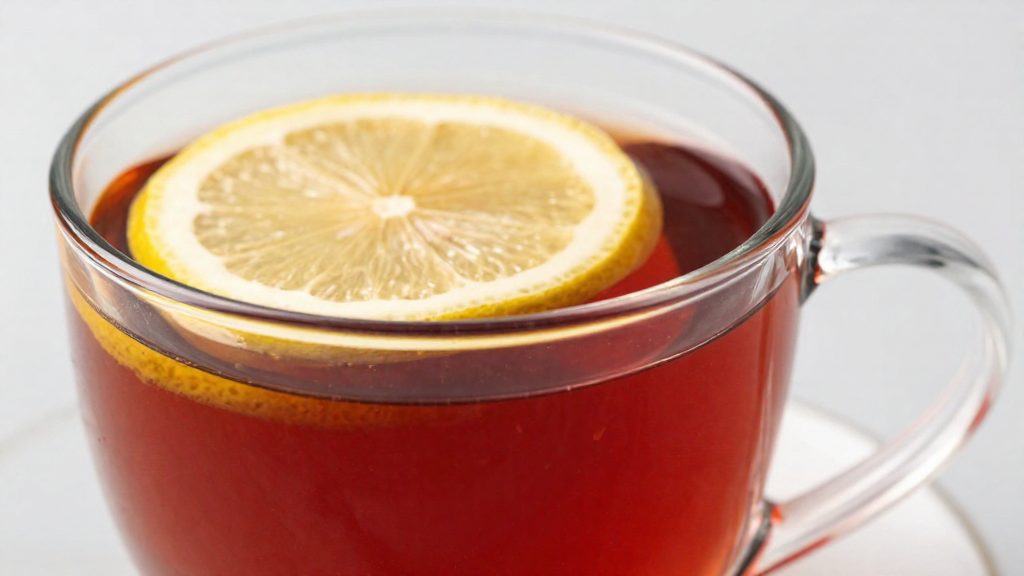
To make rooibos with honey and lemon, gather rooibos, fresh water, honey, and fresh lemon juice or zest, plus a kettle and a mug or teapot. For loose rooibos, also use a strainer or infuser. Each addition changes the flavor, so choose the honey and lemon form before you start.
Ingredients and Tools
Kettle, Teapot, Strainer and Mug
- Kettle: The Republic of Tea recommends fresh, filtered water brought to a rolling boil. Use a kettle that reaches that state, and draw fresh water each time.
- Mug or teapot: The Republic of Tea pours 6 fluid ounces over its Double Red Rooibos. A mug holding about that volume matches that serving size.
- Strainer or infuser: Loose rooibos needs a strainer or infuser to keep leaves out of the cup. A fine-mesh model works for this purpose.
Honey
Honey flavor depends on its floral source, which is usually listed on the label. Harney & Sons describes its Organic Rooibos as light-bodied, with earthy and nutty flavors. A mild honey adds sweetness without competing with those notes, while a strongly flavored honey will dominate the cup. Cuisinart steeps its honey in the water together with the tea, so the honey dissolves during steeping.
Lemon Forms
| Form | How to use | Notes |
|---|---|---|
| Fresh lemon juice | Stir in | Cuisinart’s Winter Warmer recipe uses fresh lemon juice |
| Zest | Peel only the colored outer layer | Adds aroma; the white pith adds bitterness |
| Wedge | Squeeze over the cup and remove seeds | Gives a juice-like effect without measuring |
How to Make Rooibos With Honey and Lemon
Making rooibos with honey and lemon takes three steps: steep the tea, add the sweetener, then add the lemon juice last. The sequence matters most for the lemon. Cuisinart’s Winter Warmer recipe steeps the tea bag, spices, and honey together in boiling water, then stirs in fresh lemon juice. A plain cup follows the same logic with the spices removed.
Plain Cup Method
- Pour hot water over one rooibos tea bag in a cup or small pot.
- Steep until the infusion reaches the color and strength you prefer.
- Remove the bag, then stir in honey until it dissolves.
- Add fresh lemon juice last, stirring briefly.
Adding honey after steeping lets you taste the brewed rooibos before adjusting its sweetness. Adding the lemon after steeping keeps the juice from being exposed to the full steep.
Spiced Variant
The spiced version uses a cinnamon stick and whole allspice. Cuisinart’s two-serving recipe calls for 1 cinnamon stick and ¼ teaspoon whole allspice, along with 1 rooibos tea bag, 2 cups of water, and honey.
- Place the tea bag, cinnamon stick, whole allspice, and honey in the pot.
- Pour in the boiling water and steep all of it together.
- Stir in the fresh lemon juice.
- Serve immediately.
Order of Additions Compared
| Step | Plain cup | Spiced variant |
|---|---|---|
| Tea bag | Steeped alone | Steeped with spices and honey |
| Spices | None | Cinnamon stick and whole allspice, steeped |
| Honey | Stirred in after the bag is removed | Steeped with the tea |
| Lemon juice | Stirred in last | Stirred in last |
What Temperature and Steeping Time Work Best?
The supplied sources do not establish a single steeping time for rooibos. The three examples below show how far apart the values can be.
| Source | Product or recipe | Water | Steeping time | Serving basis |
|---|---|---|---|---|
| Harney & Sons | Organic Rooibos | 212°F (boiling) | 5 minutes | Not specified |
| The Republic of Tea | Double Red Rooibos | Fresh, filtered water at a rolling boil | 5–7 minutes | 6 fluid ounces poured over the tea |
| Cuisinart | Winter Warmer Tea (spiced, with honey and lemon) | Boiling water | 8 minutes | 1 tea bag for 2 cups of water |
Harney & Sons specifies a single boiling-temperature figure, 212°F, paired with a fixed 5-minute infusion for its Organic Rooibos. The Republic of Tea gives a range instead of a fixed value, and it ties the time to a rolling boil rather than a numeric temperature. Cuisinart specifies an 8-minute steep for its recipe containing cinnamon stick and allspice, but does not state why that duration was chosen.
Why no single standard exists
- Product differences: each brand blends and cuts its rooibos differently, so the same time can produce different strengths.
- Recipe differences: adding whole spices, as in the Cuisinart recipe, changes how long the mixture needs to extract flavour.
- Serving differences: the sources describe different amounts of water per tea bag or per serving, so time alone does not fix the result.
How Much Honey and Lemon Should You Add?
The measured amounts in the sources available here come from one published recipe: Cuisinart’s Winter Warmer Tea, which serves two. It calls for 1½ teaspoons of honey and 1½ teaspoons of fresh lemon juice for two cups of water, along with one rooibos tea bag, one cinnamon stick and ¼ teaspoon of whole allspice. These quantities belong to that spiced, two-serving recipe. They are not a general rule for plain rooibos, and no source here establishes ideal amounts for a single cup of unspiced tea.
| Component | Cuisinart Winter Warmer Tea (2 servings) | Per cup, scaled by simple division |
|---|---|---|
| Honey | 1½ teaspoons | ¾ teaspoon |
| Fresh lemon juice | 1½ teaspoons | ¾ teaspoon |
| Water | 2 cups | 1 cup |
Halving the batch gives a rough starting point for one cup, but it is arithmetic, not a verified serving size. Sweetness and sourness are personal, so adjust in small steps:
- Taste before adding more. Check the cup before adjusting either ingredient.
- Scale in halves. If the cup tastes flat, add a little more of one ingredient at a time rather than doubling both.
Tea Bags Versus Loose Rooibos
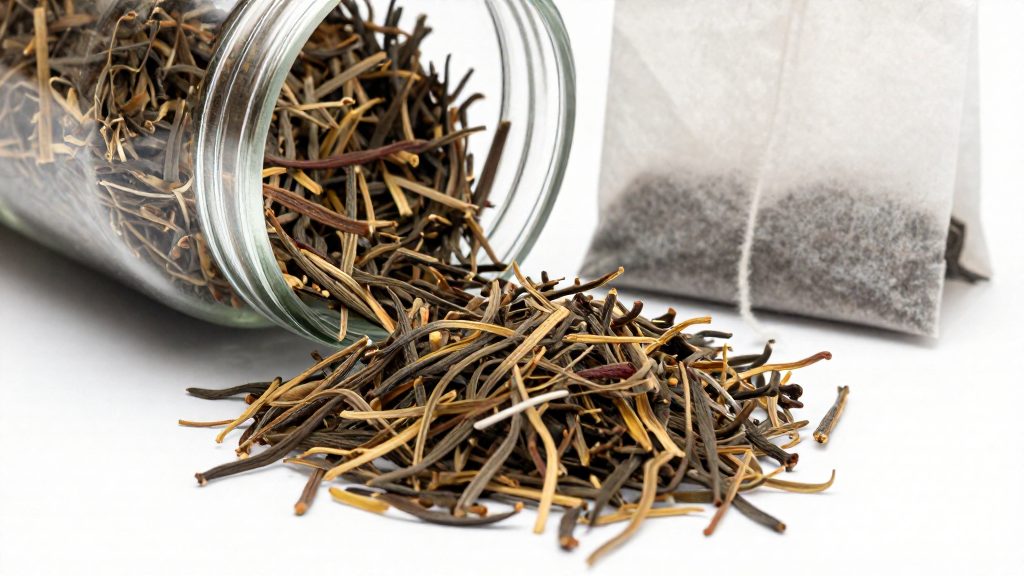
Bagged and loose rooibos differ mainly in how much room the leaf has to expand and what equipment holds it. Bagged rooibos is packed into a small sachet, so the pieces are typically finer and confined. Loose rooibos needs an open space to hydrate, so the format you choose determines the infuser and the amount you measure.
Leaf size, surface area and infusion speed
- Finer pieces have more surface area in contact with water, so they tend to release flavour faster. This is the main reason bags brew quickly.
- Larger loose pieces need room to swell. In a cramped basket they stay partly dry and extract unevenly.
- Because the cut differs, a bag and a loose measure of the same weight will not behave the same way in the pot.
Infuser baskets, strainers and teapot filters
- Use a basket with room to spare: the leaf should be able to move freely and expand fully.
- Fine-mesh strainers work for loose rooibos poured directly into cups, and they catch small fragments.
- Teapot filters keep leaves out of the cup. Any liquid remaining in contact with the leaves in the pot continues to steep; remove the leaves or pour out all the tea to end that contact.
- Spiced batches: if you add cinnamon stick or whole allspice with loose rooibos, put them in the same basket so they come out together.
Ratio: one bag for two cups
Published references use different measures:
- Cuisinart specifies 1 rooibos tea bag for 2 cups of water in its two-serving Winter Warmer Tea, which also includes cinnamon stick and whole allspice.
- The Republic of Tea recommends 6 fluid ounces of water poured over its Double Red Rooibos.
These cover different scopes: a spiced two-cup recipe and a single 6-ounce pour for one product. No universal bag-to-water ratio is established, and the sources do not give a ratio for loose rooibos.
Making an Iced Version
Iced rooibos starts with a concentrate: a brew stronger than a hot cup, because melting ice adds water to the glass. The sources do not establish a dilution ratio for rooibos over ice, so test the strength yourself. Brew a small batch, pour it over ice, taste it, and adjust the steep for the next batch.
Concentrate strength and dilution
- Brew with more tea relative to water than you would for a single hot cup, or steep for longer within the range above.
- Pour the concentrate over ice and taste before adding more ice or water.
- If the result tastes thin, use a longer steep or more tea in the next batch. If it tastes too strong, shorten the steep.
Dissolving sweetener before chilling
Stir the sweetener into the concentrate while it is still warm, and keep stirring until it has fully dissolved. Sweetener mixed into cold liquid can settle at the bottom, so dissolve it first, then chill the concentrate.
Chilling and refrigerator storage
Chill the concentrate fully before pouring it over ice, so the ice melts more slowly and dilutes the drink less. The sources do not establish how long prepared rooibos with honey and lemon keeps in the refrigerator. Refrigerate the concentrate promptly in a clean, covered container. Smell and appearance cannot confirm that it is safe to drink; discard it if its storage history is uncertain. If it smells off or looks different from when you made it, discard it.
Does Rooibos Contain Caffeine?
According to Harney & Sons, rooibos is a South African herbal infusion that is naturally caffeine-free. Plain rooibos is therefore a caffeine-free base for honey and lemon. Caffeine becomes a question when the packet contains something other than rooibos, so the check is on the label, not the plant.
Blends With Black or Green Tea
Some rooibos products are sold as blends with black or green tea. These are not caffeine-free by default, because black and green tea are caffeinated teas. No caffeine amount for any specific blend is established in this article, so the only reliable figure is the one printed by the manufacturer.
Checking the Label for Added Caffeine
Read the ingredient list rather than the product name, since a product can be called rooibos and still contain other tea.
| Label wording | What it means for caffeine |
|---|---|
| “Rooibos” as the only ingredient | Naturally caffeine-free, according to Harney & Sons |
| “Black tea” or “green tea” listed | Blend with caffeinated tea |
| Any other added caffeine source | Caffeine comes from the added ingredient, not the rooibos |