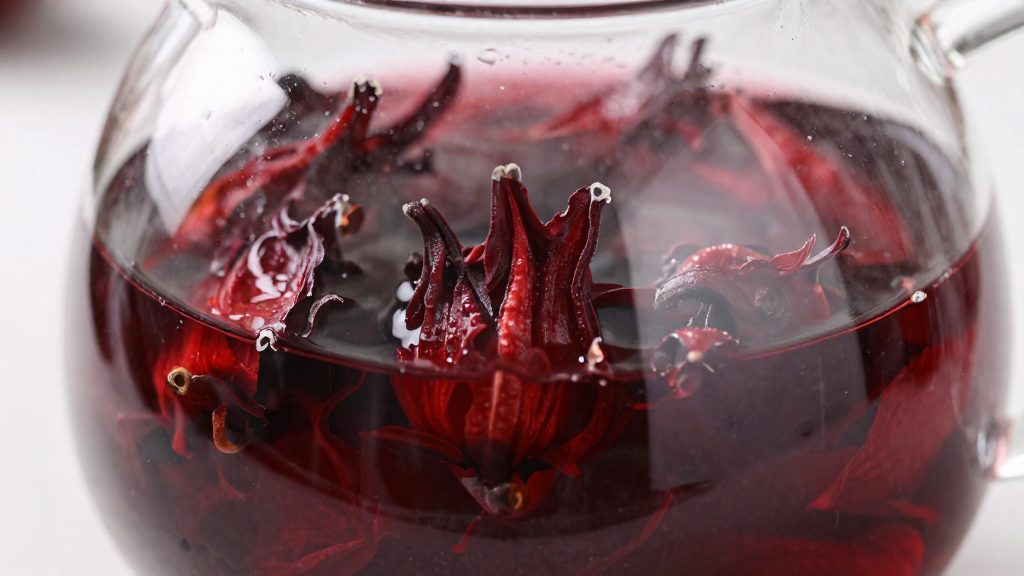
For pure hibiscus, brand instructions consistently point to about five minutes of steeping in freshly boiled water. Harney & Sons recommends five minutes at 212°F for its pure hibiscus infusion, and Rishi Tea & Botanicals suggests about five minutes for its loose hibiscus. The Republic of Tea recommends five to seven minutes for its blended Natural Hibiscus tea bag; this does not establish a general timing difference between bags and loose hibiscus.
How Long Should Hibiscus Tea Steep?
Brand steeping times by format
| Format | Brand | Recommended steep | Stated conditions |
|---|---|---|---|
| Pure hibiscus, loose | Harney & Sons | 5 minutes | 212°F; described as intensely tart and citrusy |
| Loose hibiscus | Rishi Tea & Botanicals | About 5 minutes | 12 fluid ounces of boiling water |
| Blended tea bag (Natural Hibiscus) | The Republic of Tea | 5–7 minutes | One bag in 6 fluid ounces of freshly boiled, filtered water |
Follow the time on your own package as the starting point, because the three products above differ in form and composition.
Why blended products need their own times
The Republic of Tea’s Natural Hibiscus contains hibiscus, sweet blackberry leaf and stevia leaf, so its five-to-seven-minute instruction describes that mix, not a pure flower infusion. Blended products contain other botanicals alongside hibiscus, so follow the instructions for the specific product rather than assuming that another product’s timing applies.
Cold and iced preparations
No precise cold-brew duration is given by these brands, so follow the instructions on the package for any cold method.
Batch recipes are a different case
The Smithsonian’s Hibiscus & Ginger Sweet Tea recipe steeps dried hibiscus and fresh ginger in a large volume of water for one hour off the heat, making it a different preparation from a single cup. It does not show that an hour suits a plain tart cup.
Using brand times as starting points
These times are starting points, not thresholds for tartness or bitterness.
Water Temperature for Tart Hibiscus Tea
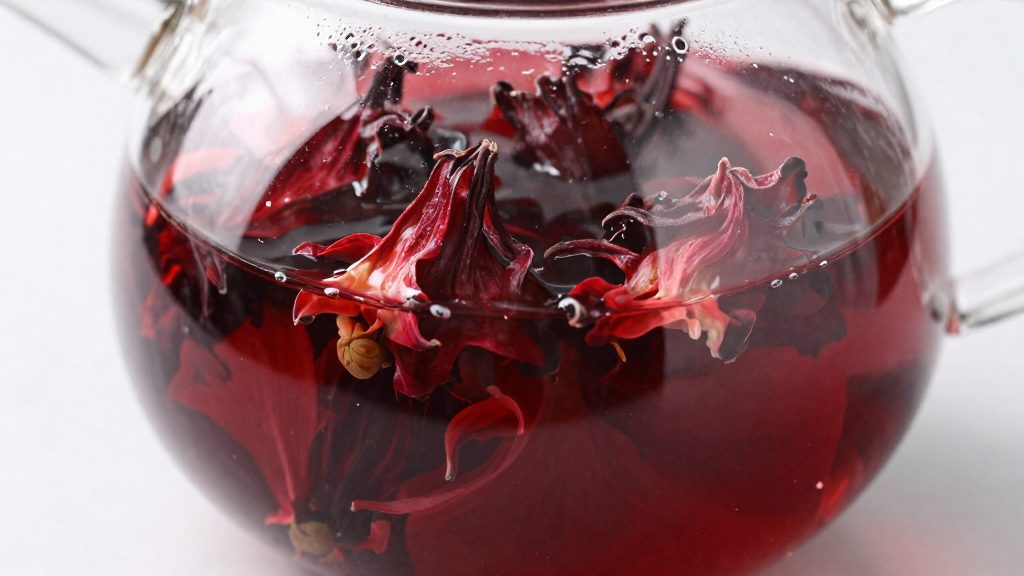
Harney & Sons recommends steeping its pure hibiscus infusion at 212°F (100°C). Hot water is the standard approach for hibiscus because it pulls out the flavor compounds faster. Rishi states that hot water releases hibiscus flavors faster than cold brewing (Rishi Tea & Botanicals), so the water temperature directly sets how quickly the tartness develops.
Hibiscus is an herbal infusion made from the flower’s calyx, not from Camellia sinensis, so it does not follow the temperature rules of green or white tea. Brand instructions vary in how precisely they state temperature:
| Source | Water specified | Product |
|---|---|---|
| Harney & Sons | 212°F | Pure hibiscus |
| Rishi Tea & Botanicals | Boiling water | Loose hibiscus |
| The Republic of Tea | Freshly boiled, filtered water | Natural Hibiscus tea bag (blend) |
Only Harney & Sons gives a numeric temperature.
Cooler Water and Extraction Speed
Cooler water is likely to produce a softer, less pronounced cup than the same leaves in boiling or near-boiling water.
How Much Hibiscus Should You Use?
Dried hibiscus is measured differently by different brands and recipes, so the right amount depends on the source. Rishi gives a single-cup measure of 1.5 tablespoons of loose hibiscus per 12 fluid ounces of boiling water. The Smithsonian’s Hibiscus & Ginger Sweet Tea uses 2 cups of dried hibiscus in 12 cups of water.
| Source | Water | Dried hibiscus | Context |
|---|---|---|---|
| Rishi Tea & Botanicals | 12 fl oz boiling water | 1.5 tablespoons loose hibiscus | Single cup of pure hibiscus infusion |
| Smithsonian National Museum of African American History & Culture | 12 cups water | 2 cups dried hibiscus | Batch sweet tea with 4 oz fresh ginger |
Read as ratios, the two sources differ considerably. Twelve fluid ounces is 1.5 cups, so Rishi’s measure works out to about 1 tablespoon of flower per cup of water. The Smithsonian’s proportion is roughly 2.7 times that per volume of water.
Why Weighing Gives Repeatable Batches
Cup and tablespoon measures for dried flower material depend on how the calyces are packed, how fluffy the batch is and how it settles in the scoop. Two scoops from different tins can hold noticeably different amounts of hibiscus. For repeatable results:
- Weigh the dried hibiscus on a kitchen scale instead of measuring by volume.
- Record the weight of each batch.
- Check the label of your specific product for a gram amount per serving or per brew, since manufacturers do not all use the same measure. Rishi’s and the Smithsonian’s figures are volume-based and do not give a weight.
Loose Hibiscus Versus Tea Bags
The Republic of Tea directs one Natural Hibiscus tea bag per 6 fluid ounces of freshly boiled, filtered water. Each bag holds a fixed amount, so you dose by counting bags rather than measuring flowers.
Loose calyx pieces need room to expand. Dried hibiscus calyces are bulky for their weight and take up more space once wet. In a packed infuser or a small basket, they cannot move freely, so the water around them extracts unevenly. A wide-mouthed teapot or a mesh basket with enough space lets the pieces spread and circulate.
Bags make measuring simpler, but the sachet limits how the flowers move. The manufacturer fixes the amount in each bag, but you can still adjust cup strength by changing the water volume, the number of bags or the steeping time. With loose flowers, you control the amount and the space, which gives you more adjustment but requires more careful measuring.
| Factor | Tea bag | Loose calyx pieces |
|---|---|---|
| Dosing unit | One bag per 6 fl oz (The Republic of Tea, blend) | Amount you add, set by the brand’s label |
| Space for flowers | Limited to the sachet | Open space needed to expand |
| Consistency | Set by the sachet’s fixed fill | Depends on how freely the pieces move |
Does Longer Steeping Make Hibiscus More Tart?
Extra steeping time does not reliably make a plain hibiscus cup more tart. Harney & Sons describes its pure hibiscus, steeped for 5 minutes at 212°F, but it does not say how sourness changes with each additional minute. Treat extra time as a variable to test in your own cup, not a guaranteed gain.
Extra Minutes: Intensity Versus Sourness
A longer steep can make the cup darker and fuller. Whether that added strength reads as more sourness or simply as more body depends on the batch and on your leaf quantity.
Side-by-Side Tasting at Timed Intervals
Brew three cups with the same leaf, water volume and water temperature. Remove the hibiscus from each cup at a different time.
| Cup | Steep time | What to compare |
|---|---|---|
| 1 | 5 minutes (Harney & Sons baseline) | Colour, aroma, and sourness on the first sip |
| 2 | 7 minutes | Whether the sourness rises, and whether the fruit notes stay clear |
| 3 | 10 minutes | Mouthfeel, dryness, and any heavy or dull finish |
Use pure hibiscus for this test.
Signs of Over-Extraction
Over-extraction is the point where a longer steep stops adding clarity and starts adding harsh notes. Judge each cup against Rishi’s description of hibiscus as tart and fruity, with cranberry, citrus and tropical punch notes. Check for these faults:
- Astringent: a dry, puckering mouthfeel that lingers after the sip.
- Flat: the bright cranberry or citrus notes fade, leaving only sourness.
- Muddy: a heavy, dull taste with no clear fruit character.
Making Hot Brewed Hibiscus Iced Tea
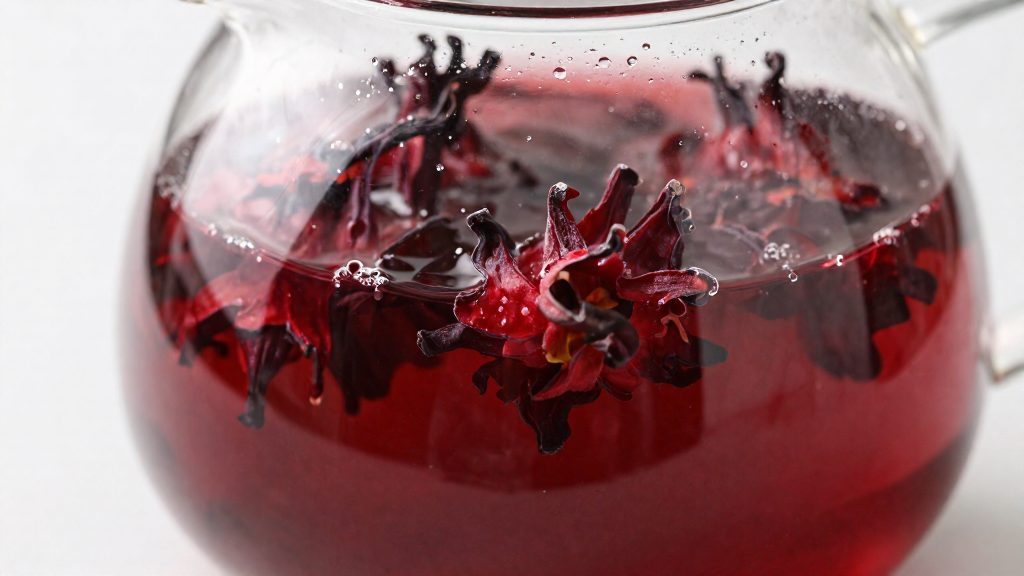
To make hot-brewed hibiscus iced tea, brew the infusion, remove the tea bag or strain out the plant material, then cool the tea before pouring it over ice.
Two published sequences
| Source | Hibiscus and liquid | Steeping and handling |
|---|---|---|
| The Republic of Tea (Natural Hibiscus, a blend) | One tea bag in 6 fl oz of freshly boiled, filtered water | Steep 5–7 minutes; serve hot or let cool before pouring over ice |
| Smithsonian National Museum of African American History & Culture (Hibiscus & Ginger Sweet Tea) | 2 cups dried hibiscus and 4 oz fresh ginger in 12 cups of water | Steep off the heat for 1 hour, then strain and sweeten |
Off-heat steeping
Off-heat steeping means removing the pot from the burner and letting the hibiscus steep as the liquid cools. The Smithsonian recipe does this for one hour.
Straining the concentrate
Strain the concentrate into a heatproof jug before it is cooled and served. Hibiscus infusions are made from the flower’s calyx, so the plant material needs to be removed before the drink is poured over ice.
Cooling and pouring over ice
The Republic of Tea instructs readers to serve the brewed tea hot or let it cool before pouring it over ice. Fill the glass with ice, then pour the liquid slowly over it. The sources give no ice-to-liquid ratio.
Adjusting Tartness to Your Taste
Once a hibiscus cup is brewed, you can soften its sourness in three ways: add a sweetener, dilute it with water, or blend the flower with a milder herb. Harney & Sons describes its pure hibiscus infusion, steeped 5 minutes at 212°F, as intensely tart and citrusy, so that plain cup is a useful baseline. Rishi Tea & Botanicals describes hibiscus as tart and fruity, with cranberry, citrus and tropical punch notes. Make small changes and taste after each one.
Sweetening the Finished Cup
A sweetener is the most direct way to balance sourness in a finished cup. Add it a little at a time, stirring and tasting between additions.
Diluting with Water
Dilution lowers both the sourness and the fruit intensity, because the flavor compounds in the cup become less concentrated. Pour a brewed cup, add a small measure of hot water, taste, and repeat until the balance suits you. Stop when the cup tastes right, because a diluted cup has less flavor overall.
Blending with Milder Herbs
A milder-herb blend shapes tartness from the start instead of after brewing.
| Adjustment | When it helps | Practical step |
|---|---|---|
| Sweetener added after brewing | Cup tastes sharp but still fruity | Add a small amount, stir, taste |
| Hot water added after brewing | Cup tastes too concentrated | Add water in small measures, taste |
| Milder-herb blend | You want a rounder base in each cup | Choose a blend and read its ingredient list |
Frequently asked questions
Can I brew the same hibiscus twice?
The brand instructions cited in this article do not cover a second infusion, so check your package for reuse guidance. If you brew the flowers again, judge the cup by taste rather than by the time on the label.
Does hibiscus tea contain caffeine?
The brands cited here give no caffeine figure for hibiscus. Check the label of any blend for added tea leaves, which contain caffeine, before assuming a cup is caffeine-free.
How should I store dried hibiscus so it stays tart?
Keep the flowers in an airtight container, away from light, heat and moisture. Check the best-by date on the package, and open only the amount you expect to use soon.